
Cosmic Sacred Geometry: Universes Underlying Patterns Unveiled
Sacred geometry is an ancient metaphysical concept that explores the fundamental patterns and mathematical ratios believed to underlie the creation and structure of the universe. It suggests that certain geometric shapes and proportions are not merely aesthetic but are the very blueprints of existence, from the microscopic to the macroscopic. This profound understanding has been woven into the fabric of various cultures, spiritual traditions, and scientific inquiries throughout history, offering a unique lens through which to perceive the cosmos.
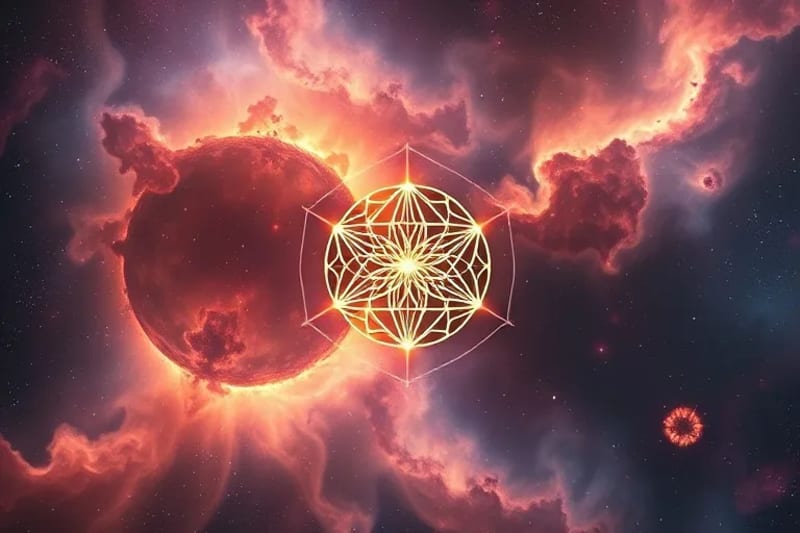 A visual representation of the universe's intricate geometric foundations, where cosmic phenomena intertwine with fundamental sacred symbols.
Fuente visual sujeta a disponibilidad del ecosistema: Wikimedia Commons bajo licencia CC BY-SA 4.0 o renderizado conceptual IA.
The study of sacred geometry transcends mere mathematics; it delves into the spiritual and philosophical implications of these forms, proposing that they hold keys to understanding consciousness, energy, and the divine order. By recognizing these patterns, individuals can gain deeper insights into the interconnectedness of all things and their place within the grand cosmic design. This exploration serves as a bridge between the tangible and the intangible, revealing the hidden harmony that orchestrates our reality.
This article will delve into the core principles of sacred geometry, tracing its historical significance, examining key geometric forms, and exploring their manifestations across the cosmos and within various disciplines. We will uncover how these ancient insights continue to resonate with modern scientific discoveries, offering a holistic perspective on the universe's underlying patterns.
Table of Contents
- Historical Roots and Ancient Wisdom
- Key Geometric Forms and Their Significance
- Cosmic Manifestations Across Disciplines
- Modern Science and Spiritual Convergence
- Personal Significance and Practical Application
Historical Roots and Ancient Wisdom
The concept of sacred geometry is deeply embedded in the historical records of numerous ancient civilizations. From the intricate designs of Egyptian temples and pyramids to the philosophical treatises of ancient Greece, evidence suggests a widespread recognition of these universal patterns. Cultures across the globe, including those in Mesopotamia, India, China, and the Americas, incorporated geometric principles into their art, architecture, and spiritual practices.
In ancient Egypt, the construction of monumental structures like the Great Pyramid of Giza is believed to have been guided by precise geometric ratios, reflecting astronomical alignments and cosmic principles. These structures were not merely tombs but served as powerful symbols of cosmic order and the journey of the soul. The Hellenistic Astrology, for example, shares a lineage with these ancient cosmological views, where celestial mechanics were often interpreted through geometric lenses.
The Greek philosophers, particularly Pythagoras and Plato, significantly advanced the understanding of sacred geometry. Pythagoras, famed for his theorem, believed that numbers and geometric forms were the essence of all things, revealing the harmony of the spheres. Plato, in his work "Timaeus," described the five Platonic Solids as the building blocks of the universe, each corresponding to a classical element: earth, air, fire, water, and aether (or cosmos).
Key Geometric Forms and Their Significance
Several geometric forms are central to the study of sacred geometry, each carrying profound symbolic and mathematical significance. Understanding these shapes provides a foundational insight into the universal patterns they represent.
- The Golden Ratio (Phi - Φ): Approximately 1.618, the Golden Ratio is found when the ratio of two quantities is the same as the ratio of their sum to the larger of the two quantities. It manifests in spirals, proportions of the human body, plant growth, and even galactic structures. Its aesthetic appeal is often linked to universal harmony and beauty.
- The Fibonacci Sequence: A series of numbers where each number is the sum of the two preceding ones (0, 1, 1, 2, 3, 5, 8, 13...). When expressed as a ratio, consecutive Fibonacci numbers approximate the Golden Ratio. This sequence is prevalent in nature, from the branching of trees to the arrangement of leaves on a stem and the spirals of a sunflower.
- Platonic Solids: These are five convex regular polyhedra (tetrahedron, cube/hexahedron, octahedron, dodecahedron, icosahedron) whose faces are all congruent regular polygons, with the same number of faces meeting at each vertex. As mentioned, Plato associated them with the elements, signifying their role as fundamental cosmic building blocks.
- The Flower of Life: An ancient symbol composed of multiple overlapping circles, forming a flower-like pattern with hexagonal symmetry. It is considered a blueprint of the universe, containing the fundamental patterns of creation, including the Seed of Life, Tree of Life, and Metatron's Cube. It represents the interconnectedness of life and all sentient beings.
- Metatron's Cube: Derived from the Flower of Life, Metatron's Cube is a complex geometric figure that contains all five Platonic Solids within its structure. It is believed to represent the energetic grid of the universe and is often used in spiritual practices for protection and energy work.
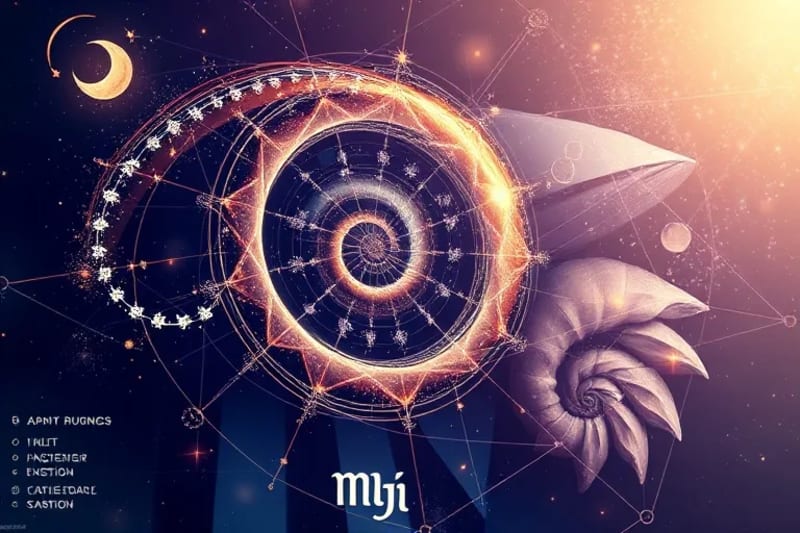 An artistic rendering showcasing the Golden Ratio and Fibonacci sequence as they manifest in various natural forms, from galaxies to flora.
Cosmic Manifestations Across Disciplines
The principles of sacred geometry are not confined to ancient texts or philosophical musings; they are observable across a vast spectrum of natural phenomena and scientific disciplines. Their presence suggests a universal language underlying all creation.
In astronomy, the spiral arms of galaxies often follow logarithmic spirals that closely approximate the Golden Ratio. Planetary orbits, while elliptical, also exhibit harmonic relationships that can be described geometrically. The study of Saturn Astrology, for instance, often delves into the structural and cyclical patterns of celestial bodies, echoing these geometric principles.
Crystallography provides another compelling example. The atomic structures of minerals and crystals naturally form precise geometric lattices, often reflecting the Platonic Solids. From the hexagonal symmetry of a snowflake to the cubic structure of salt crystals, these forms are inherent to their molecular arrangement. This intrinsic order highlights the foundational role of geometry in material composition.
Even within biology, sacred geometry is evident. The double helix of DNA, the fundamental building block of life, exhibits a spiral structure with specific proportions. The branching patterns of trees, the venation of leaves, and the intricate designs of seashells all showcase the Fibonacci sequence and the Golden Ratio. The human body itself is a testament to these proportions, with the Golden Ratio appearing in facial features, limb lengths, and organ arrangements, contributing to what is perceived as ideal beauty and functional efficiency.
Modern Science and Spiritual Convergence
While sacred geometry has ancient roots, its principles continue to find relevance in modern scientific inquiry and contemporary spiritual thought. Fields such as quantum physics, cosmology, and chaos theory often reveal patterns and symmetries that resonate with these age-old geometric understandings.
Quantum mechanics, for example, explores the fundamental nature of reality at the subatomic level, where particles exhibit wave-like properties and interact in ways that challenge classical intuition. The underlying mathematical structures governing these interactions often involve complex symmetries and geometric relationships, suggesting a deep-seated order even in the most ephemeral aspects of existence. The concept of Crystalline Grids Chakra Alignment, while spiritual, touches upon the idea of energetic structures that might be geometrically influenced.
 A conceptual arrangement of Platonic solids, symbolizing the foundational geometric elements that compose the cosmic structure.
Cosmology, the study of the universe's origin, evolution, and large-scale structure, also encounters geometric patterns. Theories about the shape of the universe, the distribution of matter, and the cosmic microwave background radiation often involve sophisticated geometric models. The fractal nature observed in galaxy clusters and the recurring patterns in cosmic voids hint at a self-similar, geometrically organized universe.
Furthermore, the convergence of sacred geometry with spiritual practices continues to thrive. Many believe that meditating on these forms, or incorporating them into sacred spaces, can facilitate a deeper connection to universal consciousness and promote healing. The use of mandalas, yantras, and other geometric designs in spiritual art across various traditions underscores their perceived power to harmonize and elevate the human spirit.
Personal Significance and Practical Application
The exploration of sacred geometry offers more than just intellectual understanding; it provides a pathway to personal growth and a deeper appreciation for the world around us. Recognizing these patterns can shift one's perspective, fostering a sense of awe and interconnectedness.
Practically, individuals can engage with sacred geometry in various ways. Studying and drawing these forms can enhance cognitive abilities, improve focus, and stimulate creativity. Incorporating sacred geometric symbols into personal spaces, such as through art or decor, is believed by some to create harmonious environments that promote well-being and positive energy flow. This aligns with broader esoteric practices that seek to align personal energies with cosmic rhythms, such as understanding one's Feng Shui Digital Nomads Harmonizing Virtual Well-being.
Furthermore, the principles of sacred geometry can be applied to design, architecture, and even urban planning, aiming to create spaces that are not only functional but also aesthetically pleasing and energetically balanced. By consciously integrating these universal patterns, we can foster environments that support human flourishing and reflect the inherent order of the cosmos.
Conclusion
Sacred geometry offers a compelling framework for understanding the universe as a beautifully orchestrated, interconnected system. From the ancient temples to the latest scientific theories, the recurring presence of these fundamental patterns speaks to a universal language of creation. It invites us to look beyond the surface of reality and perceive the profound order that governs all existence.
By embracing the wisdom of sacred geometry, we not only gain a deeper intellectual comprehension of the cosmos but also open ourselves to a more profound spiritual connection with the intricate tapestry of life. It reminds us that we are an integral part of this grand design, reflecting the same divine proportions and harmonious structures that shape galaxies, crystals, and every living thing.
Source: Hybrid content assisted by AI and human editorial supervision.


Comments
Post a Comment