
Hellenistic Astrology: Ancient Roots, Modern Revival | StarPluto
Hellenistic astrology represents a foundational pillar in the history of Western astrological thought, emerging from the vibrant cultural melting pot of the Hellenistic period (roughly 3rd century BCE to 7th century CE). This sophisticated system, born from the fusion of Babylonian celestial observations and Egyptian astrological practices with Greek philosophical traditions, laid the groundwork for much of what we recognize as Western astrology today. Its influence permeated the Roman Empire and beyond, shaping intellectual and spiritual landscapes for centuries.
Despite its profound impact, Hellenistic astrology largely receded from mainstream practice during the Renaissance and subsequent periods, overshadowed by later developments and a gradual simplification of its intricate techniques. However, the late 20th and early 21st centuries have witnessed a remarkable resurgence of interest, driven by dedicated scholars and practitioners seeking to rediscover and recontextualize its ancient wisdom. This modern revival is not merely an academic exercise; it offers a deeper, more nuanced understanding of astrological principles, enriching contemporary practice with time-tested methodologies.

Exploring the foundational texts and tools of ancient Hellenistic astrology, illuminated by cosmic light.
Table of Contents
- Historical Context and Origins
- Key Figures and Foundational Texts
- Core Techniques of Hellenistic Astrology
- Decline, Preservation, and Rediscovery
- The Modern Revival and Its Impact
- Relevance in Contemporary Astrological Practice
- Future Outlook for Hellenistic Astrology
Historical Context and Origins
The Hellenistic period marked a significant epoch of cultural exchange and intellectual synthesis. Following the conquests of Alexander the Great, Greek culture, language, and philosophy spread across the Eastern Mediterranean, encountering and integrating with the ancient traditions of Egypt and Mesopotamia. This cross-cultural fertilization provided fertile ground for the birth of a systematic form of astrology.
Babylonian astronomy, with its meticulous records of planetary movements and celestial phenomena, offered the predictive framework. Egyptian religious and magical practices contributed the concept of planetary deities and their influence on human affairs. The Greeks, with their emphasis on logic, philosophy, and systematic thought, synthesized these elements into a coherent, interpretive system that sought to understand human destiny and character through the positions of the stars and planets at the moment of birth.
Alexandria, Egypt, became the intellectual heart of this new astrological tradition. Its famous library and vibrant scholarly community attracted thinkers from across the ancient world, facilitating the translation, study, and development of astrological texts. It was here that many of the core concepts and techniques of Hellenistic astrology were codified and disseminated, influencing subsequent generations of astrologers.
Key Figures and Foundational Texts
The legacy of Hellenistic astrology is largely preserved through the works of several influential authors whose writings became canonical. Their contributions provided the theoretical underpinnings and practical methodologies that defined the tradition.
- Claudius Ptolemy (c. 90 – c. 168 CE): Arguably the most famous Hellenistic astrologer, Ptolemy’s Tarot Quantum Mechanics Intersecting Divination Reality is a comprehensive treatise that systematized much of the existing astrological knowledge. It became the definitive textbook for Western astrology for over a millennium, influencing Arabic, medieval European, and Renaissance astrologers. Ptolemy sought to ground astrology in scientific principles, aligning it with Aristotelian philosophy.
- Vettius Valens (c. 120 – c. 175 CE): A contemporary of Ptolemy, Valens was a practicing astrologer whose Zodiacal Releasing Profections: Hellenistic Timings Modern Life Paths provides a wealth of practical examples, case studies, and techniques. His work is invaluable for understanding the application of Hellenistic methods, offering a more empirical and less theoretical perspective than Ptolemy.
- Dorotheus of Sidon (1st century CE): His Western Astrology: Hellenistic Roots & Traditions Explored | StarPluto, originally written in Greek hexameter verse, is one of the earliest surviving complete Hellenistic texts. It focuses heavily on electional astrology and horary techniques, providing detailed rules for specific life events.
These texts, along with others from figures like Rhetorius and Firmicus Maternus, form the core corpus of Hellenistic astrology. Their rediscovery and translation in recent decades have been instrumental in the modern revival, allowing contemporary practitioners direct access to the original teachings.
Core Techniques of Hellenistic Astrology
Hellenistic astrology employed a sophisticated array of techniques, many of which differ significantly from modern psychological approaches. Understanding these methods is crucial for appreciating the depth and precision of the ancient system.
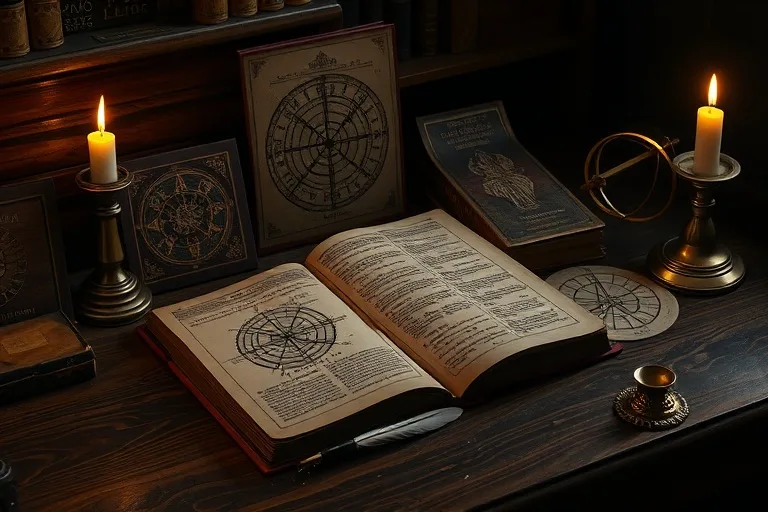
Antique tools and texts symbolize the enduring legacy of astrological scholarship.
One of the most fundamental concepts is Sect (Hairesis). This refers to whether a chart is diurnal (day chart, Sun above the horizon) or nocturnal (night chart, Sun below the horizon). Planets are considered to be "in sect" or "out of sect," which significantly modifies their benefic or malefic expression. For example, Jupiter and Saturn are considered more benefic in day charts, while Venus and Mars are more benefic in night charts.
The Planetary Joys are another key concept. Each of the seven traditional planets (Sun, Moon, Mercury, Venus, Mars, Jupiter, Saturn) was said to "rejoice" in a specific house, where its nature could be expressed most freely and positively. For instance, Venus rejoices in the 5th house (pleasure, children), and Jupiter in the 11th house (friends, good fortune). This adds a layer of contextual interpretation to planetary placements.
Lots (or Arabic Parts) are mathematical points derived from the positions of planets and ascendant. The most famous is the Lot of Fortune, but Hellenistic astrologers used dozens of lots to delineate specific areas of life, such as marriage, children, wealth, and profession. These lots provided precise focal points for predictive work.
Zodiacal Releasing is a powerful timing technique that divides a person's life into periods ruled by different zodiacal signs and planets, offering insights into peak periods of activity, stress, and achievement. This technique, often attributed to Vettius Valens, allows for a detailed chronological analysis of a native's life path.
The concept of Dodecatemoria involves dividing each zodiac sign into twelve sub-signs, each corresponding to a full sign. This adds a layer of subtle nuance to planetary placements, revealing hidden influences and deeper meanings within a sign. For example, a planet in the first dodecatemoria of Aries would have an Aries quality, but in the second, it would take on a Taurus quality, and so on.
Hellenistic astrology also placed a strong emphasis on the whole sign house system, where each sign corresponds to an entire house, with the Ascendant sign determining the 1st house. This differs from quadrant house systems commonly used in modern astrology and significantly alters the interpretation of planetary placements and house rulerships.
Finally, the concept of planetary dignities and debilities was central. Planets were considered stronger or weaker based on their placement in specific signs (e.g., domicile, exaltation, detriment, fall), influencing their capacity to act beneficently or maleficently. This framework provided a clear qualitative assessment of planetary strength.
Decline, Preservation, and Rediscovery
The decline of Hellenistic astrology in the West began gradually, influenced by several factors. The rise of Christianity led to a theological critique of fatalistic astrological doctrines. Later, during the Renaissance, while astrology experienced a brief resurgence, a shift towards a more humanistic and less deterministic approach began to take hold. The introduction of new house systems and a focus on psychological interpretation gradually moved Western astrology away from its Hellenistic roots.
However, Hellenistic knowledge was not entirely lost. It was meticulously preserved and further developed in the Islamic world. Arabic scholars translated and commented on the Greek texts, adding their own insights and expanding the tradition. This rich body of knowledge eventually made its way back to Europe during the Middle Ages, primarily through translations from Arabic into Latin, influencing medieval and early modern astrologers. This period of transmission ensured that the core ideas of Hellenistic astrology survived, albeit often in modified forms.
The true rediscovery of Hellenistic astrology in its original form began in the late 20th century. Scholars like Robert Schmidt, Robert Hand, and Chris Brennan spearheaded the "Hellenistic Revival Project," dedicating themselves to translating the original Greek texts into English. This monumental effort provided modern astrologers with unprecedented access to primary sources, allowing for a direct engagement with the ancient techniques without the filters of later interpretations. This project has been pivotal in understanding the nuances and complexities that had been lost or misunderstood for centuries.
The Modern Revival and Its Impact
The modern revival of Hellenistic astrology has transformed the landscape of contemporary astrological practice. It has challenged many assumptions, introduced forgotten techniques, and fostered a deeper appreciation for the historical evolution of astrology. This movement is characterized by a commitment to textual accuracy, rigorous research, and a willingness to re-evaluate long-held beliefs.

An abstract visualization of the precise and interconnected nature of astrological influences.
One of the most significant impacts has been the reintroduction of the whole sign house system. Many modern astrologers, after experimenting with whole signs, have found it to be more elegant and predictive than quadrant systems, especially for understanding the native's life circumstances and external events. The re-emphasis on sect and planetary joys has also provided powerful interpretive tools, allowing for a more nuanced assessment of planetary strength and beneficence.
The rediscovery of predictive techniques like zodiacal releasing and profections has offered astrologers new ways to forecast life events with remarkable precision. These methods provide a chronological framework for understanding when certain areas of life will be activated, offering insights into periods of opportunity, challenge, and transformation. This has shifted the focus of many practitioners from purely psychological interpretation back towards a more event-oriented and predictive approach.
Furthermore, the revival has fostered a greater historical awareness within the astrological community. Practitioners are now more likely to study the historical context of astrological techniques, understanding their origins and evolution. This scholarly approach has elevated the intellectual credibility of astrology and encouraged a more critical and informed practice.
Relevance in Contemporary Astrological Practice
The insights gleaned from Hellenistic astrology are highly relevant to contemporary practice, offering both a deeper understanding of foundational principles and practical tools for analysis. It provides a robust framework for understanding the interplay between fate and free will, a perennial question in astrological philosophy.
For those interested in predictive astrology, Hellenistic techniques offer a structured and systematic approach. Instead of relying solely on transits and progressions, practitioners can integrate zodiacal releasing, profections, and primary directions to gain a more comprehensive timeline of a native's life. This allows for more specific and actionable insights, helping individuals navigate crucial periods with greater awareness.
The emphasis on external events and circumstances in Hellenistic astrology complements modern psychological approaches. While modern astrology often focuses on inner development and potential, Hellenistic methods provide a lens through which to understand the external realities and opportunities that manifest in a person's life. This creates a more holistic view, acknowledging both the inner landscape and the outer world.
Moreover, the detailed rules for planetary condition, sect, and joys allow for a more precise assessment of a planet's strength and capacity to deliver on its promises. This can help clients understand why certain areas of their lives might be more challenging or more fortunate, moving beyond generic interpretations of planetary placements.
The study of Hellenistic astrology also encourages a return to primary sources and a critical engagement with the tradition. This promotes intellectual rigor and helps practitioners avoid superficial interpretations, fostering a more profound and authentic connection to the art of astrology. For those seeking to deepen their understanding of their , exploring these ancient techniques can unlock new layers of meaning.
Future Outlook for Hellenistic Astrology
The future of Hellenistic astrology appears bright, with a growing community of scholars, students, and practitioners dedicated to its study and application. The ongoing translation efforts continue to bring new texts to light, promising even deeper insights into the ancient tradition. Educational programs and workshops dedicated to Hellenistic techniques are becoming more widespread, making this complex system accessible to a broader audience.
One exciting development is the integration of Hellenistic methods with modern astrological software. This allows for easier calculation of complex techniques like zodiacal releasing and lots, removing computational barriers that once hindered widespread adoption. As technology advances, these tools will become even more sophisticated, enabling practitioners to explore Hellenistic astrology with greater ease and accuracy.
Furthermore, the dialogue between traditional and modern astrology is enriching both fields. Hellenistic astrology provides a historical anchor and a set of robust predictive tools, while modern astrology offers psychological depth and an emphasis on personal growth. The synthesis of these approaches can lead to a more comprehensive and effective astrological practice, one that honors the past while embracing the present.
As interest in spiritual and esoteric traditions continues to grow, Hellenistic astrology stands poised to offer a profound and intellectually stimulating path for those seeking to understand the cosmos and their place within it. Its rigorous methodology and rich philosophical underpinnings provide a powerful alternative or complement to other forms of astrological inquiry.
In conclusion, Hellenistic astrology, with its ancient roots and vibrant modern revival, represents a crucial chapter in the history of astrology. Its sophisticated techniques and profound philosophical insights continue to offer invaluable tools for self-understanding, prediction, and navigating the complexities of life. The dedication of scholars and practitioners ensures that this rich tradition will continue to thrive and evolve for generations to come.
Fuente: Contenido híbrido asistido por IAs y supervisión editorial humana.


Comments
Post a Comment