
Cosmic Sociology Celestial Mechanics Mapping Global Consciousness
The cosmos has long been a source of wonder and inspiration, influencing human thought and culture across millennia. Beyond its observable physical properties, there is a growing interest in how celestial mechanics might subtly interact with and even shape global consciousness. This interdisciplinary field, often termed cosmic sociology, seeks to explore the intricate relationship between planetary movements, astronomical phenomena, and the collective psychological, social, and spiritual trends observed on Earth. It delves into the hypothesis that the rhythmic dance of the planets could resonate with the ebb and flow of human collective awareness, offering a unique lens through which to understand our shared evolutionary journey.
This article introduces the foundational concepts of cosmic sociology and celestial mechanics, aiming to provide an educational and comprehensive overview for those new to this intriguing perspective. We will examine how traditional astrological principles, combined with modern understandings of consciousness, propose a framework for mapping these global trends. The exploration remains within a scientific and investigative paradigm, focusing on the potential correlations and symbolic interpretations rather than definitive causal claims, acknowledging the complex and often subtle nature of these proposed connections.

Precursors intellectuales, diagramas fundamentales y representaciones conceptuales que forjaron la visión de la interconexión cósmica sobre la conciencia colectiva.
Fuente visual sujeta a disponibilidad del ecosistema: Wikimedia Commons bajo licencia CC BY-SA 4.0 o renderizado conceptual IA.
The concept of cosmic sociology posits that human societies and their collective consciousness are not isolated phenomena but are intrinsically linked to the larger cosmic environment. This perspective suggests that just as the moon influences tides and solar flares impact Earth's magnetosphere, the intricate movements and configurations of celestial bodies might exert a subtle yet pervasive influence on human collective behavior, societal shifts, and the evolution of global thought patterns. It encourages a holistic view, where humanity is seen as an integral part of a vast, interconnected cosmic tapestry.
Table of Contents
- The Foundations of Celestial Mechanics in Astrology
- Understanding Global Consciousness: Definitions and Manifestations
- Bridging the Gap: How Celestial Cycles May Influence Collective Trends
- Astrological Tools for Mapping Consciousness: Birth Charts, Transits, Synastry
- The Role of Esoteric Symbolism in Cosmic Interpretation
- Challenges and Future Directions in Cosmic Sociology Research
The Foundations of Celestial Mechanics in Astrology
Celestial mechanics is the branch of astronomy that deals with the motions of celestial objects under the influence of gravity. It describes the orbits of planets, moons, asteroids, and comets, predicting their positions and interactions with remarkable precision. In the context of cosmic sociology, these predictable, cyclical movements form the basis for understanding potential cosmic influences on Earth. Ancient civilizations meticulously observed these cycles, developing systems like astrology to interpret their perceived impact on human affairs.
Astrology, in its most profound sense, is a symbolic language that maps these celestial movements to terrestrial events and human psychology. It interprets the positions of planets in zodiac signs and houses, as well as the angular relationships (aspects) between them, as indicators of energetic patterns and archetypal influences. These interpretations are not seen as deterministic but rather as reflections of underlying cosmic rhythms that manifest in various forms, from individual personality traits to large-scale societal trends. The concept of planetary dignities, for instance, describes how planets express their energy with varying strength depending on their zodiacal placement, influencing how these cosmic forces might be experienced collectively.
Key components of celestial mechanics relevant to this discussion include planetary cycles, such as the synodic cycles of inner planets, which describe the time it takes for a planet to return to the same position relative to the Sun and Earth. These cycles are thought to correspond to periods of growth, challenge, and transformation, not just for individuals but for entire societies. The grander cycles, like the precession of the equinoxes, are believed to mark vast epochs, influencing the overarching themes of human civilization and spiritual evolution over thousands of years.
Understanding Global Consciousness: Definitions and Manifestations
Global consciousness refers to the collective awareness, thoughts, feelings, and beliefs shared by humanity. It is not a singular entity but an emergent property of billions of individual consciousnesses interacting and influencing one another. This concept suggests that there is a palpable, though often subtle, energetic field or information network that connects all human beings, allowing for shared experiences, cultural shifts, and collective responses to global events. Manifestations of global consciousness can be observed in various phenomena.
- Synchronicity and Collective Moods: Periods of widespread optimism, anxiety, or revolutionary fervor that seem to arise spontaneously across diverse populations.
- Cultural Shifts: The rapid adoption of new ideas, technologies, or artistic expressions that transcend geographical boundaries.
- Global Movements: The emergence of unified social, political, or environmental movements that gain traction worldwide, often fueled by a shared sense of purpose or concern.
- Technological Interconnectedness: The internet and social media have amplified the speed and reach of information exchange, creating an unprecedented level of real-time collective experience and response.
Researchers in fields like sociology, psychology, and even quantum physics have explored aspects of collective consciousness, albeit with varying terminology and methodologies. The idea that human minds are interconnected is not new, echoing ancient spiritual traditions and modern theories of morphic resonance or the global mind. Mapping these trends involves analyzing vast datasets related to human behavior, communication patterns, and psychological states, seeking patterns that transcend individual variations and point to a larger collective narrative. This mapping endeavor aims to identify recurring themes and shifts that characterize humanity's collective journey.
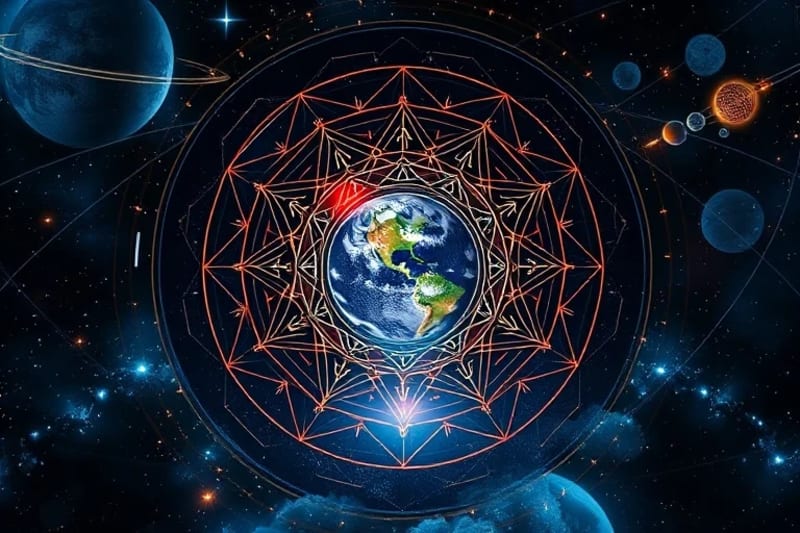
Intricate celestial clockwork illustrating the precise influence of cosmic mechanics on global trends.
Bridging the Gap: How Celestial Cycles May Influence Collective Trends
The core hypothesis of cosmic sociology lies in bridging the gap between celestial mechanics and global consciousness. It proposes that specific planetary alignments, transits, and cycles correlate with observable shifts in collective human behavior and societal evolution. For example, outer planetary cycles (Uranus, Neptune, Pluto) are traditionally associated with generational shifts, technological revolutions, spiritual awakenings, and profound societal transformations due to their long orbital periods and deep archetypal significations. These long-term cycles are thought to set the stage for major historical epochs.
Consider the transits of Pluto, a planet associated with death, rebirth, power, and transformation. Its movement through different zodiac signs often correlates with periods of profound societal restructuring, economic upheaval, and shifts in collective power dynamics. Similarly, Neptune's transits are linked to spiritual movements, artistic renaissances, and periods of collective illusion or disillusionment, reflecting its association with idealism, dreams, and the dissolution of boundaries. Uranus, the planet of innovation and rebellion, often coincides with technological breakthroughs, social revolutions, and movements for freedom and individuality.
While direct causal links are difficult to establish empirically through conventional scientific methods, the correlations observed over historical periods are compelling to many researchers. This perspective does not suggest that planets "force" events but rather that they symbolize underlying energetic currents that influence the collective psyche, making certain types of experiences or responses more probable. It's a dance of resonance, where cosmic rhythms echo within the human collective, much like how synodic cycles of inner planets influence personal growth and relationships, but on a much grander scale.
Astrological Tools for Mapping Consciousness: Birth Charts, Transits, Synastry
Astrology provides a sophisticated set of tools that, when applied to collective phenomena, can offer insights into global consciousness trends. These tools, traditionally used for individual analysis, can be scaled up to interpret the energetic landscape of nations, organizations, or even humanity as a whole.
- Mundane Astrology and National Charts: By casting birth charts for nations (based on their founding dates), astrologers can analyze the inherent psychological and energetic patterns of a collective entity. The transits to these national charts are then interpreted for periods of national crisis, growth, or transformation, reflecting shifts in collective identity and purpose.
- Planetary Transits to Global Events: Analyzing the planetary positions during significant global events (e.g., major wars, technological revolutions, pandemics) can reveal recurring astrological signatures. These transits act as cosmic timing mechanisms, indicating when certain archetypal energies are most potent and likely to manifest on a collective scale.
- Synastry for International Relations: Synastry, the comparison of two birth charts, can be applied to analyze the dynamic relationship between nations or cultural groups. It highlights areas of harmony, conflict, and potential for cooperation, offering a symbolic understanding of geopolitical trends and the interplay of collective consciousness between different societies.
- Zodiac Archetypes and Collective Narratives: The twelve Cosmic Sociology Digital Age: AI Consciousness Global Shifts represent fundamental human experiences and motivations. As planets move through these signs, they activate different archetypal energies, influencing the prevailing collective narratives, values, and challenges. For example, a significant planetary ingress into a fire sign might correlate with periods of collective passion, action, or conflict, while an ingress into an air sign might emphasize intellectual pursuits or communication.
These astrological frameworks offer a symbolic language to describe and interpret the complex, often chaotic, patterns of global consciousness. They provide a means to identify underlying themes and rhythms that might otherwise appear random, suggesting a deeper order within the apparent disorder of human history.
Abstract watercolor representing the fluid nature of collective consciousness and hidden cosmic influences.
The Role of Esoteric Symbolism in Cosmic Interpretation
Esoteric symbolism plays a crucial role in cosmic sociology, providing the interpretive framework through which celestial mechanics can be understood in relation to consciousness. This symbolism is not merely arbitrary but is rooted in millennia of human observation, spiritual insight, and philosophical inquiry. Each planet, sign, and aspect carries a rich tapestry of symbolic meanings that resonate with universal human experiences and archetypal patterns. For instance, the Sun symbolizes the core self and vitality, the Moon represents emotions and the subconscious, and Saturn embodies structure, discipline, and limitation.
These symbols act as a bridge between the observable physical universe and the intangible realm of consciousness. They allow for a qualitative understanding of cosmic energies, moving beyond purely quantitative measurements to explore the deeper, subjective impact of celestial phenomena. The interpretation of these symbols requires a nuanced approach, recognizing that their manifestations can vary widely depending on context, culture, and the specific collective being observed. It is through this symbolic lens that we can begin to discern how the cosmic dance might express itself in the collective psyche, influencing everything from artistic movements to political ideologies.
Furthermore, esoteric traditions often emphasize the concept of "as above, so below," suggesting a holographic relationship between the macrocosm (the cosmos) and the microcosm (humanity). This principle underpins the entire field of cosmic sociology, implying that the patterns observed in the heavens are mirrored in human experience. Understanding this symbolism allows for a deeper appreciation of the interconnectedness of all things and provides a language to articulate the complex interplay between cosmic forces and the evolution of global consciousness. This perspective is further enriched by considering modern concepts like astro-physics and quantum entanglement, which hint at non-local connections that might underpin these symbolic relationships.
Challenges and Future Directions in Cosmic Sociology Research
The field of cosmic sociology, while promising, faces significant challenges. The primary hurdle is the establishment of empirical, verifiable evidence for the proposed correlations between celestial mechanics and global consciousness trends. Traditional scientific methodologies often struggle to quantify subtle energetic influences or subjective experiences of consciousness. The vast number of variables involved, from individual human free will to complex geopolitical factors, makes isolating specific cosmic influences incredibly difficult.
Another challenge lies in the interdisciplinary nature of the field. It requires expertise in astronomy, physics, sociology, psychology, history, and esoteric studies, demanding a synthesis of knowledge that few individuals possess. Bridging the gap between qualitative astrological interpretation and quantitative scientific analysis remains a key area for development. Researchers must develop innovative methodologies that can rigorously test hypotheses while respecting the symbolic richness of the astrological tradition.
Despite these challenges, the future directions for cosmic sociology are exciting. Advances in data science and artificial intelligence could enable the analysis of vast historical and real-time datasets of human behavior, communication, and sentiment, potentially revealing subtle correlations with celestial events that were previously undetectable. The development of more sophisticated models that integrate astronomical data with sociological indicators could lead to a deeper understanding of these complex interactions. Furthermore, ongoing research into the nature of consciousness itself, particularly in fields like quantum consciousness or panpsychism, may provide theoretical frameworks that better accommodate the idea of cosmic influence.
The exploration of cosmic sociology encourages a broader, more holistic perspective on humanity's place in the universe. It invites us to consider that our collective journey is not merely a product of terrestrial forces but is interwoven with the grander cosmic symphony, offering profound insights into our shared destiny and the evolving nature of global consciousness. This interdisciplinary approach, while still nascent, holds the potential to unlock new understandings of the intricate dance between the cosmos and the human spirit.
Further Exploration in Cosmic Connections
- Esoteric Sound Codes: Vibrational Healing, Archetypal Awakening
Discover how ancient sound frequencies and archetypal patterns resonate with cosmic energies to promote healing and expanded consciousness. - Astral Projection: Exploring Beyond Physical Body | StarPluto
Journey beyond the physical realm and explore the potential for consciousness to transcend bodily limitations, connecting with broader cosmic fields. - Dream Interpretation: Unlocking Subconscious Messages | StarPluto
Unravel the mysteries of the subconscious mind and its connection to universal symbols, reflecting the interplay between inner and outer cosmos. - Bio-Astral Projection: Conscious Interdimensional Journeys
Learn techniques to gain conscious control within dreams, a practice that can expand awareness and potentially tap into collective unconscious information. - Planetary Cycles Numerology: Decoding Personal Timing
Explore the numerical patterns within planetary cycles and their implications for personal and collective timing, offering insights into life's rhythmic unfolding. - Void of Course Moon: Navigating Astrological Inaction | StarPluto
Understand periods of astrological "inactivity" and how they might influence collective pauses or shifts in global momentum and decision-making.
Source: Hybrid content assisted by AI and human editorial supervision.


Comments
Post a Comment