
Sacred Geometry: Universal Truths, Esoteric Symbols Unlocked
Sacred Geometry is an ancient metaphysical concept that explores the fundamental patterns and proportions observed in nature, art, and the cosmos. It posits that certain geometric shapes and ratios are not merely mathematical constructs but are imbued with profound symbolic and spiritual significance. These patterns are believed to be the blueprints of creation, revealing the underlying order and interconnectedness of all existence.
From the microscopic structure of DNA to the macroscopic arrangement of galaxies, the principles of sacred geometry are said to manifest universally. Understanding these principles offers a unique lens through which to perceive the world, bridging the gap between science and spirituality, and providing insights into the very fabric of reality. This advanced exploration delves into the core tenets, historical origins, and practical applications of sacred geometry, unveiling its role in unlocking universal truths and esoteric symbols.
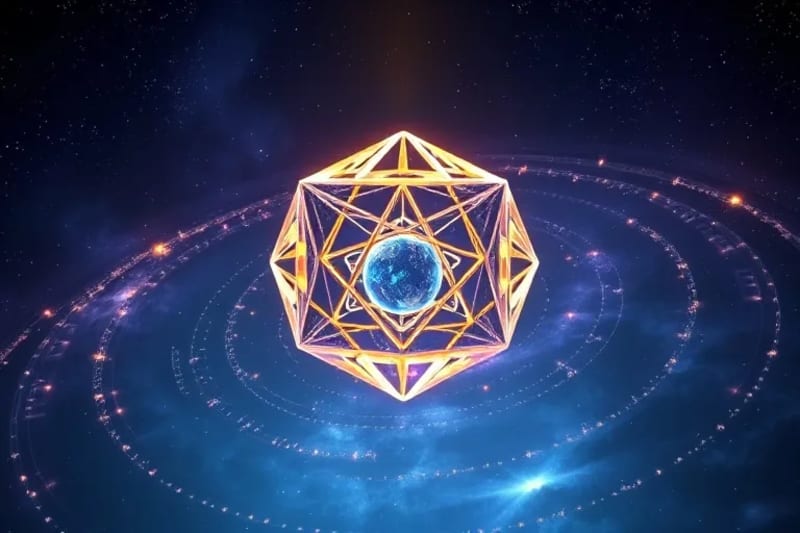 A luminous dodecahedron, a key Platonic Solid, symbolizes the ethereal and universal order inherent in sacred geometry.
Table of Contents
- Historical Roots and Philosophical Foundations
- Fundamental Principles: The Golden Ratio and Fibonacci Sequence
- The Platonic Solids: Building Blocks of Reality
- Key Sacred Symbols and Their Meanings
- Manifestations in Nature and the Human Body
- Sacred Geometry in Architecture and Art
- Spiritual and Esoteric Applications
- Modern Relevance and Contemporary Interpretations
Historical Roots and Philosophical Foundations
The origins of sacred geometry can be traced back to ancient civilizations across the globe. Evidence of its understanding and application can be found in the architectural marvels of Egypt, the intricate mandalas of India, and the philosophical texts of Greece. Ancient Egyptians incorporated geometric principles into the construction of pyramids and temples, aligning them with celestial bodies and believed to harness cosmic energies. Their understanding of proportions and angles was not merely functional but deeply symbolic, reflecting their cosmology.
In ancient Greece, philosophers like Pythagoras and Plato extensively explored the mathematical and philosophical implications of geometry. Pythagoras, often credited with the discovery of the Pythagorean theorem, believed that numbers and geometric forms held the key to understanding the universe. Plato, in his work "Timaeus," associated the five Platonic Solids with the classical elements, suggesting they were the fundamental building blocks of the cosmos. These philosophical underpinnings laid the groundwork for the Western esoteric tradition's engagement with sacred geometry, influencing later alchemists, mystics, and Renaissance artists.
The concept of a divine blueprint, where geometric patterns dictate creation, is a recurring theme across various spiritual traditions. From the Kabbalistic Tree of Life in Jewish mysticism to the Yantra diagrams in Hinduism and Buddhism, these cultures recognized geometry as a language of the divine. This historical continuity underscores the universal appeal and perceived truth of these geometric principles, transcending cultural and temporal boundaries.
Fundamental Principles: The Golden Ratio and Fibonacci Sequence
At the heart of sacred geometry lie several fundamental principles, none more pervasive than the Golden Ratio (Phi, approximately 1.618) and its mathematical cousin, the Fibonacci Sequence. The Golden Ratio is an irrational number that appears when the ratio of two quantities is the same as the ratio of their sum to the larger of the two quantities. Mathematically, it can be expressed as a/b = (a+b)/a = Phi.
The Fibonacci Sequence is a series of numbers where each number is the sum of the two preceding ones (0, 1, 1, 2, 3, 5, 8, 13, 21, and so on). As the numbers in the sequence get larger, the ratio of any Fibonacci number to the one before it approaches the Golden Ratio. These two principles are intrinsically linked and are often considered signatures of divine design, appearing in countless natural phenomena and artistic creations.
The aesthetic appeal of the Golden Ratio is well-documented, often associated with beauty and harmony. Artists and architects throughout history, from the ancient Greeks to Leonardo da Vinci, have consciously or unconsciously incorporated these proportions into their works, believing them to create visually pleasing and balanced compositions. This pervasive presence suggests a deep-seated human resonance with these specific mathematical relationships.
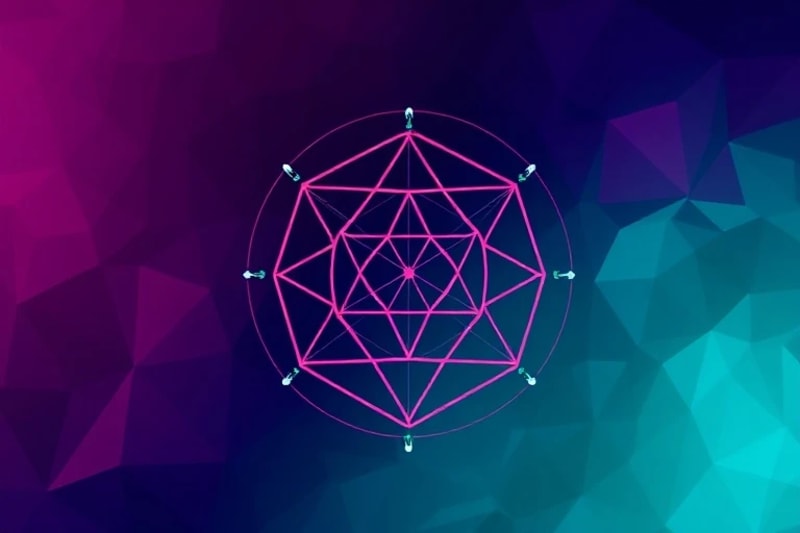 Complex geometric patterns like the Flower of Life and Metatron's Cube, symbolizing the interconnectedness of creation.
The Platonic Solids: Building Blocks of Reality
The Platonic Solids are a set of five convex regular polyhedra, meaning they are three-dimensional shapes where each face is a regular polygon of the same size and shape, and the same number of faces meet at each vertex. These five shapes are the tetrahedron, cube (hexahedron), octahedron, dodecahedron, and icosahedron. Their significance in sacred geometry stems from their perfect symmetry and their association with the fundamental elements of the universe.
Plato assigned each solid to a classical element: the tetrahedron to fire, the cube to earth, the octahedron to air, the icosahedron to water, and the dodecahedron to the cosmos or ether. This assignment suggests that these shapes are the fundamental building blocks from which all matter is composed. Modern science, particularly in crystallography, has found that many crystals and molecular structures naturally form these geometric arrangements, lending a scientific basis to their ancient spiritual significance.
| Platonic Solid | Associated Element | Symbolic Meaning |
|---|---|---|
| Tetrahedron | Fire | Willpower, courage, transformation |
| Cube (Hexahedron) | Earth | Stability, foundation, grounding |
| Octahedron | Air | Balance, compassion, integration |
| Icosahedron | Water | Flow, emotion, creativity |
| Dodecahedron | Ether/Universe | Spirit, consciousness, divine connection |
Key Sacred Symbols and Their Meanings
Beyond the Platonic Solids, several other geometric symbols hold significant importance within sacred geometry. These symbols are often seen as visual representations of cosmic laws and spiritual principles.
- The Flower of Life: This ancient symbol, found in cultures worldwide, consists of overlapping circles that form a flower-like pattern. It is considered a blueprint of the universe, containing the patterns of creation and the fundamental forms of space and time. It is believed to contain all the Platonic Solids and other geometric forms within its structure.
- The Seed of Life: A precursor to the Flower of Life, composed of seven overlapping circles. It represents the seven days of creation and the initial spark of consciousness from which all life emerges.
- The Tree of Life: A mystical symbol used in Kabbalah, consisting of ten nodes (Sephirot) arranged in a specific geometric pattern, representing the path to God and the structure of the universe. Its geometric arrangement reflects profound esoteric principles, connecting different dimensions of existence.
- Metatron's Cube: Derived from the Flower of Life, Metatron's Cube is a complex geometric figure that contains all five Platonic Solids. It is named after Archangel Metatron, who is believed to oversee the flow of energy in the universe. This symbol is often used for protection, meditation, and understanding the structure of reality.
- The Vesica Piscis: Formed by the intersection of two circles, each passing through the center of the other. It symbolizes the union of opposites, creation, and the divine feminine. It is also found in early Christian art and architecture, representing the intersection of the spiritual and material worlds.
 A golden spiral, representing the Fibonacci sequence, emerging from a serene water surface, symbolizing natural growth and divine proportion.
Manifestations in Nature and the Human Body
The presence of sacred geometry is not confined to ancient texts or human constructs; it is vividly expressed throughout the natural world. The spiral patterns in sunflower heads, pinecones, and seashells all adhere to the Fibonacci Sequence and the Golden Ratio. The branching patterns of trees, the formation of snowflakes, and the intricate designs of spiderwebs also reveal underlying geometric order. These natural occurrences suggest an inherent intelligence guiding the growth and development of life forms, reflecting a cosmic harmony.
The human body itself is a remarkable example of sacred geometry. The proportions of the human face and limbs often approximate the Golden Ratio, contributing to what is perceived as aesthetic beauty. The double helix structure of DNA, the very blueprint of life, is a spiral form that echoes these fundamental geometric principles. Even the energetic fields and aura photography around the body are sometimes described as having geometric structures, suggesting a deeper connection between our physical form and these universal patterns.
Observing these patterns in nature can lead to a profound sense of wonder and connection to the universe. It reinforces the idea that there is an underlying order to chaos, a divine intelligence orchestrating the symphony of creation. For those interested in the energetic foundations of existence, exploring concepts like astrological aspect patterns can provide further insights into how cosmic forces manifest in geometric and energetic forms.
Sacred Geometry in Architecture and Art
Throughout history, sacred geometry has been a guiding principle in the design of sacred spaces and artistic masterpieces. Ancient temples, cathedrals, mosques, and other spiritual buildings were often constructed using precise geometric ratios and alignments, believed to create environments conducive to spiritual experience and connection. The Parthenon in Greece, the Great Pyramid of Giza, and Gothic cathedrals like Chartres all exhibit proportions based on the Golden Ratio and other geometric principles.
In art, the application of sacred geometry is evident in the works of Renaissance masters such as Leonardo da Vinci, who meticulously incorporated the Golden Ratio into his paintings like "The Last Supper" and "Mona Lisa." These deliberate applications were not merely for aesthetic appeal but were intended to imbue the art with deeper meaning and a sense of divine order. The use of geometric grids and proportional systems helped artists achieve harmony, balance, and a sense of timelessness in their creations.
Beyond Western traditions, the intricate patterns in Islamic art, known as girih, are a testament to the profound understanding of geometry as a representation of divine unity and infinity. These complex tessellations, often found in mosques and palaces, create mesmerizing visual experiences that invite contemplation and reflection on the nature of existence. The universal presence of sacred geometry in art and architecture across diverse cultures highlights its enduring power to inspire and elevate the human spirit.
Spiritual and Esoteric Applications
The spiritual and esoteric applications of sacred geometry are vast and varied. Many practitioners use these symbols and patterns as tools for meditation, healing, and personal transformation. Meditating on symbols like the Flower of Life or Metatron's Cube is believed to help align one's consciousness with universal energies, promote mental clarity, and facilitate spiritual awakening. These symbols are thought to act as energetic conduits, connecting the individual to higher states of awareness.
In energy work and healing modalities, geometric patterns are sometimes used to create energetic grids or to structure intentions. For example, crystals arranged in specific geometric formations are believed to amplify their healing properties. The study of sacred geometry can also deepen one's understanding of other esoteric disciplines, such as Tarot Numerology Fusion, where numerical patterns and symbolic meanings intertwine to reveal life paths and predictive insights.
Furthermore, sacred geometry is often integrated into practices aimed at creating sacred spaces, whether through altar arrangements, mandalas, or specific room configurations. The deliberate placement of objects and the use of geometric forms are believed to harmonize energies, purify environments, and invite spiritual presence. This intentional application transforms ordinary spaces into sanctuaries, reflecting the belief that external order can foster internal peace and spiritual growth.
Modern Relevance and Contemporary Interpretations
In the modern era, sacred geometry continues to captivate scientists, artists, and spiritual seekers alike. Contemporary research in fields like quantum physics and cosmology sometimes finds parallels with ancient geometric concepts, suggesting that the universe operates on principles that are both mathematical and deeply interconnected. The exploration of fractals, for instance, reveals infinite complexity within finite patterns, echoing the self-similar nature often attributed to sacred geometric forms.
Artists and designers today are reinterpreting sacred geometry in digital art, fashion, and product design, bringing these ancient patterns into contemporary contexts. The aesthetic appeal and symbolic depth of these forms resonate with a growing audience seeking meaning and harmony in a complex world. From intricate tattoos to architectural blueprints, the influence of sacred geometry is expanding, demonstrating its timeless relevance.
For spiritual practitioners, sacred geometry offers a tangible way to connect with universal consciousness. It provides a framework for understanding the underlying order of creation and our place within it. As we continue to explore the mysteries of the cosmos and consciousness, sacred geometry stands as a powerful reminder that the universe is not a random collection of events but a beautifully orchestrated symphony of patterns and proportions, waiting to be understood and experienced. Further exploration into topics like Neuroplasticidad Cuántica can highlight how these universal structures might even influence our brain's capacity for spiritual awakening and reconfiguring our understanding of reality.
Related Searches
- Leo Zodiac Sign: Traits, Leadership, Creative Expression | StarPluto
- Zodiac Decanates Planetary Rulerships Mastering Sun Sign Nuances | StarPluto
- Advanced Synastry: Chiron & Vesta Inter-aspects | StarPluto
- Moon Houses Emotional Foundations Inner Needs Astrology Guide | StarPluto
- Candle Magic Rituals: Advanced Protection Cleansing Spells | StarPluto
- Lilith Astrology: Primal Instincts, Shadow Feminine | StarPluto
- Arabic Parts: Derived Points in Astrology | StarPluto
- Asteroid Goddesses: Ceres, Pallas, Juno in Your Birth Chart | StarPluto
- Electional Astrology Planetary Dignities Fixed Stars Timings
- Chinese Zodiac Element Compatibility: Beyond Animal Pairings | StarPluto
- Mindful Daily Horoscope: Intention & Astrological Flow | StarPluto
- Astral Projection: Safe Exploration Beyond Body | StarPluto
Source: Hybrid content assisted by AI and human editorial supervision.


Comments
Post a Comment