
Zi Wei Dou Shu Feng Shui Career Success Guide
Mastering Career Success with Zi Wei Dou Shu and Five Element Feng Shui
In the intricate tapestry of Chinese metaphysics, Zi Wei Dou Shu (Purple Star Astrology) and the Five Element Theory stand as pillars of profound wisdom, offering unparalleled insights into an individual's destiny and potential. When synergistically applied with the principles of Feng Shui, these ancient disciplines provide a sophisticated framework for not only understanding one's career trajectory but also actively shaping it towards optimal success and fulfillment. This advanced guide delves into the intricate mechanisms of these systems, revealing how to harness their predictive power for unparalleled career advancement.
The pursuit of career success often involves strategic planning, skill development, and networking. However, traditional Chinese metaphysics suggests that an underlying energetic blueprint significantly influences these external efforts. By decoding this blueprint through Zi Wei Dou Shu and aligning one's environment according to Five Element Feng Shui, individuals can unlock dormant potential, mitigate challenges, and attract auspicious opportunities with greater precision and efficacy.
- Zi Wei Dou Shu Fundamentals for Career Analysis
- Five Element Theory: The Energetic Foundation of Success
- Integrating Predictive Feng Shui for Career Advancement
- Practical Application Strategies for Career Success
- Advanced Techniques and Ethical Considerations
- Conclusion: Holistic Career Optimization

A Luopan, symbolizing ancient Chinese metaphysics, illuminates a contemporary workspace, guiding strategic career decisions.
Zi Wei Dou Shu Fundamentals for Career Analysis
Zi Wei Dou Shu, often translated as "Purple Star Astrology," is a highly sophisticated form of Chinese astrological divination that maps an individual's destiny based on their birth date, time, and place. Unlike simpler systems, Zi Wei Dou Shu utilizes a complex array of over 100 stars distributed across 12 palaces, each governing a specific aspect of life, including career, wealth, relationships, and health.
For career analysis, the primary focus is on the Career Palace (Guan Lu Gong). This palace reveals the nature of one's profession, work ethic, leadership potential, relationship with superiors, and overall career trajectory. However, a comprehensive analysis extends beyond this single palace, examining its interactions with other palaces such as the Wealth Palace (Cai Bo Gong), Life Palace (Ming Gong), and even the Friends/Subordinates Palace (Nu Pu Gong).
Key stars within the Career Palace provide specific indications:
- Zi Wei (Emperor Star): Indicates leadership, authority, high-ranking positions, and a preference for managing rather than being managed.
- Tian Fu (Treasury Star): Suggests financial management, administrative roles, stability, and wealth accumulation through career.
- Wu Qu (Military/Wealth Star): Points to careers in finance, military, or industries requiring decisive action and strong execution.
- Lian Zhen (Purity/Official Star): Implies careers in law, government, public service, or fields requiring meticulousness and integrity.
- Tian Xiang (Minister Star): Denotes supportive roles, diplomacy, public relations, and careers assisting those in power.
- Po Jun (Army Breaker Star): Signifies careers involving change, innovation, breaking new ground, or positions that require reform.
The interplay of these major stars with minor stars, auspicious (Jia) and inauspicious (Sha) influences, and the four transformational stars (Hua Lu, Hua Quan, Hua Ke, Hua Ji) provides a nuanced understanding of career strengths, weaknesses, opportunities, and challenges. For instance, Hua Lu in the Career Palace often indicates wealth and opportunities, while Hua Ji might suggest obstacles or periods of stagnation.
Five Element Theory: The Energetic Foundation of Success
The Five Element Theory (Wu Xing) is a fundamental concept in Chinese philosophy, medicine, and metaphysics, describing the dynamic interrelationships between Wood, Fire, Earth, Metal, and Water. These elements are not static substances but rather phases of energy, constantly transforming and influencing each other through constructive (Sheng) and destructive (Ke) cycles.
Understanding one's dominant and missing elements, as derived from a Zi Wei Dou Shu or BaZi chart, is crucial for career alignment. Each element corresponds to specific industries, personality traits, and even colors and shapes:
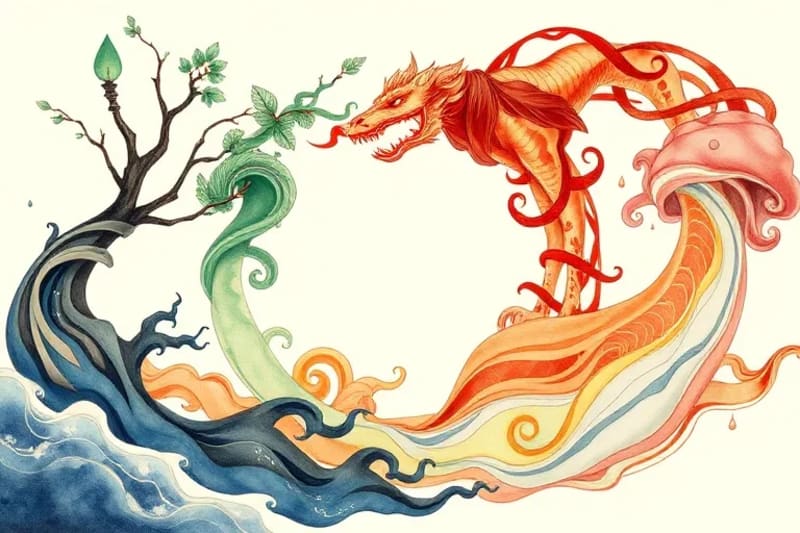
An artistic rendering of the Five Elements, illustrating their continuous cycles of creation and control in the cosmic dance.
| Element | Associated Industries | Personality Traits | Colors & Shapes |
|---|---|---|---|
| Wood | Education, creative arts, fashion, growth-oriented businesses, healthcare, agriculture. | Growth, creativity, planning, leadership, compassion, assertiveness. | Green, blue; rectangular, tall. |
| Fire | Media, entertainment, IT, energy, public speaking, marketing, restaurants. | Passion, enthusiasm, innovation, charisma, impulsiveness, vision. | Red, purple; triangular, pointed. |
| Earth | Real estate, construction, administration, human resources, hospitality, counseling. | Stability, nurturing, reliability, practicality, patience, loyalty. | Yellow, brown; square, flat. |
| Metal | Finance, law, engineering, manufacturing, technology, military, precision work. | Discipline, organization, justice, assertiveness, efficiency, analytical. | White, gold, silver; round, arched. |
| Water | Shipping, logistics, communications, consulting, sales, research, travel. | Adaptability, intuition, wisdom, communication, flexibility, introspection. | Black, dark blue; wavy, irregular. |
By identifying the elemental composition of one's Zi Wei Dou Shu chart, particularly concerning the Career Palace, individuals can discern their most naturally aligned career paths and identify areas where elemental support is needed. For example, a chart strong in Fire but weak in Water might indicate a brilliant innovator who struggles with communication or emotional depth, requiring specific elemental remedies.
Integrating Predictive Feng Shui for Career Advancement
Feng Shui, the ancient art of arranging spaces to achieve harmony with the environment, becomes a powerful predictive and prescriptive tool when combined with Zi Wei Dou Shu and Five Element Theory. It moves beyond generic auspicious placements to highly personalized energetic adjustments tailored to an individual's unique destiny chart.
The core principle is to harmonize the external environment (home, office) with the internal energetic blueprint (Zi Wei Dou Shu chart). This involves identifying the specific sectors of a space that correspond to career, wealth, and helpful people, and then enhancing or balancing them according to the individual's elemental needs and the star configurations in their Career Palace.

A conceptual 3D render illustrating the precise alignment of a modern office space with ancient astrological charts, symbolizing optimized career pathways.
Specific areas within a space are traditionally associated with career aspects:
- North Sector (Water Element): Directly linked to career, journey, and life path. Enhancing this area can boost professional opportunities and flow.
- Southeast Sector (Wood Element): Associated with wealth and prosperity. A well-activated Southeast can support financial gains through career efforts.
- Northwest Sector (Metal Element): Governs helpful people, mentors, and benefactors. Crucial for career advancement through support and guidance.
- South Sector (Fire Element): Represents recognition, fame, and reputation. Important for those seeking public acknowledgment or leadership roles.
However, a static application of these principles is insufficient for advanced predictive Feng Shui. The individual's Zi Wei Dou Shu chart dictates which elements are most beneficial or detrimental at specific times, and how these interact with the Flying Stars (Xuan Kong Fei Xing) of the current period. For example, if a person's chart indicates a strong need for Metal to support their career, they would be advised to activate the Northwest sector with Metal elements (e.g., metallic objects, white/grey colors) and avoid excessive Fire elements that would destroy Metal.
Practical Application Strategies for Career Success
Implementing Zi Wei Dou Shu and Five Element Feng Shui for career success involves a multi-layered approach that combines personal analysis with environmental adjustments and timing strategies.
1. Personalized Career Palace Analysis:
- Identify Core Strengths: Determine the dominant stars and auspicious influences in your Career Palace. These highlight your natural talents, leadership qualities, and most suitable industries.
- Pinpoint Weaknesses/Challenges: Analyze inauspicious stars (Sha stars) or unfavorable elemental interactions. This reveals potential obstacles, types of colleagues to avoid, or periods of career instability.
- Elemental Balance: Assess the elemental balance of your chart. If an element crucial for your career is weak, you'll need to strengthen it through Feng Shui and personal choices.
2. Optimized Office/Workspace Feng Shui:
- Desk Placement: Position your desk to face your most auspicious direction, as determined by your Kua number and Zi Wei Dou Shu chart. Avoid facing a wall directly or having your back to the door.
- Elemental Enhancements: Based on your chart's elemental needs, introduce specific elements into your workspace. For example, if you need Wood, add plants or wooden decor. If Water is beneficial, a small water feature or images of water can be effective.
- Sector Activation: Identify the North (Career), Southeast (Wealth), and Northwest (Mentors) sectors of your office or home office. Activate these areas with appropriate elemental objects, colors, and shapes that resonate with your personal chart's requirements.
3. Strategic Timing with Planetary Transits:
- Decade and Annual Cycles: Zi Wei Dou Shu charts reveal decade (Da Yun) and annual (Liu Nian) cycles, indicating periods of heightened opportunity or potential challenge. Align major career moves (job changes, promotions, new ventures) with auspicious cycles.
- Monthly and Daily Influences: For critical meetings, presentations, or negotiations, consult the daily and monthly elemental and star influences to choose the most favorable timing.
Advanced Techniques and Ethical Considerations
Beyond the foundational applications, advanced practitioners integrate further layers of complexity for refined predictive and prescriptive outcomes. This includes the integration of Flying Stars Feng Shui, which tracks the dynamic energy shifts within a space over time, and the consideration of personal Kua numbers for directional compatibility.
Flying Stars Feng Shui: This method analyzes the energetic patterns of a building based on its construction date and facing direction. It identifies auspicious and inauspicious "stars" that move through different sectors annually, monthly, and even daily. By overlaying these dynamic energies with an individual's Zi Wei Dou Shu chart and elemental needs, one can make highly precise adjustments. For example, activating a career sector with a beneficial Flying Star while simultaneously aligning it with one's personal favorable element can amplify positive outcomes.
Personal Kua Number: Derived from one's birth year and gender, the Kua number identifies personal auspicious and inauspicious directions. While Zi Wei Dou Shu provides the "what" and "when," the Kua number offers the "where" in terms of personal orientation within a space. Sitting facing a favorable Kua direction during work, especially when combined with a strong Career Palace in Zi Wei Dou Shu, can significantly enhance focus, productivity, and decision-making.
Ethical Considerations: It is paramount to approach these powerful metaphysical tools with an ethical mindset. Predictive systems like Zi Wei Dou Shu offer insights into potential, not fixed fate. They guide self-awareness and strategic action rather than promoting passive reliance. Feng Shui adjustments should always prioritize safety, practicality, and personal comfort. A skilled practitioner acts as a guide, empowering individuals to make informed choices, rather than dictating outcomes.
Furthermore, the interpretation of complex charts requires extensive study and experience. Misinterpretations can lead to misguided decisions. Therefore, seeking guidance from certified and reputable practitioners is crucial for accurate analysis and effective application of these advanced techniques.
Conclusion: Holistic Career Optimization
The sophisticated integration of Zi Wei Dou Shu and Five Element Theory with predictive Feng Shui offers a holistic and powerful approach to career optimization. By meticulously analyzing one's innate energetic blueprint, understanding the dynamic interplay of elements, and harmonizing the living and working environments, individuals can transcend conventional career planning.
This advanced methodology provides a roadmap for identifying intrinsic strengths, mitigating potential challenges, and strategically timing career moves to align with auspicious cosmic energies. It empowers individuals not merely to react to circumstances but to proactively shape their professional destiny, leading to greater success, fulfillment, and prosperity. Embracing these ancient wisdom traditions in a modern context offers a distinctive edge in navigating the complexities of today's career landscape.
Fuente: Contenido híbrido asistido por IAs y supervisión editorial humana.


Comments
Post a Comment