
Cosmic Sociology: Mapping Global Consciousness Trends
Cosmic Sociology & Celestial Mechanics: Mapping Global Consciousness & Collective Trends
The intricate dance between cosmic phenomena and human societal evolution has long fascinated thinkers across disciplines. Cosmic sociology, an emerging field, posits that celestial mechanics and astrological principles offer profound insights into global consciousness, collective trends, and historical shifts. This advanced exploration delves into how planetary movements, aspects, and cycles correlate with large-scale human behavior, technological advancements, and cultural transformations, moving beyond individual horoscopes to analyze the macrocosm of human civilization.
 Precursors intellectuales, diagramas fundamentales y representaciones conceptuales que forjaron la visión de la sociología cósmica sobre la conciencia global.
Fuente visual sujeta a disponibilidad del ecosistema: Wikimedia Commons bajo licencia CC BY-SA 4.0 o renderizado conceptual IA.
Understanding these correlations requires a synthesis of ancient astrological wisdom with modern sociological analysis, examining how planetary energies manifest as archetypal patterns influencing the collective psyche. This article provides a technical framework for mapping these celestial influences, offering a deeper comprehension of humanity's journey through time and space. We will explore the theoretical underpinnings, methodologies, and practical applications of this interdisciplinary approach.
Table of Contents
- Foundations of Cosmic Sociology: Astrological Archetypes and Collective Behavior
- Celestial Mechanics: Precision in Planetary Influences
- Global Consciousness Mapping: Astrological Indicators
- Synastry of Nations: Interplay of Global Charts
- Predictive Models: Forecasting Trends with Celestial Data
- Ethical Considerations and Interpretive Nuances
Foundations of Cosmic Sociology: Astrological Archetypes and Collective Behavior
Cosmic sociology begins with the premise that planetary positions and their dynamic relationships (aspects) are not merely random occurrences but rather symbolic representations of underlying energetic patterns that resonate with human psychological and sociological structures. Each planet, sign, and house in astrology embodies an archetypal principle, which, when activated by celestial movements, can trigger specific collective responses and trends.
For instance, the outer planets—Uranus, Neptune, and Pluto—are often associated with generational and societal shifts due to their slow movement and long cycles. Uranus governs innovation, rebellion, and sudden change; Neptune relates to spirituality, dissolution, and collective illusions; and Pluto signifies transformation, power dynamics, and profound regeneration. When these planets form significant aspects, particularly with each other or with the slower-moving inner planets, their archetypal energies are amplified, manifesting as widespread societal phenomena.
The concept of collective consciousness, as popularized by Carl Jung, finds a complementary framework within cosmic sociology. Jung's idea of the collective unconscious, a reservoir of shared human experiences and archetypes, can be seen as being influenced and activated by these overarching planetary configurations. Global events, from economic depressions to technological revolutions, often coincide with specific planetary cycles, suggesting a deep, albeit often unseen, connection.
Understanding these archetypal influences is crucial for mapping global trends. For example, a prominent Saturn-Pluto conjunction, occurring approximately every 33-38 years, has historically correlated with periods of significant restructuring, power struggles, and systemic challenges, often leading to profound societal transformations. These are not mere coincidences but rather reflections of deep karmic patterns playing out on a global stage, influencing everything from political ideologies to economic structures.
Celestial Mechanics: Precision in Planetary Influences
Celestial mechanics provides the precise mathematical framework for calculating planetary positions, movements, and aspects. While astrology interprets the *meaning* of these positions, celestial mechanics offers the *data*. Accurate ephemerides, which are tables of planetary positions, are fundamental to cosmic sociology, allowing researchers to track significant astrological events over long historical periods. This precision enables the correlation of planetary cycles with specific historical epochs and their associated collective trends.
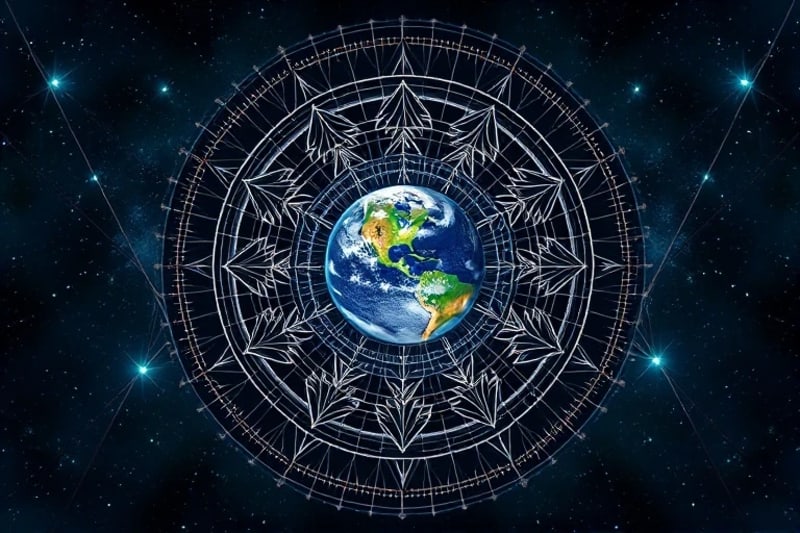 An intricate diagram illustrating the interconnectedness of planetary orbits and their symbolic influence on human societal structures.
Key concepts within celestial mechanics relevant to cosmic sociology include planetary transits, progressions, and solar and lunar returns for nations or significant historical events. Transits, the ongoing movement of planets through the zodiac, activate points in a mundane chart (a chart cast for a nation or a significant event). For example, a transit of Uranus over a nation's natal Sun might indicate a period of revolutionary change or technological advancement within that country.
The study of Planetary Dignities is also critical here. A planet's dignity (its strength or weakness in a particular sign) can influence how its archetypal energy manifests on a global scale. A planet in its domicile or exaltation might express its energies more constructively, while a planet in its detriment or fall could indicate challenges or destructive manifestations in collective trends. Furthermore, the phenomenon of Retrograde Planets, often associated with introspection and re-evaluation on an individual level, can signify periods of collective re-assessment, delays, or a turning inward for societies when observed in mundane astrology.
The interaction of these planetary movements creates a complex web of influences that can be mathematically modeled and correlated with historical data. This approach moves beyond anecdotal evidence, seeking to identify statistically significant patterns between celestial configurations and global events. The precision offered by celestial mechanics allows for a more rigorous and data-driven analysis of cosmic sociology.
Global Consciousness Mapping: Astrological Indicators
Mapping global consciousness involves identifying specific astrological indicators that correspond to major shifts in human collective thought, technological paradigms, and societal structures. Historical analysis reveals compelling correlations between significant planetary conjunctions, squares, and oppositions, particularly involving the outer planets, and pivotal moments in human history.
- Uranus Cycles: Uranus, associated with innovation, revolution, and technological breakthroughs, has an 84-year cycle. Its ingresses into new signs often mark shifts in scientific discovery and social paradigms. For example, Uranus in Gemini (1942-1949) coincided with the dawn of the information age and early computing.
- Neptune Cycles: Neptune, with its 165-year cycle, relates to spirituality, arts, collective illusions, and dissolution. Its transits often highlight periods of artistic flourishing, spiritual awakenings, or the breakdown of old ideologies. Neptune in Leo (1915-1929) saw the rise of Hollywood and mass entertainment, alongside the disillusionment following WWI.
- Pluto Cycles: Pluto's 248-year cycle signifies transformation, power, death, and rebirth. Its movements are often linked to profound societal upheavals, economic restructuring, and shifts in global power dynamics. Pluto in Capricorn (2008-2024) has been associated with the global financial crisis, the rise of corporate power, and the challenging of established institutions.
Beyond individual planetary cycles, the interplay of these outer planets through conjunctions and squares offers even more potent indicators. The Uranus-Pluto square of the 2010s, for instance, coincided with widespread technological disruption, social unrest, and calls for radical change, reflecting the archetypal tension between innovation (Uranus) and deep transformation (Pluto). These celestial alignments act as cosmic triggers, activating latent potentials within the collective psyche and guiding the trajectory of human development.
 A conceptual rendering of abstract geometric forms, astrological symbols, and planetary models, representing the unseen forces shaping collective realities.
The mapping process involves not only identifying these correlations but also understanding their qualitative nature. It's not just *what* happens, but *how* the collective consciousness responds to these energetic shifts. This requires a nuanced understanding of astrological symbolism combined with historical and sociological data. Researchers in cosmic sociology often employ sophisticated data analysis techniques to discern patterns that might not be immediately obvious, linking specific planetary configurations to measurable societal outcomes.
Synastry of Nations: Interplay of Global Charts
Just as individual synastry analyzes the compatibility and dynamics between two birth charts, the "synastry of nations" examines the astrological interplay between the charts of different countries. Each nation, founded at a specific time and place, possesses a natal chart that reflects its inherent character, strengths, weaknesses, and destiny. By comparing these national charts, cosmic sociologists can gain insights into geopolitical relationships, alliances, conflicts, and economic interactions.
For example, the aspects formed between the natal planets of two nations can indicate periods of cooperation or tension. A harmonious aspect (trine or sextile) between the Sun of one nation and the Jupiter of another might suggest a beneficial alliance or shared prosperity. Conversely, challenging aspects (squares or oppositions) between Mars or Pluto in national charts could point to periods of intense conflict, power struggles, or military confrontation. This approach offers a unique lens through which to understand the historical ebb and flow of international relations.
Mundane astrology, a branch of astrology dedicated to world events, governments, and collective phenomena, forms the bedrock of this analysis. It utilizes various techniques, including the charts of national foundings, inaugurations, and significant historical events, to track the astrological influences on a global scale. By overlaying transit charts onto national charts, researchers can identify periods when a nation is likely to experience internal changes, external pressures, or significant diplomatic events.
The concept extends to understanding economic cycles and global market trends. The interaction of planetary cycles with the charts of major economic powers or global financial institutions can provide insights into periods of boom, bust, or significant market shifts. While not a deterministic prediction, it offers a framework for understanding the archetypal forces at play in global economic dynamics. The intricate relationships between nations, often driven by deep-seated historical and cultural factors, can be illuminated through this celestial lens.
Predictive Models: Forecasting Trends with Celestial Data
One of the most compelling applications of cosmic sociology is the development of predictive models for forecasting collective trends. By analyzing historical correlations between specific planetary configurations and societal outcomes, researchers can project future celestial events and infer potential collective responses. This is not about fortune-telling but rather about identifying probabilities and archetypal potentials that are likely to manifest under certain cosmic conditions.
These models often integrate astrological data with other quantitative and qualitative sociological indicators. For instance, a period marked by a challenging aspect involving Uranus and Saturn might be flagged as a time of potential tension between innovation and tradition, or between freedom and restriction. Depending on other contextual factors, this could manifest as social unrest, legislative reforms, or technological breakthroughs that challenge existing structures.
The accuracy of these models relies heavily on robust historical data and careful interpretation of astrological symbolism. Researchers must avoid deterministic thinking, recognizing that celestial influences provide a backdrop of potential energies, which can be expressed in various ways depending on human agency and existing societal conditions. The goal is to provide a framework for understanding the *zeitgeist*—the spirit of the times—and to anticipate the prevailing collective mood and direction.
Furthermore, the study of Fixed Stars and the Galactic Center can add another layer of depth to these predictive models. These distant celestial bodies, while not planets in our solar system, are considered by some astrological traditions to exert profound, long-term influences on collective consciousness and destiny. Their conjunctions with key planetary points in mundane charts can indicate periods of heightened spiritual awareness, major paradigm shifts, or significant global events that transcend typical planetary cycles.
The integration of advanced data science techniques, such as machine learning and pattern recognition, is beginning to enhance the sophistication of these predictive models. By processing vast amounts of historical astrological and sociological data, algorithms can identify subtle correlations and recurring patterns that might elude human observation, thereby refining our ability to map and forecast global consciousness shifts. This interdisciplinary approach holds promise for a more holistic understanding of human collective evolution.
Ethical Considerations and Interpretive Nuances
As with any field that attempts to understand and predict human behavior, cosmic sociology carries significant ethical considerations and requires careful interpretive nuances. It is crucial to emphasize that astrological influences are not deterministic; they represent energetic potentials and archetypal patterns rather than fixed outcomes. Human free will and collective agency always play a role in how these energies are expressed.
One primary ethical concern is the potential for misinterpretation or fatalism. Presenting astrological correlations as absolute predictions can lead to undue anxiety or a sense of powerlessness. Therefore, the language used in cosmic sociology must always be framed in terms of probabilities, tendencies, and archetypal activations, encouraging informed awareness rather than passive acceptance. The goal is to empower individuals and societies to navigate these cosmic currents consciously.
Another nuance lies in the complexity of astrological symbolism itself. Each planetary aspect can have a multitude of expressions, both constructive and destructive. For example, a Mars-Pluto aspect might signify intense conflict, but it could also represent profound collective willpower directed towards positive transformation. The interpretation requires deep astrological knowledge, historical context, and an understanding of the prevailing socio-cultural landscape.
Furthermore, the field must continuously engage in self-correction and critical evaluation. As new historical data emerges and societal structures evolve, the correlations identified by cosmic sociology must be re-examined and refined. This iterative process ensures that the models remain relevant and robust. The integration of Neurotechnologies Brain Optimization could even offer new avenues for understanding how individuals perceive and react to these collective energetic shifts, bridging the gap between macrocosmic and microcosmic influences.
Ultimately, cosmic sociology serves not to dictate destiny but to illuminate the underlying energetic currents that shape our collective journey. By understanding these subtle influences, societies can make more informed decisions, anticipate challenges, and harness periods of favorable cosmic alignments for growth and positive transformation. It encourages a holistic view of humanity, deeply interconnected with the cosmos.
The study of cosmic sociology is a burgeoning field that seeks to bridge the gap between ancient wisdom and modern scientific inquiry. It offers a unique perspective on the forces that shape global consciousness and collective trends, inviting a deeper appreciation for the intricate relationship between humanity and the cosmos.
While still developing its methodologies and gaining broader acceptance, the potential for cosmic sociology to provide profound insights into historical patterns and future possibilities is immense. It encourages a multidisciplinary approach, combining astrology, sociology, history, and data science to paint a more complete picture of our collective existence.
Related Explorations & Further Reading
- 7th House Astrology: Relationships, Partnerships, Marriage
- Astro-Genomics Karmic Health Patterns DNA Blueprint
- Lunar Phases Magic: Rituals and Intentions
- Decans & Duads: Unveiling Zodiac's Hidden Layers
- Lucid Dreaming: Advanced Techniques for Soul Growth
- Intercepted Signs Davison Charts: Unveiling Core Purpose
- Biophilic Manifestation Nature's Blueprint: Harmonizing Intentions
- Astrology Food Guide: Eating Zodiac Planetary Needs
- Bio-Acoustic Therapy: Sound Healing Frequencies Alignment
- Biogeometry Energy Fields: Harmonizing Space Wellness Growth
- Dream Interpretation Guide: Decoding Subconscious Messages
- Bienestar Financiero: Estrategias, Deudas, Riqueza
- Modelos Predictivos IA Startups: Escalabilidad Riesgo
- Grados Críticos Horóscopo: Significado Impacto Carta Natal
- Horóscopo Anual 2025 Predicciones Consejos: Guía Completa
- Serpiente Tigre Compatibilidad: Desafío Kármico Análisis Avanzado
- Pecado Mortal y Venial: Comprensión y Reconciliación
- Rosario Sacramental Mayor: Protección Liberación Mariana
- Profetas Sufíes: Diálogos Olvidados con Tradición Cristiana
Source: Hybrid content assisted by AI and human editorial supervision.


Comments
Post a Comment