
Lunar Mansions Geomancy: Sacred Urban Architectural Structures
The intricate relationship between celestial mechanics and terrestrial design has captivated humanity for millennia. This profound connection forms the bedrock of what can be termed "mystical architecture," where the cosmos dictates the blueprint for human habitations and sacred spaces. At the heart of this ancient practice lies the concept of Lunar Mansions, a system of dividing the moon's monthly path across the sky into distinct segments, each imbued with unique energetic qualities. When these celestial influences are harmonized with the Earth's inherent energies through urban geomancy, the result is the creation of sacred structures and cityscapes designed to foster well-being, spiritual growth, and cosmic alignment.
This exploration delves into the sophisticated interplay between these ancient wisdom traditions. We will uncover how lunar mansions, often overlooked in Western astrology, provide a dynamic framework for understanding subtle energetic currents. Furthermore, we will examine how urban geomancy, the art and science of aligning human environments with natural energy flows, translates these celestial insights into tangible architectural forms. Finally, we will investigate how these principles culminate in the design of sacred structures, from ancient temples to modern spiritual centers, creating spaces that resonate with both earthly vitality and cosmic harmony.

A conceptual ancient city designed in harmony with lunar cycles and telluric energies, reflecting principles of urban geomancy.
Table of Contents
- Understanding Lunar Mansions: Celestial Frameworks
- The Principles of Urban Geomancy
- Sacred Structures: Architectural Manifestations
- Interweaving Celestial Rhythms and Earth Energies
- Historical Perspectives: Global Geomantic Traditions
- Modern Interpretations and Future Urbanism
- Challenges, Skepticism, and the Enduring Legacy
Understanding Lunar Mansions: Celestial Frameworks
Lunar Mansions represent a venerable system of celestial division, predating many modern astrological frameworks. Unlike the solar zodiac, which divides the Sun's annual path into twelve signs, lunar mansions track the Moon's approximately 27.3-day journey around the Earth. This path is divided into segments, typically numbering 27 or 28, each associated with a specific star or asterism and carrying distinct energetic qualities and influences. These divisions are known as Nakshatras in Vedic astrology, Xiu in Chinese astrology, and Manazil al-Qamar in Arabic traditions.
Each mansion is believed to govern specific activities, emotions, and even physical manifestations. For instance, some mansions are deemed auspicious for starting new ventures, while others are more suited for introspection or healing. The Moon, being the fastest-moving celestial body, rapidly shifts through these mansions, creating a dynamic energetic backdrop that influences daily life and long-term endeavors. Understanding these subtle lunar rhythms is crucial for practitioners of mystical architecture, as it provides a temporal and qualitative dimension to site selection and design.
The specific characteristics of each lunar mansion are derived from its associated constellation and mythological attributes. For example, certain Nakshatras might be linked to themes of creation, destruction, nurturing, or conflict. These attributes are not merely symbolic; they are considered active energetic fields that can be harnessed or mitigated through conscious design. Architects and urban planners working within this paradigm would consider the dominant lunar mansion energies of a location or a specific time for construction to imbue the resulting structure with desired qualities.
The Principles of Urban Geomancy
Urban geomancy is the art and science of harmonizing human environments with the Earth's natural energy flows. It is an extension of broader geomantic principles, such as Feng Shui in China or Vastu Shastra in India, applied specifically to the layout and design of cities, towns, and large-scale developments. The core tenet of geomancy is that the Earth possesses a subtle energy matrix, often referred to as telluric currents, ley lines, or dragon veins, which can either support or hinder human well-being and prosperity.
Practitioners of urban geomancy analyze the topography, hydrology, geology, and existing built environment to identify these energy pathways. The goal is to orient buildings, roads, water features, and green spaces in a way that optimizes the flow of beneficial energy (Sheng Qi or Prana) and dissipates or redirects detrimental energy (Sha Qi). This involves careful consideration of cardinal directions, the placement of mountains and water bodies, and the alignment of structures with natural energetic axes.
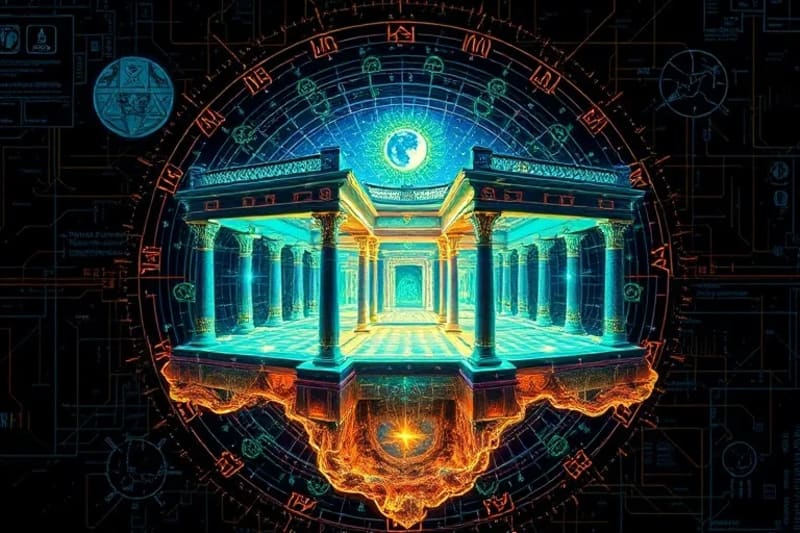
An illustrative diagram detailing the geomantic energy flows within a sacred architectural space.
Key principles of urban geomancy include the concept of the "dragon and tiger" (representing mountainous terrain and flowing water, respectively, in Feng Shui), which dictate the protective and nourishing qualities of a site. The orientation of city gates, the placement of central squares, and the curvature of streets are all designed to channel positive energy throughout the urban fabric. The integration of nature, through parks, gardens, and water features, is also paramount, as natural elements are seen as conduits and regulators of Earth energies. For a deeper understanding of how planetary cycles influence global trends, one might explore Mundane Astrology Planetary Cycles.
Sacred Structures: Architectural Manifestations
Sacred structures are not merely buildings; they are conceived as conduits between the earthly and the divine, designed to facilitate spiritual experiences and energetic transformation. From the megalithic circles of Stonehenge to the soaring cathedrals of Europe, the meticulously planned temples of ancient Egypt, and the intricate pagodas of Asia, these edifices embody profound cosmological understanding. Their architecture is often a physical manifestation of sacred geometry, celestial alignments, and geomantic principles.
The orientation of sacred buildings is frequently aligned with solstices, equinoxes, or specific stellar risings, connecting the structure to the grand cosmic clock. The dimensions and proportions of these buildings often adhere to sacred ratios, such as the Golden Ratio (Phi) or specific numerical sequences, believed to resonate with universal harmony. Materials used in their construction are carefully chosen for their energetic properties, and even the sounds and light within these spaces are often designed to evoke particular states of consciousness.
In many traditions, sacred structures are placed at sites identified as powerful energy nodes or confluences of ley lines. These locations are believed to amplify spiritual practices and create a potent field for healing, meditation, and communion with higher realms. The architectural design then serves to focus, channel, and radiate these energies, creating an environment that is both physically and spiritually uplifting. The study of Psycho-Astrology Archetypal Psychology Jungian Shadow Natal Chart Wholeness further illuminates the archetypal narratives embedded within such designs.
Interweaving Celestial Rhythms and Earth Energies
The true mastery of mystical architecture lies in the seamless integration of lunar mansion influences with urban geomancy. This holistic approach ensures that a structure or urban layout is not only grounded in the Earth's energies but also attuned to the dynamic rhythms of the cosmos. For example, a city planner might identify a site with strong, beneficial telluric currents through geomantic analysis. Then, they would consult the lunar mansions to determine the most auspicious time to lay the foundation or to dedicate specific areas for particular functions.
Consider a temple dedicated to healing. Geomantically, it would be placed on a site known for its restorative energies, perhaps near a natural spring or a confluence of beneficial ley lines. Architecturally, its design might incorporate elements that reflect the nurturing qualities of certain lunar mansions, enhancing its intended purpose. The orientation of its main altar could be aligned not just with the cardinal directions but also with the rising point of a specific star associated with a healing Nakshatra during a significant lunar phase.
This interweaving creates a multi-layered energetic resonance. The Earth provides the foundational stability and vitality, while the Moon's journey through its mansions offers a nuanced, ever-changing energetic overlay. This allows for the creation of spaces that are not static but dynamically responsive to cosmic influences, fostering environments that evolve with the celestial dance. The precision required for such alignment often involves complex calculations and deep intuitive understanding, passed down through generations of master builders and geomancers.
Historical Perspectives: Global Geomantic Traditions
Throughout history, diverse cultures across the globe have developed sophisticated systems for integrating celestial and terrestrial energies into their built environments. These traditions, while distinct in their methodologies, share a common understanding of the universe as an interconnected, living entity.
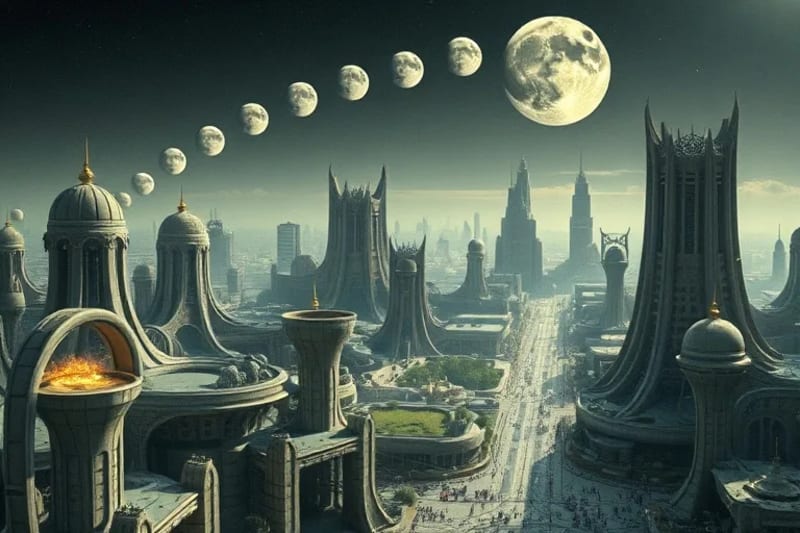
A vision of future urban design, harmonizing modern aesthetics with ancient geomantic and celestial principles.
- Ancient China: Feng Shui is perhaps the most widely recognized system of geomancy, deeply integrated with the Chinese lunar calendar and the 28 Xiu (lunar mansions). Cities like Beijing were meticulously planned according to Feng Shui principles, with the Forbidden City at its energetic heart, aligned with cardinal directions and protected by surrounding natural features.
- Vedic India: Vastu Shastra provides guidelines for architectural design and city planning based on cosmic energies, planetary influences, and the 27 Nakshatras. Temples and homes are oriented to maximize beneficial energy flow, and specific rooms are designated based on the energetic qualities of directions and celestial timings.
- Islamic Civilizations: The Manazil al-Qamar (lunar mansions) played a crucial role in navigation, agriculture, and divination. While less explicitly tied to urban planning than Feng Shui or Vastu, the principles of sacred geometry and celestial orientation were fundamental in the design of mosques, madrasas, and even entire cities like Baghdad, which was designed as a perfect circle.
- Pre-Columbian Americas: Civilizations like the Maya, Aztec, and Inca demonstrated profound astronomical knowledge, aligning their pyramids, observatories, and urban centers with celestial events, including lunar cycles. Chichen Itza and Teotihuacan are prime examples of cities built with precise astronomical and geomantic considerations.
- Ancient Europe: Megalithic structures like Stonehenge and Newgrange showcase an advanced understanding of celestial mechanics, particularly solar and lunar cycles. Later, medieval cathedrals were often built on ancient sacred sites, incorporating geomantic principles and astrological symbolism into their design and orientation.
These historical examples underscore a universal human endeavor to create living spaces that resonate with the greater cosmos, fostering harmony between humanity, Earth, and the heavens. The wisdom embedded in these traditions offers invaluable insights for contemporary design. For those interested in personal energetic alignment, exploring Astrology Crystal Grids can provide complementary practices.
Modern Interpretations and Future Urbanism
In the contemporary world, there is a growing recognition of the impact of built environments on human well-being. This has led to a resurgence of interest in ancient geomantic principles, though often reinterpreted through a modern lens. Sustainable architecture, biophilic design, and eco-cities all strive to create environments that are in harmony with nature, echoing many of the core tenets of urban geomancy.
While direct application of lunar mansion astrology in mainstream urban planning remains niche, the underlying philosophy of attuning human habitats to natural rhythms is gaining traction. Architects and designers are increasingly incorporating elements like natural light cycles, material sourcing that respects local ecosystems, and layouts that promote positive social interaction and energy flow. The concept of "energetic architecture" is emerging, where buildings are designed not just for function and aesthetics but also for their subtle energetic impact on occupants.
Future urbanism could see a more explicit integration of these mystical principles. Imagine cities where public spaces are designed to align with auspicious lunar mansion energies for community gatherings, or where residential zones are oriented to optimize personal well-being based on individual astrological charts. The use of advanced computational tools and AI could potentially map subtle energy fields and celestial influences with unprecedented precision, allowing for the creation of truly "smart" and cosmically aligned cities. This could even extend to fields like AI Oneiromancy, where algorithms decode complex symbolic data for holistic urban planning.
Challenges, Skepticism, and the Enduring Legacy
Despite the rich historical evidence and growing contemporary interest, the integration of lunar mansions and urban geomancy into mainstream architectural and urban planning practices faces significant challenges. Skepticism from conventional scientific paradigms often dismisses these concepts as pseudoscientific or superstitious, lacking empirical validation through modern scientific methods. The subtle nature of energetic influences makes them difficult to measure with current instrumentation, leading to a divide between empirical and experiential knowledge.
Another challenge lies in the complexity and cultural specificity of these traditions. Translating ancient, often esoteric knowledge systems into a universally applicable framework for diverse modern contexts requires careful interpretation and adaptation. The loss of traditional knowledge and the fragmented understanding of these practices also pose hurdles. Furthermore, the economic pressures of modern development often prioritize cost-efficiency and speed over meticulous, time-consuming geomantic analyses.
Nevertheless, the enduring legacy of mystical architecture persists. The undeniable sense of peace, harmony, and spiritual upliftment experienced in well-designed sacred spaces, regardless of one's belief system, speaks to the inherent wisdom embedded in these practices. As humanity seeks more sustainable, holistic, and human-centered approaches to living, the principles of lunar mansions and urban geomancy offer a profound blueprint for creating environments that nourish not just the body but also the soul, reconnecting us to the cosmic dance from which we emerged.
Explore Further: Related Insights
-
Metal Snake Horoscope: Traits & Destiny Unveiled
Dive into the unique characteristics and destiny of the Metal Snake in Chinese astrology. -
Akashic Records: Soul's Blueprint, Past Lives
Uncover the cosmic library holding the entire history of every soul. -
Relationship Red Flags Synastry Charts: Spotting Warning Signs
Learn to identify potential challenges in relationships through astrological synastry. -
Advanced Draconic Astrology: Soul's Destiny & Reincarnations
Explore the deeper spiritual path and karmic lessons revealed by Draconic charts. -
Nostradamus Astrology Prophecies: Influence, Interpretation, Legacy
Delve into the astrological underpinnings of Nostradamus's famous predictions.
Source: Hybrid content assisted by AI and human editorial supervision.


Comments
Post a Comment