
Remedial Astro-Herbalism: Botanical Alignments Planetary Transits
In an increasingly complex world, the pursuit of holistic well-being often leads us to explore ancient wisdom traditions that offer integrated approaches to health. Remedial astro-herbalism stands as a profound example, merging the celestial insights of astrology with the healing power of botanical medicine. This practice posits that planetary movements and their energetic influences directly impact our physical, emotional, and spiritual states, and that specific herbs can be aligned with these cosmic energies to restore balance.
This article delves into the foundational principles of astro-herbalism, exploring its historical context, the intricate correspondences between planets and plants, and practical applications for navigating challenging planetary transits. By understanding these alignments, individuals can proactively support their well-being during periods of cosmic intensity, transforming potential challenges into opportunities for growth and healing.

A visual representation of the harmonious blend between celestial energies and vibrant botanical elements, illustrating the core concept of astro-herbalism.
Table of Contents
- Understanding Astro-Herbalism: A Synergistic Approach
- Historical Roots and Philosophical Foundations
- Key Principles of Planetary-Herbal Correspondence
- Identifying Challenging Planetary Transits
- Crafting Botanical Alignments for Remediation
- Practical Application and Ethical Considerations
- The Future of Astro-Herbalism in Holistic Wellness
Understanding Astro-Herbalism: A Synergistic Approach
Astro-herbalism is not merely the casual pairing of an herb with a zodiac sign; it is a sophisticated system that interprets the energetic qualities of planets, signs, and houses within an astrological chart and matches them with the energetic and medicinal properties of plants. This practice operates on the Hermetic principle of "As Above, So Below," suggesting a profound interconnectedness between cosmic phenomena and terrestrial life.
The core idea is that each planet, zodiac sign, and astrological house governs specific aspects of human experience, including physical organs, emotional states, personality traits, and life circumstances. Similarly, every plant possesses unique medicinal properties, energetic signatures, and affinities with certain elements or planetary rulers. By carefully analyzing an individual's natal chart and current planetary transits, an astro-herbalist can identify areas of imbalance or stress and recommend specific herbs to counteract or support these energies.
This holistic perspective extends beyond symptomatic relief, aiming to address the root energetic cause of an imbalance. For instance, a challenging Mars transit might manifest as inflammation or anger, leading an astro-herbalist to suggest cooling, calming herbs ruled by Venus or the Moon, rather than simply suppressing the symptoms. The goal is to harmonize the individual's internal energetic landscape with the external cosmic influences.
Historical Roots and Philosophical Foundations
The practice of astro-herbalism boasts a rich history, tracing its origins back to ancient civilizations that viewed the cosmos and nature as inseparable entities. Early Mesopotamian, Egyptian, Greek, and Roman cultures all integrated astrological observations with their medicinal practices. Physicians and healers of these eras were often also astrologers, believing that the stars held clues to both diagnosis and treatment.
One of the most influential figures in the development of Western astro-herbalism was the Greek physician Claudius Galen (2nd century CE), whose humoral theory linked bodily fluids to planetary influences. Later, during the Renaissance, figures like Paracelsus and Nicholas Culpeper further codified these correspondences. Culpeper's "The English Physitian" (1652) remains a seminal text, detailing hundreds of herbs and their planetary rulerships, making astrological medicine accessible to the common person.
These historical traditions underscore a fundamental philosophical premise: humanity is a microcosm reflecting the macrocosm of the universe. Illness was often seen as a disharmony between these two realms, and healing involved restoring that cosmic balance through natural remedies. This perspective contrasts sharply with modern reductionist medicine, offering a profound depth to understanding health and disease.
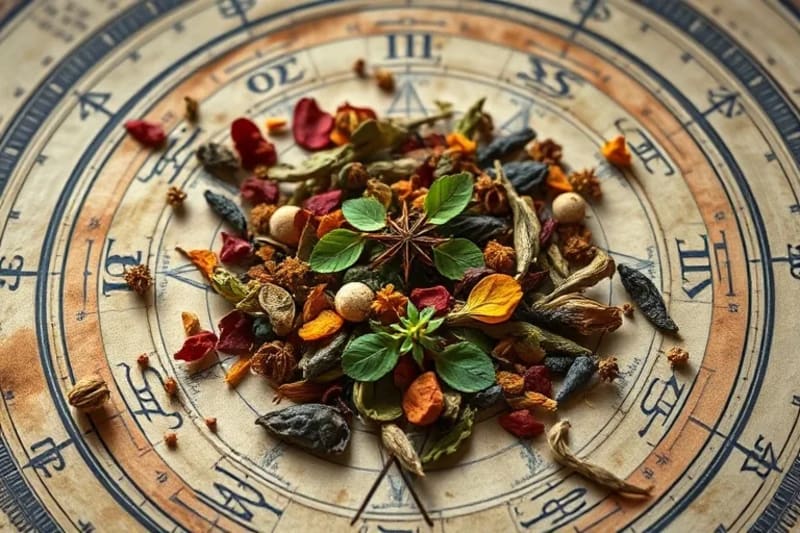
A detailed macro shot showcasing various dried medicinal herbs meticulously arranged on an ancient astrological chart, symbolizing their planetary alignments.
Key Principles of Planetary-Herbal Correspondence
The heart of astro-herbalism lies in its intricate system of correspondences. Each planet is associated with specific qualities, body parts, emotions, and even colors or flavors, which are then mirrored in the plant kingdom. Understanding these connections is crucial for effective remedial work.
Here is a simplified overview of planetary correspondences:
- Sun: Rules the heart, spine, vitality, ego. Herbs are often warming, strengthening, and yellow/orange (e.g., St. John's Wort, Calendula).
- Moon: Governs emotions, stomach, fluids, intuition. Herbs are cooling, moistening, calming (e.g., Chamomile, Lemon Balm, Mugwort).
- Mercury: Associated with communication, nervous system, lungs, intellect. Herbs support mental clarity and nerve function (e.g., Lavender, Valerian, Gotu Kola).
- Venus: Rules beauty, love, kidneys, skin, throat. Herbs are often pleasant-tasting, nourishing, and promote harmony (e.g., Rose, Damiana, Licorice).
- Mars: Linked to energy, aggression, muscles, blood, inflammation. Herbs are often stimulating, pungent, or cooling to inflammation (e.g., Cayenne, Garlic, Nettle, Dandelion).
- Jupiter: Governs expansion, liver, prosperity, wisdom. Herbs support liver function and overall well-being (e.g., Dandelion Root, Burdock, Milk Thistle).
- Saturn: Associated with structure, bones, teeth, discipline, limitations. Herbs are often astringent, grounding, and support skeletal health (e.g., Horsetail, Comfrey, Solomon's Seal).
- Uranus: Rules sudden change, nervous shocks, innovation. Herbs for nervous system support and adaptability (e.g., Skullcap, Passionflower).
- Neptune: Linked to spirituality, dreams, confusion, lymphatic system. Herbs for clarity, detoxification, and spiritual connection (e.g., Kava, Blue Lotus).
- Pluto: Governs transformation, regeneration, hidden power. Herbs for deep cleansing and profound change (e.g., Reishi Mushroom, Pau d'Arco).
These correspondences are not rigid but dynamic, taking into account the plant's growth habit, taste, scent, color, and traditional uses. For a deeper dive into these connections, exploring resources on Tarot Quantum Mechanics Intersecting Divination Reality can provide further insights into the underlying energetic patterns.
Identifying Challenging Planetary Transits
Planetary transits refer to the current movements of planets across the sky and how they interact with the positions of planets in an individual's natal chart. While all transits bring lessons, some are inherently more challenging, often manifesting as periods of stress, conflict, or profound transformation. These challenging aspects typically include squares (90-degree angles), oppositions (180-degree angles), and certain conjunctions, especially involving outer planets or malefic planets like Mars and Saturn.
Common challenging transits and their potential effects:
- Saturn Transits (e.g., Saturn Square Sun): Can bring feelings of restriction, burden, self-doubt, or physical fatigue. It often highlights areas where more discipline or structure is needed.
- Mars Transits (e.g., Mars Opposition Venus): May manifest as increased conflict, anger, impulsivity, or physical inflammation and injuries. It can stir up passions but also aggression.
- Uranus Transits (e.g., Uranus Square Moon): Often brings sudden, disruptive changes, emotional instability, anxiety, or a strong urge for freedom that can feel unsettling.
- Neptune Transits (e.g., Neptune Conjunct Sun): Can lead to confusion, disillusionment, escapism, or a weakening of boundaries and vitality. It may also heighten spiritual sensitivity.
- Pluto Transits (e.g., Pluto Square Ascendant): Typically involves profound transformation, power struggles, psychological crises, or a forced confrontation with hidden truths. These transits are intense but ultimately regenerative.
Understanding which planets are involved and the houses they rule in your natal chart provides specific context for these challenges. For example, a Saturn transit through the 6th house (health and daily routine) might manifest as chronic fatigue or a need to restructure daily habits. This detailed analysis forms the basis for selecting appropriate herbal remedies.
Crafting Botanical Alignments for Remediation
Once a challenging transit is identified, the astro-herbalist selects herbs whose energetic and medicinal properties can either mitigate the harshness of the transit or support the individual in navigating its lessons. The approach can be either "contrary" (using an herb with opposing energy to balance) or "supportive" (using an herb that strengthens the affected planetary principle).
Examples of botanical alignments for challenging transits:
- For Challenging Saturn Transits (Restriction, Fatigue):
- Supportive: Horsetail (Equisetum arvense) for bone and connective tissue support (Saturn rules structure).
- Contrary: Lemon Balm (Melissa officinalis) for emotional uplift and nervous system support (Moon/Jupiter influence to counter Saturn's heaviness).
- For Challenging Mars Transits (Anger, Inflammation):
- Supportive: Garlic (Allium sativum) for blood purification and immune boost (Mars rules blood).
- Contrary: Rose (Rosa spp.) for cooling inflammation and promoting emotional calm (Venus influence to soothe Mars' aggression).
- For Challenging Uranus Transits (Anxiety, Disruption):
- Supportive: Skullcap (Scutellaria lateriflora) for nervous system relaxation and stability.
- Contrary: Chamomile (Matricaria chamomilla) for gentle calming and emotional soothing (Moon influence to ground erratic Uranus energy).
- For Challenging Neptune Transits (Confusion, Escapism):
- Supportive: Reishi Mushroom (Ganoderma lucidum) for immune support and grounding spiritual experiences.
- Contrary: Rosemary (Rosmarinus officinalis) for mental clarity and focus (Sun/Mercury influence to cut through Neptunian fog).
- For Challenging Pluto Transits (Transformation, Intensity):
- Supportive: Dandelion Root (Taraxacum officinale) for deep detoxification and liver support (Pluto's transformative cleansing).
- Contrary: Hawthorn (Crataegus spp.) for heart support and emotional resilience during intense periods (Sun/Venus influence for strength and love).
The selection also considers the individual's constitution, existing health conditions, and personal preferences. An experienced astro-herbalist will often combine several herbs into a synergistic formula to address multiple layers of influence.
A symbolic digital painting of a figure finding solace and balance through an herbal sachet, set against a backdrop of dynamic and challenging cosmic transits.
Practical Application and Ethical Considerations
Engaging with remedial astro-herbalism requires a thoughtful and informed approach. While the principles are ancient, modern practice integrates scientific understanding of herbal constituents with traditional wisdom. It is essential to consult with qualified practitioners for both astrological interpretation and herbal recommendations, especially when dealing with chronic conditions or medications.
Key considerations for practical application:
- Professional Consultation: Seek guidance from certified astrologers and clinical herbalists who specialize in astro-herbalism. They can provide personalized chart readings and safe, effective herbal protocols.
- Quality Sourcing: Ensure herbs are sourced from reputable suppliers, preferably organic and sustainably harvested, to maximize their potency and minimize environmental impact.
- Dosage and Preparation: Adhere to recommended dosages and preparation methods (tinctures, teas, capsules, poultices) as advised by a professional.
- Individual Sensitivity: Pay attention to your body's response. Not all herbs are suitable for everyone, and individual sensitivities or allergies must be considered.
- Integration with Conventional Medicine: Astro-herbalism should complement, not replace, conventional medical care. Always inform your primary healthcare provider about any herbal remedies you are using.
The ethical dimension also extends to respecting plant wisdom and the environment. Sustainable harvesting practices and a deep reverence for the plant kingdom are integral to the philosophy of astro-herbalism. This approach encourages a conscious relationship with nature and the cosmos, fostering a sense of interconnectedness and responsibility.
The Future of Astro-Herbalism in Holistic Wellness
As interest in holistic and personalized medicine grows, remedial astro-herbalism is experiencing a resurgence. Modern practitioners are blending traditional knowledge with contemporary scientific research, exploring the biochemical mechanisms behind herbal actions and validating ancient wisdom through new lenses. The integration of technology, such as advanced astrological software and databases of herbal properties, is also making this complex field more accessible and precise.
The ability of astro-herbalism to offer deeply personalized remedies, tailored to an individual's unique cosmic blueprint and current life cycles, positions it as a powerful tool for preventative health and profound healing. It encourages self-awareness, connecting individuals to the rhythms of the universe and empowering them to take an active role in their own well-being. By embracing this ancient yet ever-relevant practice, we can cultivate a more harmonious relationship with ourselves, our planet, and the stars above.
Source: AI-assisted hybrid content with human editorial oversight.


Comments
Post a Comment