
Astral Projection: Safely Exploring Consciousness | StarPluto
Astral projection, often referred to as an out-of-body experience (OBE), is a fascinating and ancient practice that involves the conscious separation of the astral body from the physical body. This phenomenon has been documented across various cultures and spiritual traditions throughout history, offering individuals a unique perspective on consciousness and reality.
For many, the idea of leaving the physical body behind to explore other realms can be both alluring and intimidating. This guide aims to demystify astral projection, providing an introductory and educational overview of what it entails, the techniques involved, and crucial safety considerations. Our approach is grounded in a balanced perspective, acknowledging both historical accounts and modern interpretations, while emphasizing a responsible and informed exploration of this esoteric practice.

The ethereal form of the astral body, connected to its physical counterpart by a shimmering silver cord, embarking on a journey beyond the material plane.
The concept of astral projection touches upon fundamental questions about the nature of the self, consciousness, and existence beyond the material world. It suggests that our awareness is not solely confined to the brain but can operate independently, traversing dimensions unseen by the physical eye. Understanding these principles is the first step towards a meaningful engagement with astral travel.
This exploration will navigate the historical context, the scientific discussions, practical techniques, and the benefits reported by practitioners. We will also address the common fears and provide guidance on how to approach this experience with confidence and peace of mind. By the end, readers will have a foundational understanding of astral projection and the tools to begin their own safe and conscious exploration.
Table of Contents
- What is Astral Projection?
- The Science and Skepticism Behind OBEs
- Techniques for Inducing Astral Projection
- Ensuring Safety During Astral Travel
- Benefits and Potential Insights from Astral Projection
- Common Experiences and Misconceptions
What is Astral Projection?
Astral projection is the experience of the consciousness, often referred to as the "astral body," separating from the physical body and traveling independently. This astral body is believed to be an energetic duplicate of the physical form, capable of moving through space and time, and interacting with what is known as the astral plane.
Unlike lucid dreaming, where one is aware of dreaming and can control the dream narrative, astral projection is often described as feeling more real than waking life. The individual perceives themselves as being fully conscious and present, but detached from their physical body, which remains in a state of deep relaxation or sleep. This distinction is crucial for understanding the unique nature of OBEs.
Historically, references to out-of-body experiences can be found in ancient Egyptian texts, where the concept of the "Ka" or "Ba" (soul or spirit) leaving the body was central to their beliefs about the afterlife. In various shamanic traditions, practitioners undertake journeys to other realms to gain knowledge or healing, which closely align with descriptions of astral travel. Eastern philosophies, particularly Hinduism and Buddhism, also speak of subtle bodies and planes of existence beyond the physical.
The astral plane itself is often described as a non-physical dimension existing parallel to our physical world, composed of energy and thought forms. It is believed to be inhabited by various entities, including spirits, thought-forms, and other astral travelers. Understanding this conceptual framework helps contextualize the experiences reported by those who successfully achieve astral projection.
The experience typically begins with a state of deep relaxation, often accompanied by strong vibrations or a sensation of floating. As the separation occurs, individuals might feel a "pop" or a surge of energy, followed by the sensation of being outside their body, observing it from a different vantage point. The clarity and vividness of these experiences are often reported as astonishing.
The Science and Skepticism Behind OBEs
While anecdotal evidence for astral projection is abundant, scientific research into the phenomenon remains limited and largely inconclusive. Mainstream science often attributes OBEs to neurological or psychological factors rather than actual out-of-body travel. These explanations typically involve states of altered consciousness, sleep paralysis, or hypnagogic and hypnopompic hallucinations.

An antique journal, astrolabe, and flickering candle symbolize the historical pursuit of esoteric knowledge and consciousness exploration.
Sleep paralysis, a temporary inability to move or speak while falling asleep or waking up, is frequently accompanied by vivid, often frightening, hallucinations. Researchers suggest that some OBEs might be a benign interpretation of these sensations, where the mind, unable to reconcile the body's immobility with its waking awareness, creates the illusion of separation.
Neuroscientific studies have explored brain activity during reported OBEs, with some findings suggesting involvement of the temporoparietal junction, a region of the brain involved in integrating sensory information and body awareness. Stimulation of this area in laboratory settings has been shown to induce sensations similar to out-of-body experiences in some individuals.
Parapsychological research, however, attempts to investigate OBEs as genuine non-physical phenomena. Studies conducted by institutions like the Monroe Institute have explored the use of binaural beats and other audio technologies to induce and study OBEs, with some participants reporting verifiable perceptions of distant targets while out of their bodies. These studies, while intriguing, are often met with skepticism due to methodological challenges and the difficulty of replication.
It is important to approach these discussions with an open yet critical mind. While scientific explanations offer valuable insights into the neurological underpinnings of consciousness, they do not necessarily negate the subjective reality and profound impact that OBEs have on individuals. The scientific community continues to explore the mysteries of consciousness, and astral projection remains a topic of ongoing debate and personal exploration.
Techniques for Inducing Astral Projection
Inducing astral projection requires patience, practice, and a conducive environment. The core principle involves achieving a state of deep physical relaxation while maintaining full mental awareness. This delicate balance allows the consciousness to disengage from the physical body.
Deep Relaxation and Meditation: Begin by finding a quiet, comfortable space where you won't be disturbed. Lie down and systematically relax every part of your body, from your toes to your head. Focus on your breath, allowing your body to sink deeper into relaxation. This is similar to a deep meditative state, where the body is asleep but the mind is awake.
The "Vibration Method": As you reach a deep state of relaxation, you might begin to experience strong vibrations throughout your body. These are often described as a buzzing, tingling, or electrical sensation. Instead of resisting them, allow them to intensify. Focus on these vibrations and mentally encourage them to spread throughout your entire being. This phase is often seen as a precursor to separation.
The "Rope Technique": Once the vibrations are strong, visualize a rope hanging above you. Mentally "climb" this rope, using only your awareness, not your physical body. Imagine yourself pulling yourself up, hand over hand, feeling the sensation of rising. This visualization helps to dislodge the astral body from the physical.
Visualization Exercises: Another effective technique involves visualizing yourself floating out of your body. Imagine yourself gently lifting upwards, perhaps hovering above your bed, looking down at your physical form. Maintain this visualization with unwavering focus and belief.
Affirmations and Intent: Before beginning any practice, set a clear intention to astral project safely and consciously. Use affirmations such as "I will safely project my consciousness tonight" or "I am capable of exploring beyond my body." A strong, positive intent can significantly influence the outcome.
Consistency is key. Many individuals report that their first successful projection occurs after weeks or even months of consistent practice. It's also common for experiences to happen spontaneously during hypnagogic states (the transition from wakefulness to sleep) or hypnopompic states (the transition from sleep to wakefulness), as these are natural states of altered consciousness.
Ensuring Safety During Astral Travel
Safety is a paramount concern for anyone exploring astral projection. While many practitioners assert that it is inherently safe, taking precautions can enhance peace of mind and ensure a positive experience. The concept of the "silver cord" is central to understanding safety in astral travel.
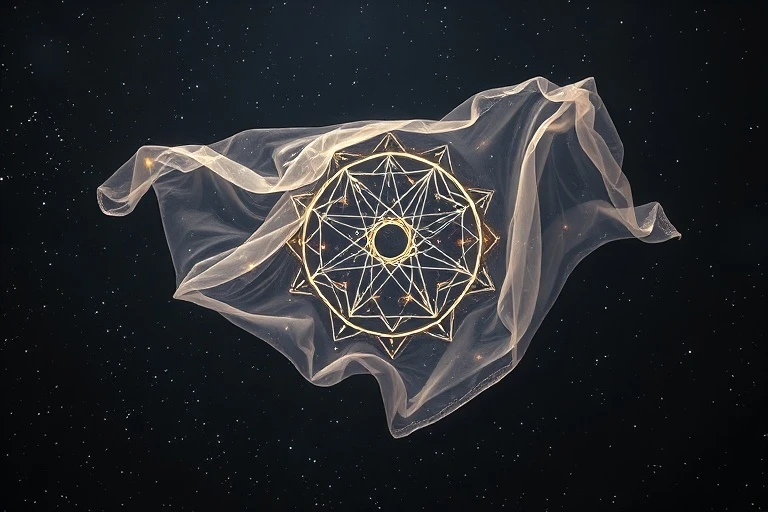
A shimmering veil, adorned with subtle geometric designs, symbolizes the delicate boundary separating our physical reality from the expansive astral dimensions.
The silver cord is an energetic link, described as a flexible, luminous cord, that connects the astral body to the physical body. It is believed to be unbreakable during a projection and acts as an anchor, ensuring that the astral body can always return to its physical counterpart. This cord is often cited as the primary reason why astral projection is considered safe, as it prevents permanent separation.
Protection Techniques:
Mental Shielding: Before attempting projection, visualize a protective shield or bubble of white light surrounding your physical body and your astral self. Affirm that only positive energies and experiences are allowed to interact with you.
Positive Intent: Always approach astral projection with a positive and clear intention. Focus on exploration, learning, and spiritual growth, rather than seeking out negative or fear-inducing experiences.
Grounding: After returning from a projection, take time to fully ground yourself. This can involve eating a light meal, walking barefoot on the earth, or focusing on physical sensations. Grounding helps integrate the experience and re-establish full connection to the physical world.
Avoiding Fear: Fear is often the biggest obstacle and potential source of negative experiences. Understand that you are always connected to your body and can return instantly by simply thinking about it. Cultivate a mindset of curiosity and courage.
While encounters with other entities on the astral plane are sometimes reported, most experienced practitioners advise maintaining a neutral and non-reactive stance. Your intention and emotional state act as a filter for your experiences. By focusing on light and positive energy, you are more likely to attract similar experiences.
Benefits and Potential Insights from Astral Projection
Beyond the sheer novelty of the experience, astral projection is often reported to offer profound benefits and insights that can significantly impact an individual's life. These benefits extend to personal growth, spiritual understanding, and a broader perspective on existence.
Expanded Consciousness: The most frequently cited benefit is an expansion of consciousness. Experiencing oneself outside the physical body can lead to a realization that consciousness is not limited to the brain, fostering a deeper understanding of one's true nature and potential.
Overcoming Fear of Death: Many who have experienced OBEs report a significant reduction or complete elimination of the fear of death. The direct experience of consciousness existing independently of the physical body can provide a powerful sense of continuity and reassurance about life beyond physical demise.
Spiritual Exploration and Growth: Astral projection can facilitate direct spiritual experiences, allowing individuals to explore different planes of existence, encounter spiritual guides, or gain insights into universal truths. This can accelerate spiritual development and provide a sense of purpose and connection.
Enhanced Intuition and Creativity: The act of consciously navigating non-physical realms can sharpen intuitive abilities and foster creativity. Insights gained during astral travel can translate into new perspectives, problem-solving skills, and artistic inspiration in waking life.
Self-Discovery and Healing: By observing oneself and one's life from a detached, higher perspective, individuals can gain clarity on personal issues, emotional blockages, and life paths. Some report profound healing experiences, both emotional and energetic, during their astral journeys.
The insights gained from astral projection are deeply personal and subjective, yet consistently point towards a greater understanding of the interconnectedness of all things. It offers a direct pathway to experiential knowledge that can complement and enrich intellectual and spiritual pursuits.
Common Experiences and Misconceptions
First-time astral travelers often report a range of common experiences and sensations, which can be both exhilarating and disorienting. Understanding these can help prepare individuals for their own journeys and alleviate potential fears.
Sensations During Separation: Many describe a feeling of intense vibrations, a rushing sound, or a sensation of falling or floating. Some report a "pop" sound or feeling as the final separation occurs. These physical sensations are often the most challenging part for beginners, as the natural inclination is to react or become startled, which can pull one back into the physical body.
Initial Perceptions: Upon separation, it's common to find oneself hovering near the physical body, often observing the room from a slightly elevated position. The environment might appear more vibrant, clearer, or slightly distorted than in waking life. Some report seeing their physical body asleep below them, which can be a surreal and profound experience.
Meeting Entities: The astral plane is believed to be populated by various beings, including other astral travelers, spirit guides, and elemental entities. Encounters can range from benevolent and enlightening to neutral or even unsettling. It's important to maintain a calm and assertive demeanor, and to remember that your intention and energetic frequency largely determine the nature of your interactions.
Visiting Places: Astral travelers often report visiting familiar places, such as their homes or local areas, but also distant locations or even entirely different dimensions. The ability to "travel" instantaneously by thought is a common feature. Some use astral projection to revisit past memories or explore potential future scenarios.
Common Misconceptions:
Getting Lost: The silver cord ensures you are always connected to your physical body, making it impossible to get permanently lost. A simple thought of returning is usually enough to bring you back.
Possession: The idea of another entity taking over your physical body while you are out is a common fear, but widely considered a misconception by experienced practitioners. Your physical body is protected by your own energetic presence and the silver cord.
Death: Astral projection is not death. It is a temporary separation of consciousness from the physical body, a natural process that occurs daily during sleep, though usually unconsciously.
By understanding these aspects, individuals can approach astral projection with greater confidence and curiosity, transforming potential fears into opportunities for profound exploration and self-discovery. The journey beyond the physical body offers a unique lens through which to perceive reality and one's place within it.
Fuente: Contenido híbrido asistido por IAs y supervisión editorial humana.


Comments
Post a Comment