
Celestial Mechanics Planetary Stations Direct Retrograde | StarPluto
In the intricate dance of celestial bodies, planets appear to move across our sky in predictable patterns. However, from our Earth-bound perspective, these movements sometimes seem to defy logic, particularly when a planet appears to slow down, stop, and then move backward before resuming its forward course. These fascinating phenomena are known as direct motion, retrograde motion, and planetary stations, and they form a cornerstone of astrological interpretation.
Understanding the celestial mechanics behind these turning points is crucial for anyone seeking to deepen their grasp of astrology. This comprehensive guide will delve into the astronomical realities that create these apparent motions and explore their profound astrological significance, offering insights into how these cycles influence our lives and the collective consciousness.
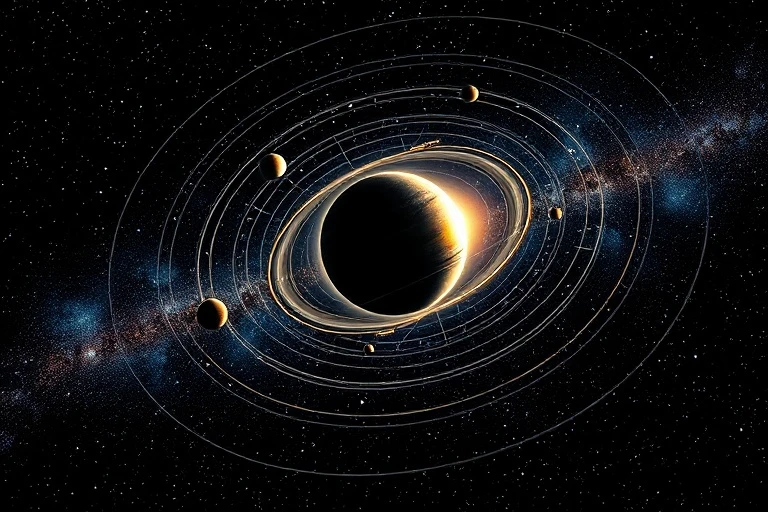
A grand cosmic ballet illustrating the complex orbital paths that give rise to perceived direct and retrograde planetary movements.
Table of Contents
- Understanding Celestial Mechanics: The Illusion Explained
- Direct Motion: The Standard Journey
- Retrograde Motion: The Period of Reflection
- Planetary Stations: The Pivotal Turning Points
- Astrological Significance of Stations
- Major Planets and Their Retrograde Cycles
- Impact on Natal Charts and Transits
- Navigating Planetary Cycles: Practical Wisdom
Understanding Celestial Mechanics: The Illusion Explained
To comprehend planetary stations and retrograde motion, it's essential to first grasp the difference between a heliocentric and geocentric perspective. Astronomically, we know that planets orbit the Sun (heliocentric model). However, astrology traditionally uses a geocentric model, interpreting planetary movements as observed from Earth.
Retrograde motion is an optical illusion caused by the differing orbital speeds of planets relative to Earth. Imagine two cars on a multi-lane highway: if your car is in the inner lane and moving faster, the car in the outer lane will appear to fall behind you. Similarly, when Earth overtakes a slower-moving outer planet (like Mars, Jupiter, or Saturn), or when an inner planet (like Mercury or Venus) overtakes Earth, the slower planet appears to move backward against the backdrop of fixed stars.
This phenomenon is purely an apparent motion, not an actual reversal of a planet's orbit. The planets always continue their elliptical paths around the Sun. The "backward" movement is merely a trick of perspective from our vantage point on Earth.
Direct Motion: The Standard Journey
Direct motion, also known as prograde motion, is the normal, forward movement of a planet through the zodiac. This is the default state for all planets as they orbit the Sun. From an astrological perspective, direct motion signifies a period of outward expression, progress, and clarity related to the planet's energies.
When a planet is direct, its influence is generally considered straightforward and unhindered. For example, Mercury direct supports clear communication and logical thinking, while Mars direct encourages decisive action and assertive energy. This is a time when the themes associated with that planet tend to manifest externally and move forward with relative ease.
- Forward Momentum: Direct motion is associated with advancement and development.
- External Manifestation: Planetary energies are expressed outwardly and visibly.
- Clarity and Flow: Themes related to the planet tend to be clearer and flow more smoothly.
- Action-Oriented: Favorable for initiating new projects, relationships, or endeavors.
Retrograde Motion: The Period of Reflection
Retrograde motion is perhaps the most discussed and often misunderstood planetary phenomenon in astrology. As explained, it's an optical illusion where a planet appears to move backward in the sky. Astrologically, this apparent reversal signifies a shift from outward expression to inward reflection and re-evaluation.
During a retrograde period, the energies of the planet are said to turn inward, prompting us to revisit, review, and reconsider matters related to that planet's domain. It's a time for introspection, inner work, and sometimes, for old issues or people to resurface. This is not necessarily a negative period, but rather an opportunity for deeper processing and integration.
An abstract digital painting capturing the essence of retrograde motion as a period of deep introspection and internal re-evaluation.
For instance, Mercury retrograde is famously associated with communication breakdowns and technological glitches, but its deeper purpose is to encourage us to review our thoughts, words, and plans. Similarly, Venus retrograde might prompt a re-evaluation of relationships and values, while Mars retrograde could lead to a reassessment of our actions and desires.
It's crucial to dispel the myth that retrograde periods are inherently "bad." While they can bring challenges, these challenges often serve as catalysts for necessary internal adjustments and growth. They are periods designed for the "re-" words: review, revise, reflect, re-evaluate, reconnect, and reconsider.
Planetary Stations: The Pivotal Turning Points
Planetary stations are the moments when a planet appears to stand still in the sky before changing direction. These are the exact turning points between direct and retrograde motion, or vice versa. There are two types of stations:
- Station Retrograde (SR): When a planet slows down, stops, and begins its apparent backward motion.
- Station Direct (SD): When a planet slows down, stops, and begins its apparent forward motion.
Astronomically, a planet's speed relative to Earth reaches a point where its apparent motion along the ecliptic momentarily ceases. This "stillness" can last for a few hours to several days, depending on the planet. During this period, the planet's influence is considered to be highly concentrated and potent, acting as a fulcrum for change.
A dramatic 3D render depicting a planet at its station, appearing to pause before shifting direction, highlighting the intensity of these celestial turning points.
Astrological Significance of Stations
Astrologically, planetary stations are moments of heightened intensity and focus. The energy of the planet is not moving forward or backward but is "locked" in place, making its themes particularly pronounced and impactful. These periods often mark significant turning points or culminations in personal and collective experiences.
When a planet stations retrograde, it signals a powerful shift inward. It's a moment of decision or a strong pull to internalize the planet's themes, often leading to a deep re-evaluation that will unfold over the coming retrograde period. Conversely, when a planet stations direct, it marks the end of the introspective phase and the beginning of a renewed outward thrust. The lessons learned during the retrograde period are now ready to be integrated and applied in the external world.
The days surrounding a station are often felt more intensely than the middle of a retrograde period. Events or insights that occur during these stationary phases tend to be highly significant and can set the tone for the subsequent cycle. For example, a Mercury station direct might bring a sudden clarity or a breakthrough in communication after a period of confusion.
Major Planets and Their Retrograde Cycles
Each planet's retrograde cycle has its unique duration and astrological implications. Understanding these differences helps in navigating their influence.
| Planet | Approximate Retrograde Duration | Key Astrological Themes for Re-evaluation |
|---|---|---|
| Mercury | 3-4 times a year, for about 3 weeks each | Communication, thinking, learning, technology, travel, contracts. |
| Venus | Every 18 months, for about 6 weeks | Relationships, values, aesthetics, finances, self-worth. |
| Mars | Every 2 years, for about 2-3 months | Action, drive, assertiveness, courage, anger, sexual energy. |
| Jupiter | Once a year, for about 4 months | Growth, expansion, philosophy, beliefs, luck, higher education. |
| Saturn | Once a year, for about 4.5 months | Structure, discipline, responsibility, boundaries, karma, authority. |
| Uranus | Once a year, for about 5 months | Innovation, rebellion, freedom, sudden change, awakening. |
| Neptune | Once a year, for about 5 months | Spirituality, dreams, illusions, compassion, escapism, intuition. |
| Pluto | Once a year, for about 5-6 months | Transformation, power, death and rebirth, subconscious, control. |
The outer planets (Uranus, Neptune, Pluto) spend a significant portion of each year in retrograde motion. This means that many people will have these planets retrograde in their natal charts. Their influence is often more collective or generational, prompting society to re-evaluate broad themes over longer periods.
Impact on Natal Charts and Transits
Planetary stations and retrogrades manifest differently depending on whether they appear in your natal chart or as transiting events.
Natal Retrogrades: If a planet is retrograde in your birth chart, it suggests that the energies associated with that planet are processed more internally or unconventionally. Individuals with natal retrogrades often have unique perspectives or challenges related to those planetary themes. For example, a natal Mercury retrograde might indicate a person who thinks deeply before speaking, or who processes information in a non-linear way.
These natal positions do not imply a deficiency but rather a different mode of operation. The individual may need to "re-do" or "re-learn" certain lessons related to that planet throughout their life, often leading to profound wisdom and self-understanding. For more on this, you might explore Retrograde Planets: Karmic Lessons, Soul Growth.
Transiting Retrogrades: When a planet goes retrograde by transit, its influence is felt by everyone, though its impact will be most significant for those whose natal charts are directly aspected by the retrograde planet. These periods encourage collective and personal re-evaluation of the planet's themes.
For example, a transiting Mars retrograde might cause widespread frustration or a need to re-think aggressive strategies. A transiting Jupiter retrograde could prompt a re-evaluation of our beliefs and where we seek growth. The house and sign where the retrograde occurs in your personal chart will indicate the specific areas of life most affected.
Navigating Planetary Cycles: Practical Wisdom
Understanding direct motion, retrograde motion, and planetary stations offers a powerful framework for navigating life's cycles. Instead of fearing retrogrades, we can embrace them as opportunities for growth.
- During Direct Motion: This is an excellent time for initiating new projects, making definitive decisions, and moving forward with plans. The energy is expansive and outward-focused.
- During Retrograde Motion: Focus on introspection, review, and completion of existing tasks rather than starting new ones. It's a period for internal processing, healing, and gaining new perspectives.
- During Stationary Periods: These are highly potent times. Pay close attention to insights, challenges, or opportunities that arise. The energy is intense and can feel like a pause before a significant shift. Use this time for deep reflection and preparation for the upcoming change in direction.
By aligning with these celestial rhythms, we can work with the energetic currents rather than against them. This allows for more conscious decision-making and a deeper understanding of our personal and collective evolutionary journey.
Conclusion
The celestial mechanics of planetary stations, direct, and retrograde motion are not mere astronomical curiosities; they are fundamental components of astrological interpretation. These apparent shifts in planetary movement offer profound insights into the ebb and flow of energy, encouraging us to balance outward action with inward reflection.
By understanding these turning points, we gain a richer appreciation for the dynamic interplay between the cosmos and our human experience. Embracing these cycles allows us to navigate life with greater awareness, purpose, and a deeper connection to the universal rhythms that shape our reality.
Fuente: Contenido híbrido asistido por IAs y supervisión editorial humana.


Comments
Post a Comment