
Chinese Zodiac Baby Names: Elemental & Auspicious Meanings | StarPluto
Choosing a name for a newborn is a deeply significant act in many cultures, and in Chinese tradition, this process is imbued with layers of astrological and philosophical meaning. Far beyond mere aesthetics, a name is believed to profoundly influence an individual's destiny, personality, and fortune. The intricate system of Chinese zodiac baby names combines the characteristics of the birth year's animal sign with the principles of the Five Elements (Wu Xing), creating a personalized blueprint for auspicious living.
This comprehensive guide delves into the advanced aspects of selecting a Chinese zodiac baby name, moving beyond basic animal traits to explore the nuanced interplay of elements, lucky numbers, and character strokes. Understanding these principles allows parents to craft a name that not only sounds pleasant but also harmonizes with the child's innate energy, fostering balance, prosperity, and success throughout their life's journey.
Table of Contents
- Introduction to Chinese Zodiac Naming
- The Five Elements and Their Influence on Naming
- Elemental Characteristics and Name Selection
- Zodiac Animal Traits and Naming Strategies
- Auspicious Character Strokes and Phonetics
- Balancing Yin and Yang in Names
- Modern Applications and Cultural Sensitivity
- Conclusion
Introduction to Chinese Zodiac Naming
The Chinese zodiac, known as Sheng Xiao (生肖), is a repeating cycle of 12 years, with each year represented by an animal and its reputed attributes. This ancient system is not merely a calendar but a profound astrological framework that influences personality, relationships, and life paths. When it comes to naming children, the zodiac animal of their birth year serves as a foundational element, guiding the selection of characters that complement or enhance the animal's inherent qualities.
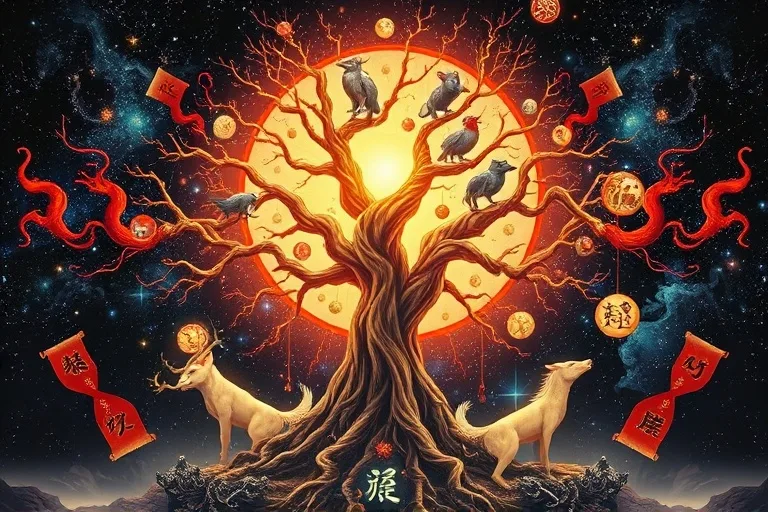 A digital illustration depicting the intricate connection between the cosmic elements, Chinese zodiac animals, and the ancient art of auspicious baby naming.
Beyond the animal sign, the Five Elements theory (Wu Xing) introduces another layer of complexity and personalization. Each zodiac year is also associated with one of the five elements: Wood, Fire, Earth, Metal, and Water. This elemental assignment further refines the child's energetic profile, suggesting specific character meanings, stroke counts, and even phonetic sounds that can create a harmonious or discordant influence. A name, therefore, becomes a carefully constructed talisman, designed to attract positive energy and mitigate potential challenges.
The Five Elements and Their Influence on Naming
The Five Elements theory is a cornerstone of Chinese philosophy, medicine, and astrology. It describes the cyclical interaction and transformation of Wood (木), Fire (火), Earth (土), Metal (金), and Water (水). Each element has specific attributes, colors, directions, seasons, and, crucially for naming, associated character radicals and meanings. Understanding these interactions—the productive cycle (e.g., Wood feeds Fire) and the destructive cycle (e.g., Water extinguishes Fire)—is paramount in selecting a name that supports the child's elemental birth chart.
When a child is born, their elemental affinity is determined by their birth year. For instance, a child born in a Wood Rat year will have a primary Wood element. The goal in naming is often to strengthen a weak element, balance an overbearing one, or introduce an element that is beneficial according to the productive cycle. This requires a deep understanding of the child's birth chart, which includes not only the year but also the month, day, and hour of birth, each with its own elemental associations.
 A visual representation of the Five Elements' essence through traditional Chinese art supplies, symbolizing their profound impact on name selection.
Elemental Characteristics and Name Selection
Each element carries a unique set of characteristics that can be reinforced or balanced through name choices. Parents often seek characters that contain radicals or meanings associated with a desired element. For example, a child with a weak Wood element might benefit from names containing characters like 林 (lín, forest), 森 (sēn, dense forest), or 杰 (jié, outstanding, often associated with trees).
According to the ancient text "Huangdi Neijing" (The Yellow Emperor's Classic of Internal Medicine), the Five Elements are not static entities but dynamic forces in constant flux, influencing all aspects of existence, including human constitution and destiny. "The five phases circulate and transform, each giving birth to the next, and each overcoming another. This is the constant way of Heaven and Earth, the principle of all things."
Below is a table summarizing the elemental characteristics and suggested naming approaches:
| Element | Key Attributes | Naming Strategy | Example Characters/Meanings |
|---|---|---|---|
| Wood (木) | Growth, creativity, kindness, flexibility | Strengthen growth, foster compassion. Use characters with wood radical or meanings. | 林 (forest), 森 (dense forest), 杰 (outstanding), 艺 (art, talent) |
| Fire (火) | Passion, energy, intelligence, leadership | Ignite ambition, enhance wisdom. Characters with fire radical or bright meanings. | 炎 (flame), 煜 (bright, shining), 耀 (glorious), 晶 (crystal, clear) |
| Earth (土) | Stability, reliability, nurturing, practicality | Grounding, promote steadfastness. Characters with earth radical or stable meanings. | 坤 (earth, female principle), 坚 (firm, strong), 培 (cultivate), 磊 (pile of stones, upright) |
| Metal (金) | Strength, determination, justice, clarity | Enhance resilience, foster integrity. Characters with metal radical or precious meanings. | 金 (gold, metal), 锐 (sharp, keen), 锋 (peak, sharp edge), 银 (silver) |
| Water (水) | Adaptability, wisdom, intuition, communication | Encourage flow, deepen insight. Characters with water radical or fluid meanings. | 泽 (marsh, grace), 涵 (contain, tolerate), 润 (moist, smooth), 浩 (vast, grand) |
Zodiac Animal Traits and Naming Strategies
Each of the twelve zodiac animals possesses distinct characteristics that influence naming conventions. For example, a child born in the Year of the Dragon might be given names that evoke power, nobility, and good fortune, such as 龙 (lóng, dragon) or 腾 (téng, to soar). Conversely, for a child born in the Year of the Rabbit, names might emphasize gentleness, peace, and agility, like 敏 (mǐn, quick, clever) or 宁 (níng, peaceful).
 A conceptual artwork illustrating the subtle integration of the twelve Chinese zodiac animals within a tranquil landscape, symbolizing their inherent influence.
Beyond direct animal associations, naming often considers the animal's compatibility with other signs, its preferred habitats, and even its diet. For instance, a Rat thrives in environments with grain, so names incorporating characters related to harvest or abundance might be considered auspicious. A Horse, known for its freedom and movement, might benefit from names suggesting open spaces or swiftness. This intricate approach ensures the name resonates deeply with the child's innate zodiac energy.
Here’s a brief overview of zodiac animal traits and their naming implications:
- Rat (子): Clever, resourceful, adaptable. Names suggesting intelligence, quickness, or abundance.
- Ox (丑): Diligent, strong, dependable. Names implying stability, hard work, or steadfastness.
- Tiger (寅): Brave, confident, adventurous. Names denoting courage, leadership, or charisma.
- Rabbit (卯): Gentle, compassionate, artistic. Names reflecting peace, beauty, or creativity.
- Dragon (辰): Powerful, noble, ambitious. Names signifying strength, fortune, or authority.
- Snake (巳): Wise, enigmatic, intuitive. Names suggesting insight, mystery, or charm.
- Horse (午): Energetic, free-spirited, active. Names evoking freedom, speed, or passion.
- Goat (未): Mild-mannered, artistic, empathetic. Names implying gentleness, creativity, or harmony.
- Monkey (申): Intelligent, playful, curious. Names denoting cleverness, wit, or innovation.
- Rooster (酉): Observant, hardworking, confident. Names suggesting diligence, punctuality, or brilliance.
- Dog (戌): Loyal, honest, protective. Names reflecting faithfulness, integrity, or guardianship.
- Pig (亥): Generous, compassionate, optimistic. Names implying prosperity, kindness, or contentment.
Auspicious Character Strokes and Phonetics
Beyond elemental and zodiac compatibility, the number of strokes in Chinese characters (笔画, bǐhuà) and their phonetic sounds (音韵, yīnyùn) are critical considerations. In numerology, certain stroke counts are deemed auspicious, while others are considered unlucky. The total number of strokes in a person's full name, as well as in individual characters, can be analyzed using complex formulas to predict fortune in various life aspects, such as career, health, and relationships.
Furthermore, the phonetic qualities of a name are vital. Names should be pleasant to the ear, easy to pronounce, and avoid homophones that might carry negative connotations. The interplay of tones also plays a role, with harmonious tonal combinations believed to attract positive energy. Expert namers often spend considerable time analyzing these subtle aspects, ensuring the name not only looks good on paper but also sounds melodious and carries favorable vibrations when spoken.
Balancing Yin and Yang in Names
The concept of Yin and Yang, the complementary opposing forces, is fundamental to Chinese philosophy and extends to name selection. A balanced name should ideally reflect a harmonious blend of Yin and Yang energies, corresponding to the child's gender and inherent energetic constitution. For example, a name for a boy might lean slightly more towards Yang characteristics (strength, assertiveness), while a girl's name might emphasize Yin qualities (grace, nurturing). However, an extreme imbalance in either direction is generally avoided.
This balance can be achieved through the choice of characters, their meanings, the number of strokes, and even the elements they represent. For instance, Water and Earth elements are often associated with Yin, while Fire and Wood lean towards Yang. Metal can be balanced. A name that achieves this delicate equilibrium is believed to promote inner peace, adaptability, and overall well-being for the individual.
Modern Applications and Cultural Sensitivity
In contemporary society, the practice of Chinese zodiac baby naming continues to thrive, albeit with adaptations. Many modern parents seek names that honor tradition while also being unique, global, and easy to pronounce in various languages. This often involves combining traditional auspicious characters with modern phonetic preferences or incorporating elements from both Chinese and Western naming conventions.
For families outside of China or those with mixed cultural backgrounds, it is crucial to approach Chinese naming with cultural sensitivity and respect. Consulting with experienced naming masters (起名大师, qǐmíng dàshī) or individuals deeply knowledgeable in Chinese astrology and linguistics is highly recommended. This ensures that the chosen name is not only auspicious but also culturally appropriate and meaningful, bridging ancient wisdom with contemporary life.
Conclusion
The art of selecting a Chinese zodiac baby name is a profound journey that intertwines astrology, philosophy, and linguistics. By meticulously considering the child's birth year animal, elemental affinity, character stroke counts, phonetic harmony, and Yin-Yang balance, parents can bestow a name that is not just an identifier but a powerful tool for shaping a positive destiny. This practice, rooted in millennia of tradition, offers a unique pathway to fostering a child's inherent strengths and guiding them towards a life of prosperity and fulfillment.
Fuente: Contenido híbrido asistido por IAs y supervisión editorial humana.


Comments
Post a Comment