
Chinese Zodiac Elemental Compatibility: Advanced Analysis | StarPluto
The Chinese Zodiac, with its twelve animal signs, offers a fascinating glimpse into personality traits and basic compatibility. However, to truly unlock the depths of interpersonal dynamics and energetic harmony, one must venture beyond the surface-level animal signs and delve into the intricate world of the Five Elements: Wood, Fire, Earth, Metal, and Water. This advanced analysis provides a more nuanced understanding of how individuals interact, revealing strengths, challenges, and potential growth areas in relationships.
Understanding elemental compatibility is crucial for anyone seeking to deepen their knowledge of Chinese metaphysics and apply it to real-world connections. It moves beyond generic readings, offering a personalized framework for navigating relationships, whether they are romantic, familial, or professional. By identifying the dominant elements at play, we can better appreciate inherent tendencies and foster more balanced interactions.
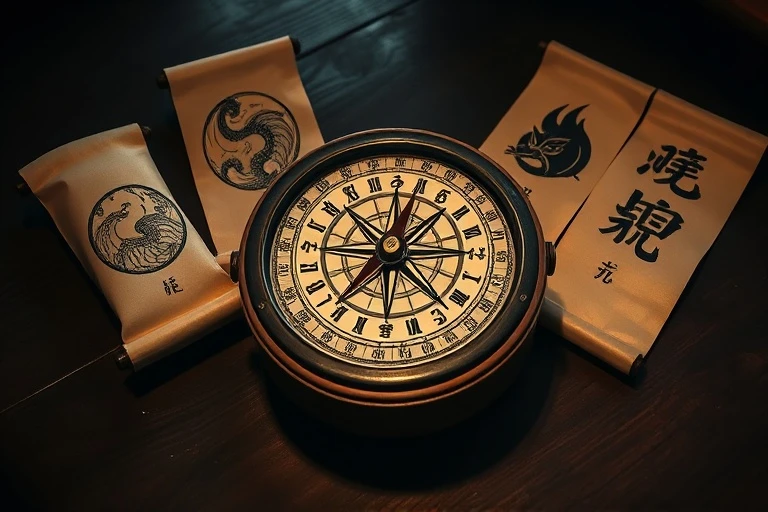
An ancient Lo Pan compass surrounded by scrolls, symbolizing the deep wisdom of elemental interactions in the Chinese Zodiac.
This comprehensive guide will explore the foundational principles of the Five Elements, their productive and destructive cycles, and how to apply this knowledge to gain profound insights into compatibility. We will move past simple generalizations to uncover the energetic blueprint that truly shapes our connections with others.
Table of Contents
- The Five Elements: A Foundation of Chinese Metaphysics
- Understanding Elemental Cycles: Productive and Destructive
- Determining Your Elemental Affiliation
- Elemental Compatibility in Practice: Decoding Relationships
- Advanced Elemental Considerations Beyond the Birth Year
- Conclusion: Harnessing Elemental Wisdom for Harmonious Connections
The Five Elements: A Foundation of Chinese Metaphysics
In Chinese metaphysics, the Five Elements (Wu Xing) are not merely static components but dynamic phases of energy that describe the natural world, human physiology, and cosmic cycles. Each element possesses unique characteristics, influences, and associations, which extend to personality traits and interaction styles. Understanding these fundamental properties is the first step toward advanced compatibility analysis.
- Wood (木 - Mù): Represents growth, expansion, creativity, and new beginnings. Wood personalities are often ambitious, pioneering, and assertive. They are natural leaders, but can also be stubborn or inflexible.
- Fire (火 - Huǒ): Symbolizes passion, energy, enthusiasm, and transformation. Fire individuals are charismatic, dynamic, and love to be in the spotlight. They can be impulsive, quick-tempered, and sometimes overly dramatic.
- Earth (土 - Tǔ): Embodies stability, nurturing, practicality, and reliability. Earth types are grounded, supportive, and patient. They can be overly cautious, resistant to change, or prone to worrying.
- Metal (金 - Jīn): Signifies structure, precision, discipline, and integrity. Metal personalities are organized, principled, and determined. They can be rigid, critical, and emotionally reserved.
- Water (水 - Shuǐ): Represents introspection, adaptability, wisdom, and flow. Water individuals are intuitive, compassionate, and adaptable. They can be secretive, indecisive, or prone to anxiety.
These elemental descriptions provide a rich tapestry of human characteristics, far beyond what a single animal sign can convey. When combined with the animal sign, the elemental influence adds a layer of depth, refining the personality profile and offering more specific insights into an individual's energetic makeup.
Understanding Elemental Cycles: Productive and Destructive
The interaction between the Five Elements is governed by two primary cycles: the Productive (Sheng) Cycle and the Destructive (Ke) Cycle. These cycles are fundamental to understanding compatibility, as they describe how different energies support or challenge each other.
A 3D render of geometric shapes illustrates the intricate and balanced interplay of the Five Elements.
The Productive Cycle describes a harmonious flow where one element nurtures or gives rise to another:
- Wood feeds Fire: Wood is fuel for fire. (Creativity fuels passion).
- Fire creates Earth: Fire turns wood into ash, which enriches the earth. (Passion grounds into stability).
- Earth bears Metal: Metal is mined from the earth. (Stability produces structure).
- Metal collects Water: Metal becomes liquid when melted, or a container for water. (Structure facilitates wisdom).
- Water nourishes Wood: Water helps trees grow. (Wisdom fosters growth).
The Destructive Cycle (also known as the Controlling Cycle) describes a relationship where one element controls or weakens another. While often labeled "destructive," this cycle is not inherently negative; it represents balance and regulation. Too much of one element can be detrimental, and the controlling element helps to keep it in check.
- Wood controls Earth: Tree roots penetrate and hold the earth. (Assertiveness can overcome stubbornness).
- Earth controls Water: Earth can absorb or dam water. (Stability can contain emotional flow).
- Water controls Fire: Water extinguishes fire. (Wisdom can temper impulsiveness).
- Fire controls Metal: Fire melts metal. (Passion can soften rigidity).
- Metal controls Wood: Metal (an axe) cuts wood. (Discipline can prune excessive growth).
Understanding these cycles is paramount for elemental compatibility. A productive relationship suggests mutual support and growth, while a destructive one indicates potential friction or a need for balance. However, even a destructive cycle can be beneficial if it prevents an imbalance from becoming overwhelming.
Determining Your Elemental Affiliation
While each Chinese Zodiac animal sign is associated with a fixed element (e.g., Tiger is Wood, Horse is Fire), your personal elemental affiliation is primarily determined by the last digit of your birth year. This is often referred to as your "Birth Year Element" or "Heavenly Stem Element."
| Last Digit of Birth Year | Associated Element |
|---|---|
| 0 or 1 | Metal |
| 2 or 3 | Water |
| 4 or 5 | Wood |
| 6 or 7 | Fire |
| 8 or 9 | Earth |
For example, someone born in 1984 (Year of the Rat) would have a Wood element, as the last digit is 4. This means their core energetic makeup is influenced by Wood, regardless of the Rat's inherent Water element. This dual elemental influence provides a more complex and accurate personality profile. For a deeper dive into your specific animal sign, you can explore resources like Tarot Quantum Mechanics Intersecting Divination Reality insights.
Elemental Compatibility in Practice: Decoding Relationships
Once you know the Birth Year Elements of two individuals, you can analyze their compatibility based on the Productive and Destructive Cycles. This analysis offers a dynamic view of how their energies will interact.

A watercolor landscape depicts the harmonious flow and interconnectedness of the Five Elements in nature.
Productive Relationships: When one person's element produces another's, the relationship tends to be supportive, nurturing, and growth-oriented. For instance, a Wood person and a Fire person would likely have a dynamic where Wood provides ideas and initiative, and Fire brings passion and enthusiasm to manifest those ideas. This creates a natural flow of energy and mutual encouragement. Similarly, a Metal person and a Water person would find Metal providing structure and clarity, while Water offers adaptability and emotional depth, leading to a well-rounded partnership.
Destructive Relationships: When one person's element controls another's, there can be challenges, friction, or a power dynamic. For example, a Water person and a Fire person might experience clashes, as Water tends to dampen Fire's enthusiasm, or Fire might feel stifled by Water's introspection. However, this doesn't mean the relationship is doomed. Instead, it highlights areas where conscious effort is needed for balance. The "controlling" element might help the "controlled" element avoid excesses, acting as a necessary check. A Fire person (controlling Metal) might help a Metal person become less rigid and more adaptable.
It's important to remember that neither cycle is inherently "good" or "bad." A relationship with only productive elements might lack the necessary tension for growth and challenge, potentially leading to stagnation. Conversely, a relationship with destructive elements can be incredibly transformative if both individuals are willing to understand and navigate their energetic differences. The key is awareness and conscious effort.
Example Scenarios:
- Wood (Partner A) & Earth (Partner B): Wood controls Earth. Partner A might feel that Partner B is too slow or stubborn, while Partner B might feel overwhelmed or pressured by Partner A's assertiveness. To balance this, Partner A needs to practice patience, and Partner B needs to be open to new ideas.
- Earth (Partner A) & Metal (Partner B): Earth produces Metal. This is a supportive match. Partner A (Earth) provides stability and resources for Partner B (Metal), who brings structure and order. They can build a strong, reliable foundation together.
- Fire (Partner A) & Water (Partner B): Fire is controlled by Water. Partner A might feel their passion is extinguished by Partner B's cautious nature, while Partner B might find Partner A too impulsive. They can learn from each other: Water can teach Fire to be more reflective, and Fire can encourage Water to be more decisive.
Advanced Elemental Considerations Beyond the Birth Year
While the Birth Year Element provides a strong foundation, advanced Chinese Zodiac analysis delves even deeper. Each person has a unique Bazi (Four Pillars of Destiny) chart, which includes elements associated with their birth year, month, day, and hour. Each of these "pillars" has a Heavenly Stem (element) and an Earthly Branch (animal sign and its hidden elements).
The most significant elemental influence in a Bazi chart is often the "Day Master" or "Self Element," which is derived from the Heavenly Stem of the birth day. This element represents the core of an individual's personality and their primary energetic expression. Comparing Day Masters between two people offers an even more precise understanding of their fundamental compatibility.
Furthermore, the concept of "missing elements" or "over-represented elements" in a Bazi chart can also impact compatibility. A person lacking a certain element might be drawn to someone who possesses it strongly, seeking balance. Conversely, two people with an excess of the same element might amplify both its strengths and weaknesses in their relationship. For example, two strong Fire individuals might have immense passion but also be prone to explosive arguments.
Exploring these deeper layers requires a professional Bazi reading, but even a basic understanding of the Five Elements and their cycles, combined with the Birth Year Element, provides significantly more insight than just comparing animal signs alone. It allows for a more holistic view of compatibility, acknowledging the multifaceted nature of human energy and interaction. Those interested in further astrological insights might find value in exploring Astrological Aspects: Conjunctions, Oppositions, Trines Explained for Western astrology parallels, or delve into the nuances of Chinese Horoscope: Year of Water Snake for specific elemental year influences.
Conclusion: Harnessing Elemental Wisdom for Harmonious Connections
Moving beyond simple Chinese Zodiac animal sign compatibility to embrace the Five Elements offers a powerful tool for understanding and enhancing relationships. By identifying the elemental affiliations of ourselves and others, and by recognizing the productive and destructive cycles at play, we can gain invaluable insights into the dynamics of our connections.
This advanced approach encourages empathy, communication, and conscious effort to balance energies. It teaches us that differences are not necessarily obstacles but opportunities for growth and mutual enrichment. Whether you are seeking to improve existing relationships or understand potential new ones, elemental compatibility provides a profound framework for fostering deeper, more harmonious interactions in all areas of life.
Embrace the wisdom of the Five Elements, and you will discover a richer, more intricate tapestry of human connection, guided by the ancient principles of energetic flow and balance. This journey into advanced Chinese Zodiac analysis is not just about prediction, but about empowerment and conscious relationship building.
Fuente: Contenido híbrido asistido por IAs y supervisión editorial humana.


Comments
Post a Comment