
Financial Astrology: Market Trends, Wealth Potential Guide | StarPluto
Understanding Financial Astrology: A Comprehensive Introduction
Financial astrology is an ancient yet continually evolving discipline that explores the correlation between celestial movements and economic phenomena. It posits that planetary cycles, aspects, and transits can influence collective human behavior, thereby impacting financial markets, commodity prices, and even individual wealth potential. This field, often viewed as a niche area within both astrology and finance, seeks to identify patterns and predict potential shifts based on cosmic rhythms.
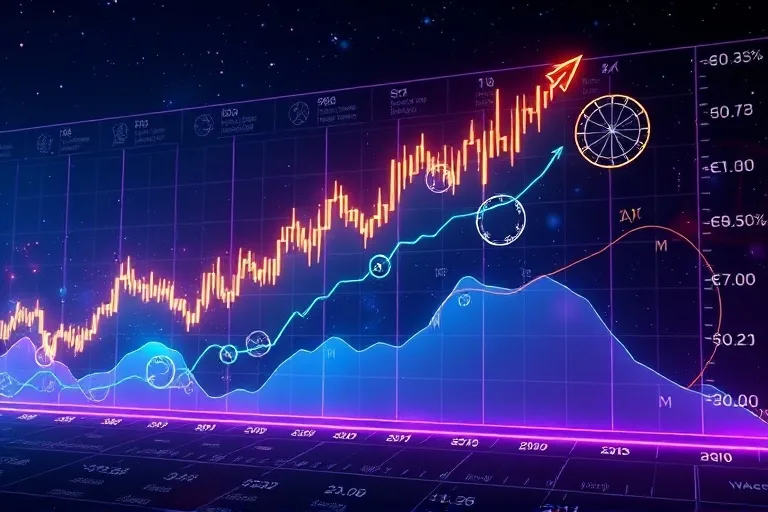
A digital illustration depicting an astrological chart integrated with a stock market graph, symbolizing the intricate connection between celestial patterns and financial movements.
While traditional economics relies heavily on fundamental and technical analysis, financial astrology introduces a unique, cyclical perspective that considers broader, often unseen, influences. Proponents believe that understanding these cosmic rhythms can provide an edge, helping to anticipate periods of expansion, contraction, volatility, or stability in various financial sectors. It's important to approach this subject with an open mind, recognizing it as a complementary tool rather than a definitive predictor.
The core premise is that human collective consciousness, which drives economic activity, is subtly influenced by planetary positions and their geometric relationships. These influences are not seen as deterministic but rather as indicators of prevailing energies or moods that can shape market sentiment and decision-making. By observing these celestial patterns, financial astrologers aim to identify potential turning points or prolonged trends in the economic landscape.
Table of Contents
- Historical Roots and Evolution
- Key Astrological Factors in Financial Analysis
- Predicting Market Trends with Astrology
- Unlocking Personal Wealth Potential
- Ethical Considerations and Limitations
- Integrating Astrology with Traditional Finance
- The Future of Financial Astrology
Historical Roots and Evolution of Financial Astrology
The practice of correlating celestial events with earthly affairs dates back thousands of years. Ancient civilizations, including the Babylonians, Egyptians, Greeks, and Romans, meticulously observed planetary movements and their perceived effects on harvests, wars, and the fortunes of kingdoms. While not explicitly "financial" in the modern sense, these early observations laid the groundwork for understanding cosmic cycles as indicators of prosperity or hardship.
During the Renaissance, figures like John Dee, an advisor to Queen Elizabeth I, applied astrological principles to various state matters, which often included economic considerations. However, it wasn't until the late 19th and early 20th centuries that financial astrology began to crystallize into a distinct field. Pioneers like W.D. Gann, a legendary stock market trader, famously used geometric and astrological methods to predict market movements, leaving behind a legacy of complex charts and theories.
In the modern era, with the advent of sophisticated computing and vast amounts of historical market data, researchers have been able to explore these correlations with greater precision. While mainstream financial institutions largely dismiss it, a dedicated community of traders, investors, and astrologers continues to refine techniques, focusing on specific planetary cycles and their impact on different asset classes. This evolution highlights a continuous quest to find underlying patterns in seemingly chaotic market behavior.
Key Astrological Factors in Financial Analysis
Financial astrologers employ a range of astrological elements to analyze and predict market trends. These factors are interpreted not as direct causes but as symbolic representations of underlying energies that can influence collective sentiment and economic activity. Understanding these elements is crucial for anyone looking to delve into this specialized field.
- Planetary Cycles: The movement of planets through the zodiac, especially the slower-moving outer planets (Jupiter, Saturn, Uranus, Neptune, Pluto), is considered highly significant. Their cycles often correspond to long-term economic trends.
- Planetary Aspects: The angular relationships between planets (e.g., conjunctions, oppositions, squares, trines) are believed to trigger specific market reactions. Hard aspects (squares, oppositions) might indicate volatility or corrections, while soft aspects (trines, sextiles) could suggest periods of growth or stability.
- Ingresses: When a planet enters a new zodiac sign, it can mark a shift in the prevailing energy, potentially influencing market sentiment related to that sign's themes.
- Eclipses: Solar and lunar eclipses are often seen as powerful catalysts for change, signaling major turning points or significant events in financial markets. These can be periods of heightened uncertainty or rapid shifts.
- Retrograde Periods: When planets appear to move backward in the sky, their energies are thought to be internalized or reviewed. Mercury retrograde, for instance, is often associated with communication breakdowns and logistical issues, which can impact short-term trading.
- Lunations (New and Full Moons): These monthly cycles are often correlated with short-term market fluctuations, influencing investor emotions and trading volumes.
Each planet is associated with specific financial themes. Jupiter, for example, is linked to expansion, growth, and optimism, often correlating with bull markets. Saturn, conversely, represents contraction, discipline, and restriction, frequently associated with bear markets or economic slowdowns. Uranus signifies innovation, disruption, and sudden changes, while Neptune relates to speculation, illusion, and bubbles. Pluto governs transformation, debt, and deep structural changes in the economy.
Predicting Market Trends with Astrology
The application of astrology to market trend prediction involves analyzing the birth charts of countries, corporations, and even the inception charts of stock exchanges. By studying these charts in conjunction with current planetary transits and progressions, financial astrologers attempt to forecast periods of economic growth, recession, or significant market events. This methodology often involves a blend of historical data analysis and astrological interpretation.
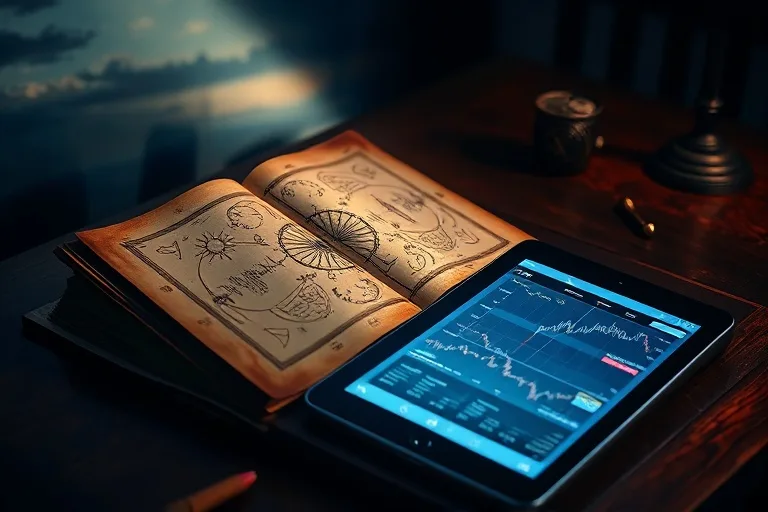
A cinematic still life showcasing an ancient astrology text alongside a contemporary financial tablet, symbolizing the bridge between traditional wisdom and modern economic analysis.
For instance, a significant transit of Uranus through a particular sign might be interpreted as a period of technological disruption or unexpected market volatility. A Jupiter-Pluto conjunction, on the other hand, could signal massive financial restructuring or significant shifts in global wealth distribution. These interpretations are often nuanced and require deep understanding of both astrological symbolism and economic principles.
Commodity markets, such as gold, silver, oil, and agricultural products, are also frequently analyzed through an astrological lens. Specific planetary influences are believed to correlate with price movements in these sectors. For example, the Moon's phases and aspects to Mercury can be linked to short-term fluctuations in agricultural commodities due to their influence on weather patterns and public sentiment.
While no method guarantees perfect predictions, financial astrology offers a framework for anticipating potential shifts in market psychology. It encourages a long-term perspective, helping investors identify opportune times for entry or exit based on overarching cosmic cycles rather than daily noise. This can be particularly useful for strategic asset allocation and risk management.
Unlocking Personal Wealth Potential Through Astrology
Beyond predicting market trends, financial astrology also delves into an individual's natal chart to uncover their unique wealth potential and financial predispositions. This personalized approach can offer insights into career paths, money management styles, and potential challenges or opportunities related to personal finance. It helps individuals understand their innate relationship with money and resources.
Key areas of the natal chart analyzed for wealth potential include:
- Second House: Represents personal possessions, earned income, values, and self-worth. Planets and signs in this house indicate how an individual acquires and manages resources.
- Eighth House: Governs shared resources, investments, inheritances, debt, and other people's money. It sheds light on financial partnerships and transformative financial experiences.
- Tenth House (Midheaven): Relates to career, public image, and professional achievements. Its ruler and aspects can reveal paths to financial success through one's profession.
- Jupiter: The planet of abundance and expansion. Its placement by sign and house, along with its aspects, indicates areas where an individual can experience growth and good fortune financially.
- Venus: Associated with money, values, and attraction. Its position reveals one's spending habits, aesthetic preferences, and how they attract wealth.
- Saturn: Represents discipline, limitations, and responsibility. Its placement can highlight areas where financial lessons are learned or where hard work is required to build lasting wealth.
- North Node: Points to one's karmic path and life lessons, which can include financial growth and purpose-driven wealth accumulation.

A conceptual art piece illustrating a golden balance scale, with cosmic elements on one side and currency symbols on the other, representing the delicate equilibrium between universal energies and financial prosperity.
By understanding these astrological indicators, individuals can make more informed decisions about their career choices, investment strategies, and overall financial planning. For example, someone with a strong Jupiter in their second house might naturally attract wealth, while a challenging Saturn aspect could indicate a need for rigorous financial planning and patience. It's about aligning personal financial strategies with one's unique cosmic blueprint.
Ethical Considerations and Limitations
As with any predictive discipline, financial astrology comes with important ethical considerations and inherent limitations. It is crucial to emphasize that astrological insights should not be treated as infallible prophecies or the sole basis for making significant financial decisions. Instead, they are best utilized as supplementary tools for gaining a broader perspective.
One primary ethical concern is the potential for misinterpretation or over-reliance. Financial markets are complex systems influenced by countless variables, including geopolitical events, technological advancements, and human psychology. Attributing all market movements solely to planetary influences would be an oversimplification and could lead to poor decision-making. Responsible practitioners advocate for integrating astrological analysis with traditional financial research, never replacing it.
Furthermore, the deterministic nature sometimes associated with astrology can be problematic. Financial astrology should empower individuals to understand potential energies and make conscious choices, rather than fostering a fatalistic view of their financial destiny. It's about recognizing patterns and probabilities, not absolute certainties. The free will and informed decisions of individuals always play a pivotal role.
Limitations also arise from the subjective interpretation of astrological charts and the inherent complexity of financial markets. Different astrologers may interpret the same planetary configurations differently, leading to varied conclusions. The field lacks standardized, universally accepted predictive models, which can make it challenging to validate its efficacy through conventional scientific methods. Therefore, users should exercise caution, critical thinking, and consult with certified financial advisors for all investment decisions.
Integrating Astrology with Traditional Financial Analysis
For those interested in exploring financial astrology, the most prudent approach is to integrate its insights with established financial analysis methods. This hybrid strategy allows investors and traders to leverage the unique cyclical perspective of astrology while grounding their decisions in fundamental and technical data. It's about adding another layer of analysis, not replacing existing ones.
Here are ways to integrate financial astrology:
- Confirmation Tool: Use astrological indicators to confirm trends or turning points identified through technical analysis (e.g., if a major planetary aspect aligns with a key support/resistance level).
- Long-Term Strategy: Apply slow-moving planetary cycles (Jupiter, Saturn, Uranus, Neptune, Pluto) to inform long-term investment strategies and asset allocation, anticipating major economic shifts.
- Risk Management: Be aware of periods of heightened astrological volatility (e.g., eclipses, hard aspects involving Uranus or Pluto) to adjust risk exposure or re-evaluate portfolio holdings.
- Sector-Specific Analysis: Correlate specific planetary influences with sectors they rule (e.g., Uranus for technology, Neptune for pharmaceuticals) to identify potential growth or decline.
- Personalized Timing: For individual investors, use personal transits and progressions to identify favorable periods for career advancement, starting a business, or making significant investments, complementing their financial goals.
By combining the cyclical insights of financial astrology with the data-driven approaches of fundamental and technical analysis, individuals can develop a more holistic and potentially robust framework for navigating the financial markets. This integrated perspective acknowledges the multifaceted nature of economic forces, encompassing both tangible data and subtle energetic influences. It encourages a more comprehensive understanding of market dynamics.
The Future of Financial Astrology
The future of financial astrology is likely to be shaped by advancements in technology and a growing interest in alternative analytical methods. As more data becomes available and computational tools become more sophisticated, researchers may uncover new correlations and refine existing predictive models. The integration of artificial intelligence and machine learning could potentially enhance the ability to process vast amounts of astrological and financial data, identifying subtle patterns that are currently difficult to discern.
There is also a growing trend towards interdisciplinary studies, where fields traditionally seen as disparate are beginning to converge. Financial astrology, with its blend of ancient wisdom and modern application, could find a more prominent place in this landscape. As financial markets become increasingly globalized and complex, investors may seek out diverse perspectives to gain a competitive edge, making room for less conventional approaches.
However, for financial astrology to gain wider acceptance, it will need to demonstrate greater empirical validation and develop more standardized methodologies. Continued research, transparent reporting of results, and a clear distinction between speculative interpretation and verifiable correlation will be essential. Ultimately, its future depends on its ability to consistently provide valuable, actionable insights that complement, rather than contradict, sound financial principles. The journey of financial astrology from ancient observation to a modern analytical tool is far from over, promising continued exploration and refinement.
Fuente: Contenido híbrido asistido por IAs y supervisión editorial humana.


Comments
Post a Comment