
Financial Astrology: Timing Investments Decisions Cosmic Cycles | StarPluto
Financial astrology is an intriguing and often debated discipline that seeks to understand and predict market trends, economic shifts, and investment opportunities by analyzing planetary movements and cosmic cycles. Far from being a mere superstition, proponents view it as a sophisticated tool that offers a unique perspective, complementing traditional economic analysis and technical indicators. This approach suggests that celestial alignments can influence collective human psychology, which in turn impacts financial markets.
- Historical Roots: Tracing back to ancient civilizations, the belief in cosmic influence on earthly affairs, including commerce, is deeply embedded.
- Modern Application: Today, financial astrologers use advanced software and detailed ephemerides to correlate planetary positions with market behavior.
- Complementary Tool: It is generally not presented as a standalone predictive method but rather as an additional layer of insight for investors and business leaders.
Table of Contents
- Introduction to Financial Astrology
- A Historical Perspective on Cosmic Economics
- Key Astrological Principles in Finance
- Major Cosmic Cycles and Their Market Impact
- Practical Applications for Astrological Investors
- Limitations and Ethical Considerations
- Conclusion: Navigating Markets with Cosmic Insight
Introduction to Financial Astrology
Financial astrology posits that the movements and alignments of celestial bodies correlate with fluctuations in financial markets and economic trends. This isn't about predicting specific stock prices with absolute certainty, but rather identifying periods of increased volatility, shifts in sentiment, or turning points that might offer strategic advantages to investors and businesses. The underlying premise is that human behavior, often driven by collective psychological states, is subtly influenced by cosmic energies, and these behaviors manifest in economic activity.
The concept extends beyond individual horoscopes, focusing on mundane astrology, which studies the charts of nations, corporations, and major events. By analyzing the birth charts of companies (incorporation dates), countries (founding dates), or even major currencies, financial astrologers look for patterns that align with their subsequent performance. This field requires a deep understanding of both astrological principles and financial markets, blending ancient wisdom with modern economic theory.

Financial astrology offers a unique lens, merging ancient cosmic wisdom with contemporary market analysis to identify potential trends.
A Historical Perspective on Cosmic Economics
The roots of financial astrology can be traced back to ancient Mesopotamia, Egypt, and Greece, where astronomy and astrology were intertwined. Early civilizations observed the cycles of celestial bodies and correlated them with agricultural seasons, natural disasters, and even the rise and fall of empires. This holistic view naturally extended to commerce and trade, as economic prosperity was often linked to favorable environmental conditions and societal stability.
During the Renaissance, figures like Johannes Kepler, a renowned astronomer, also practiced astrology, advising powerful patrons on matters including finance. While the scientific revolution gradually separated astronomy from astrology, the practice of applying astrological principles to worldly events, including economic ones, persisted. In the 20th century, pioneers like W.D. Gann, a legendary stock market trader, famously incorporated astrological and geometric principles into his trading strategies, achieving remarkable success and sparking renewed interest in the field.
"The markets are not random; they are governed by natural law, and the law of vibration."
- W.D. Gann, a prominent figure in financial astrology, emphasized the cyclical nature of markets influenced by cosmic forces.
The enduring appeal of financial astrology lies in its capacity to offer a framework for understanding seemingly irrational market behavior. By looking at long-term planetary cycles, practitioners aim to identify underlying currents that might influence investor sentiment, governmental policies, and technological advancements, all of which are critical drivers of economic performance. This historical continuity underscores a persistent human quest to find order and meaning in complex systems.
Key Astrological Principles in Finance
Understanding financial astrology requires familiarity with its core components: planets, zodiac signs, houses, and aspects. Each element carries specific symbolism that, when applied to financial contexts, can offer insights into market dynamics and individual investment profiles.
Planetary Influences on Finance
Each planet is associated with certain financial themes:
- Sun: Represents the core economy, gold, leadership, and overall market sentiment.
- Moon: Reflects public mood, short-term fluctuations, commodities, and real estate.
- Mercury: Governs communication, trade, commerce, contracts, and short-term market reversals. Mercury retrograde periods are often associated with delays and re-evaluations.
- Venus: Linked to value, luxury goods, banking, art, and harmony in financial relationships.
- Mars: Symbolizes action, aggression, speculation, war, and sudden market movements.
- Jupiter: The planet of expansion, growth, abundance, speculation, and large-scale financial institutions. Often associated with bull markets.
- Saturn: Represents contraction, discipline, limitations, debt, government, and long-term structures. Associated with bear markets and economic slowdowns.
- Uranus: Signifies innovation, disruption, technology, sudden changes, and market volatility.
- Neptune: Linked to illusions, bubbles, speculation, oil, gas, and periods of confusion or deception in markets.
- Pluto: Governs transformation, power, debt, large corporations, and profound economic restructuring.
Zodiac Signs and Economic Archetypes
Each zodiac sign can be associated with certain economic sectors or market behaviors:
| Zodiac Sign | Financial Associations |
|---|---|
| Aries | New ventures, aggressive investments, quick gains. |
| Taurus | Stability, real estate, banking, agriculture, luxury goods. |
| Gemini | Communication, media, transportation, short-term trading. |
| Cancer | Home, family, food, retail, emotional market reactions. |
| Leo | Gold, entertainment, speculation, luxury brands. |
| Virgo | Analysis, healthcare, services, meticulous financial planning. |
| Libra | Partnerships, law, diplomacy, balance in markets. |
| Scorpio | Insurance, debt, taxes, mergers, deep market transformations. |
| Sagittarius | Foreign markets, travel, education, high-risk ventures. |
| Capricorn | Government, large corporations, long-term investments, discipline. |
| Aquarius | Technology, innovation, social trends, unexpected market shifts. |
| Pisces | Oil, gas, pharmaceuticals, charities, market illusions, liquidity. |
Houses and Financial Spheres
In a birth chart (for an individual, company, or event), specific houses relate to financial matters:
- 2nd House: Personal finances, earned income, possessions, resources, and spending habits.
- 8th House: Shared resources, investments, debt, taxes, inheritance, mergers, and external money.
- 10th House: Career, public image, reputation, and long-term financial goals tied to professional standing.
Astrological Aspects and Market Volatility
Aspects are the angular relationships between planets. They indicate how planetary energies interact, influencing market sentiment and volatility:
- Conjunctions (0°): Merging of energies, often signaling new beginnings or intensified trends.
- Squares (90°): Tension, challenges, and potential for sudden market corrections or reversals.
- Trines (120°): Harmony, ease, and periods of smooth growth or stability.
- Oppositions (180°): Polarization, conflict, and potential for market turning points or balancing acts.
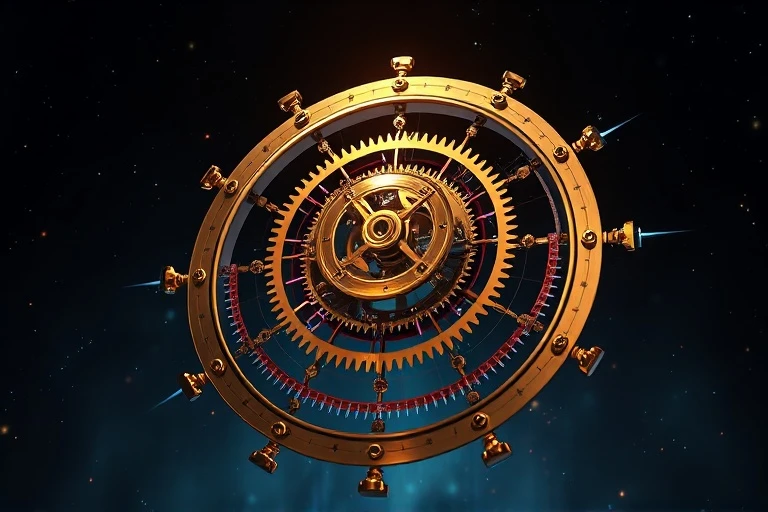
Intricate planetary movements are believed to synchronize with the complex rhythms and fluctuations of financial markets.
Major Cosmic Cycles and Their Market Impact
Financial astrology places significant emphasis on the cycles of outer planets (Jupiter, Saturn, Uranus, Neptune, Pluto) due to their longer duration and profound influence on societal and economic trends. Inner planets (Mercury, Venus, Mars) are often used for shorter-term market timing.
Jupiter-Saturn Conjunctions (Great Conjunctions)
Occurring approximately every 20 years, these conjunctions mark significant shifts in economic paradigms. Jupiter represents expansion and growth, while Saturn signifies contraction and structure. Their alignment often coincides with major economic turning points, including periods of innovation followed by consolidation, or the end of one economic era and the beginning of another. Historically, these cycles have been correlated with significant changes in global power dynamics and financial systems.
Uranus Cycles: Innovation and Disruption
Uranus, with its 84-year cycle, is associated with technological breakthroughs, sudden market shocks, and revolutionary changes. When Uranus forms significant aspects (especially conjunctions, squares, or oppositions) to key points in a national or corporate chart, it can signal periods of rapid technological adoption, market bubbles, or unexpected crashes. Its influence often brings about a departure from the norm, forcing adaptation and innovation in financial sectors.
Neptune Cycles: Bubbles and Illusions
Neptune's 165-year cycle is linked to collective dreams, illusions, and spiritual trends. In finance, Neptune's influence can manifest as periods of irrational exuberance, speculative bubbles, or widespread deception. It is often associated with industries like oil, gas, pharmaceuticals, and anything that involves blurring lines or creating an "idealized" vision. Neptune transits can also coincide with periods of increased liquidity or, conversely, market confusion and uncertainty.
Pluto Cycles: Transformation and Restructuring
Pluto, with its 248-year orbit, is the planet of profound transformation, power dynamics, and destruction followed by rebirth. In financial astrology, Pluto cycles can indicate periods of deep economic restructuring, the rise and fall of major corporations, and shifts in global financial power. Its transits often coincide with crises that force fundamental changes in how money and resources are managed, leading to long-term systemic shifts.
Mercury Retrograde: Communication and Reversals
While a shorter cycle (occurring 3-4 times a year), Mercury retrograde is a popular concept in financial astrology. It's often associated with communication breakdowns, delays in contracts, and re-evaluations. In markets, this period can sometimes coincide with increased volatility, unexpected reversals, or a need to re-examine existing financial agreements. Many traders prefer to avoid initiating new major ventures during these times, focusing instead on review and refinement.

The abstract interplay of cosmic energies is often mirrored in the fluid and sometimes unpredictable nature of economic landscapes.
Practical Applications for Astrological Investors
For those who integrate financial astrology into their strategy, the goal is to gain an edge by understanding the underlying energetic currents that may influence market behavior. This involves several practical applications:
- Identifying Opportune Times: Astrologers look for favorable planetary aspects (e.g., Jupiter trine Sun) to suggest periods of growth or stability for buying, and challenging aspects (e.g., Saturn square Moon) for potential market downturns or selling opportunities.
- Understanding Market Psychology: Lunar cycles and Mercury's movements are often correlated with short-term market sentiment. A full moon, for instance, can sometimes coincide with emotional highs or reversals, while a new moon might signal a new trend.
- Personal Financial Astrology: An individual's natal chart can reveal their inherent financial strengths, weaknesses, and relationship with money. This can guide them toward suitable investment styles (e.g., conservative vs. speculative) and help them understand their own psychological biases in financial decisions. For example, a strong Jupiter in the 2nd house might indicate natural abundance, while challenging aspects to Saturn might suggest a need for more disciplined saving.
- Corporate and National Charts: Analyzing the incorporation chart of a company or the founding chart of a nation can provide insights into its economic destiny, periods of growth, challenge, or transformation. This can inform long-term investment decisions in specific stocks or national economies.
- Sector-Specific Analysis: By associating planets and signs with specific industries (e.g., Uranus with technology, Neptune with oil), astrologers can identify which sectors are likely to thrive or face challenges during particular cosmic cycles.
It's crucial to note that financial astrology is not about deterministic predictions but rather about identifying probabilities and patterns. It serves as a framework to anticipate potential shifts in market energy, allowing investors to prepare and adjust their strategies accordingly. This proactive approach, when combined with fundamental and technical analysis, can enhance decision-making.
For example, during a strong Jupiter-Pluto aspect, one might anticipate significant capital flows and transformations in large corporations, making it a period to look for opportunities in mergers and acquisitions or large-cap stocks. Conversely, a challenging Saturn-Uranus aspect could signal periods of economic contraction coupled with disruptive innovation, suggesting a need for caution in traditional sectors and a focus on emerging technologies. For more insights on planetary influences, you might explore Tarot Quantum Mechanics Intersecting Divination Reality.
Limitations and Ethical Considerations
While financial astrology offers a compelling alternative perspective, it comes with inherent limitations and ethical considerations that must be acknowledged. It is not a crystal ball for guaranteed profits, and relying solely on astrological predictions without conventional financial due diligence can lead to significant losses.
- Not a Sole Predictor: Financial astrology should always be used as a supplementary tool. Fundamental analysis (company financials, economic indicators) and technical analysis (chart patterns, volume) remain indispensable for sound investment decisions.
- Interpretation Varies: Astrological interpretations can be subjective. Different astrologers may interpret the same planetary alignment differently, leading to varied conclusions.
- Risk Management: Even with astrological insights, market risks persist. Diversification, stop-loss orders, and prudent risk management strategies are paramount.
- Avoidance of Speculative Excess: The allure of quick gains can be strong, but financial astrology should not encourage reckless speculation. Its purpose is to understand cycles, not to promote gambling.
- Ethical Responsibility: Practitioners have an ethical responsibility to emphasize the complementary nature of their insights and to caution clients against making decisions based purely on astrological forecasts.
The complexity of modern financial markets, influenced by countless variables from geopolitical events to technological shifts, means that no single methodology can offer a complete picture. Financial astrology provides a unique, cyclical framework that can highlight potential periods of opportunity or caution, but it must be integrated thoughtfully into a broader, well-researched investment strategy. Understanding Tarot Quantum Mechanics Intersecting Divination Reality can also provide context on its development as a predictive tool.
Conclusion: Navigating Markets with Cosmic Insight
Financial astrology, though unconventional to some, offers a fascinating and historically rich approach to understanding economic and market cycles. By correlating planetary movements with human collective psychology and subsequent financial behavior, it provides a unique lens through which to view investment timing and business decisions. From the expansive influence of Jupiter to the transformative power of Pluto, each celestial body contributes to a complex cosmic rhythm that proponents believe mirrors earthly economic tides.
While not a standalone solution, integrating financial astrology with traditional economic and technical analysis can offer a more holistic and potentially insightful strategy. It encourages a deeper awareness of cyclical patterns, helping investors and business leaders anticipate periods of growth, contraction, innovation, or caution. As markets continue to evolve in complexity, the quest for diverse analytical tools, including those rooted in ancient wisdom, remains relevant for those seeking a deeper understanding of the forces that shape our financial world.
Fuente: Contenido híbrido asistido por IAs y supervisión editorial humana.


Comments
Post a Comment