
Fixed Stars Astrology: Mythos & Impact | StarPluto
In the vast tapestry of the cosmos, beyond the familiar dance of planets within our solar system, lie the enigmatic fixed stars and constellations. These celestial bodies, seemingly static from our earthly vantage point, have captivated humanity for millennia, inspiring myths, guiding navigators, and profoundly influencing astrological traditions. Unlike planets, which move through the zodiac, fixed stars maintain their relative positions, offering a stable backdrop against which the planetary drama unfolds.
For centuries, astrologers have studied their subtle yet powerful influence, believing they imbue specific qualities, talents, and even fated events upon individuals whose birth charts align with their positions. This article delves into the rich mythos surrounding these distant suns and explores their enduring impact on astrological interpretation, providing an introductory yet comprehensive guide for those new to this fascinating aspect of celestial wisdom.
What Are Fixed Stars and Constellations?
Fixed stars are celestial bodies that appear to remain stationary in the night sky relative to each other, forming the recognizable patterns we call constellations. From an astronomical perspective, they are distant suns, many times larger and brighter than our own, located light-years away from Earth. In contrast to the wandering planets (from the Greek word "planetes," meaning wanderer), fixed stars do not visibly change their positions within the zodiacal band over a human lifetime, hence the term "fixed."
Constellations are groups of fixed stars that form perceived patterns or figures, often named after mythological characters, animals, or objects. While astronomers use 88 officially recognized constellations to divide the celestial sphere, astrologers often focus on specific bright stars within these formations, particularly those located near the ecliptic (the Sun's apparent path across the sky).
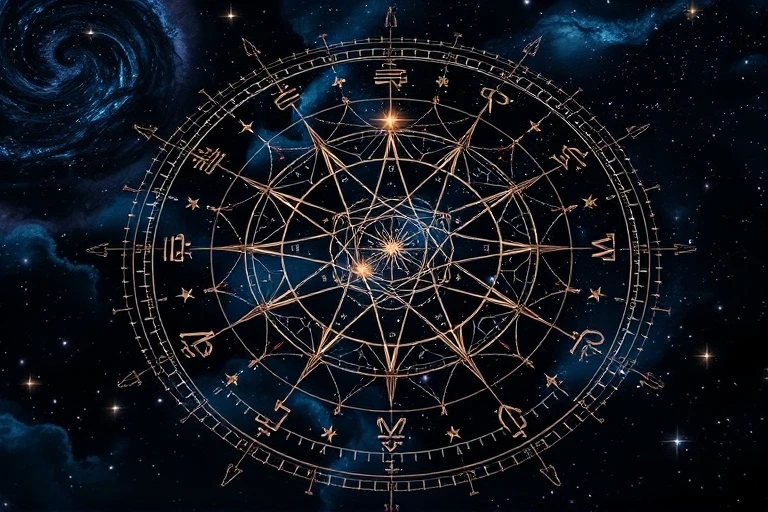
A conceptual representation of fixed stars and constellations, illustrating their intricate connection with ancient astrological symbols and cosmic energies.
The significance of fixed stars in astrology stems from the belief that their light and energy, reaching Earth from immense distances, carry unique vibrational frequencies. When a planet or an angle (like the Ascendant or Midheaven) in a natal chart aligns with a specific fixed star, it is said to "activate" the star's influence, adding another layer of complexity and potential to the individual's life path. These influences are often described as more fated or karmic than planetary aspects, suggesting deep-seated patterns or extraordinary talents.
A Historical Perspective: Ancient Wisdom
The study of fixed stars predates much of modern astrology, with roots firmly planted in ancient civilizations. The Babylonians, Egyptians, and Greeks were meticulous observers of the night sky, charting the positions of prominent stars and attributing divine or mythical significance to them. These cultures often wove elaborate narratives around constellations, seeing them as celestial reflections of their gods, heroes, and cultural values.
For instance, the constellation Orion, the Hunter, was recognized across many cultures, often associated with powerful figures or deities. The heliacal rising (first visible appearance before sunrise) of certain stars, like Sirius (Sopdet to the Egyptians), was crucial for agricultural calendars and religious festivals, signifying the annual flooding of the Nile and the beginning of a new year. This demonstrates a practical and spiritual integration of fixed star knowledge into daily life.
During the Hellenistic period, Greek astrologers began to systematically incorporate fixed stars into their horoscopic calculations, often linking them to planetary influences. Ptolemy, in his influential work "Tetrabiblos," detailed the natures of various fixed stars, comparing their effects to those of the planets. This laid the groundwork for future astrological interpretations, which were further refined and expanded by Arabic scholars during the Islamic Golden Age.
Medieval European astrologers continued this tradition, often consulting intricate star tables and texts that described the "virtues" and "malefices" of specific stars. The Renaissance saw a renewed interest in classical texts, including those on fixed stars, influencing figures like Johannes Kepler. Today, while fixed stars are sometimes overlooked in introductory astrology, advanced practitioners recognize their profound historical and interpretive value.
Fixed Stars vs. Planets: Key Distinctions
Understanding the difference between fixed stars and planets is fundamental to appreciating their distinct roles in astrology. Planets in a natal chart represent dynamic psychological functions, drives, and areas of life that are subject to change and personal development. They signify our choices, our growth, and the ongoing narrative of our lives. Their positions change rapidly, creating unique charts for each moment.

An antique astronomical globe and weathered star charts, symbolizing the deep historical roots and meticulous observation of celestial bodies in ancient astrology.
Fixed stars, on the other hand, are often seen as representing more fundamental, inherent qualities or fated circumstances. Their influence is typically described as more potent, less mutable, and often associated with extraordinary events, either positive or challenging. They don't symbolize a choice or a developing aspect of personality in the same way planets do, but rather a predisposition or a significant, often external, factor.
- Motion: Planets move through the zodiac, changing signs and houses frequently. Fixed stars remain in virtually the same zodiacal degree for centuries, moving only very slowly due to precession.
- Influence: Planetary influences are personal and dynamic, reflecting psychological processes and life experiences. Fixed star influences are often seen as more collective, fated, or indicative of exceptional circumstances, talents, or challenges.
- Orb: Astrologers typically use very tight orbs (usually 0.5 to 1 degree) for fixed star conjunctions, whereas planetary aspects can have much wider orbs.
- Activation: Fixed stars are usually considered active when conjunct (within a small orb) a planet, the Ascendant, Midheaven, Descendant, or Imum Coeli in a natal chart.
While planets describe "how" we operate and "what" we experience, fixed stars can indicate "where" we might encounter extraordinary luck, profound challenges, or unique gifts. They add a layer of cosmic destiny to the personal narrative painted by the planets. For more on planetary influences, you can explore Tarot Quantum Mechanics Intersecting Divination Reality.
Major Fixed Stars and Their Astrological Significance
Several fixed stars are particularly prominent in astrological interpretation due to their brightness, position near the ecliptic, and historical associations. Each carries a unique symbolic meaning, often linked to the mythology of its constellation and the planetary energies it is said to resemble. Here are some of the most influential fixed stars and their general interpretations:
- Sirius (Alpha Canis Majoris): Located in Canis Major, "The Greater Dog," Sirius is the brightest star in the night sky. Astrologically, it is associated with immense power, ambition, fame, honor, and spiritual insight. It can bring great success and recognition, but also intense pressure and responsibility. It is often linked to Jupiter and Mars energies.
- Aldebaran (Alpha Tauri): The eye of the Bull in Taurus, Aldebaran is one of the four Royal Stars of Persia. It signifies honor, integrity, courage, military success, and public recognition. It is associated with Mars and Jupiter, suggesting leadership and strong moral principles. However, it can also bring challenges if integrity is compromised.
- Regulus (Alpha Leonis): The heart of the Lion in Leo, Regulus is another Royal Star. It bestows leadership qualities, royalty, nobility, ambition, and a desire for power. It is linked to Mars and Jupiter. While it promises great success, it also carries a warning of potential downfall if pride, revenge, or cruelty dominate.
- Antares (Alpha Scorpii): The heart of the Scorpion in Scorpio, Antares is the fourth Royal Star. It is associated with boldness, courage, a destructive nature, obsession, and a strong drive for power. It carries Mars and Jupiter energies, often bringing military or strategic success, but also risk and danger, especially related to violence or fanaticism.
- Spica (Alpha Virginis): The ear of wheat held by Virgo, Spica is a star of brilliance, success, honor, and protection. It is generally considered highly benevolent, associated with Venus and Mars. It can bring artistic talent, scientific acumen, and good fortune, especially in intellectual pursuits and public life.
- Algol (Beta Persei): The "Demon Star" in the constellation Perseus, Algol represents the head of Medusa. It is one of the most intensely discussed fixed stars, often associated with violence, passion, beheading, and extreme experiences. It is linked to Saturn and Uranus, indicating powerful, sometimes destructive, energy that can manifest as intense creativity or profound challenges.
These are just a few examples; hundreds of fixed stars have been cataloged and interpreted by astrologers throughout history. The specific impact of a fixed star depends heavily on its exact conjunction with a planet or angle, the nature of that planet, and the overall context of the natal chart. It's a nuanced field requiring careful study.
Constellations: Beyond Individual Stars
While individual fixed stars hold significant weight, the constellations themselves also carry symbolic meaning in astrology. These larger patterns often reflect archetypal narratives and collective energies that influence the general atmosphere of an era or the backdrop against which personal destinies unfold. The twelve zodiacal constellations, for instance, define the twelve astrological signs, each imbued with distinct characteristics and life lessons.
Beyond the zodiac, other prominent constellations like Ursa Major (the Great Bear), Orion (the Hunter), and Cassiopeia (the Queen) have rich mythologies that can provide deeper context to the stars they contain. For example, the myth of Perseus, who slew Medusa (represented by Algol), speaks to themes of heroism, confrontation with evil, and transformation. When a natal chart feature aligns with a constellation, it can suggest an individual's life story resonates with the overarching themes of that celestial myth.

An abstract digital illustration depicting the intricate flow of cosmic energy and interconnectedness between distant stars and our planet, symbolizing profound astrological influences.
The study of constellations in astrology often involves understanding the "paran" relationships, where a fixed star or constellation rises, culminates, or sets simultaneously with a planet from a specific location on Earth. This adds another layer of precision and localized influence, suggesting specific talents or challenges that manifest at particular times or places in a person's life. This ancient technique, often associated with Babylonian and Egyptian astrology, offers a more geographical and temporal dimension to fixed star analysis.
Modern Astrological Application and Interpretation
In contemporary astrology, fixed stars are often used as a supplementary layer of interpretation, adding depth and nuance to a natal chart reading. While planetary placements and aspects form the core of analysis, fixed star conjunctions can highlight areas of exceptional potential or significant challenge. They are particularly useful for understanding unusual talents, fated encounters, or events that seem to transcend the ordinary scope of planetary influences.
Modern astrologers often consult specialized ephemerides or software that list the precise zodiacal longitudes of prominent fixed stars. The most common method of interpretation involves looking for conjunctions (within a small orb, typically 0.5 to 1 degree) between a fixed star and a natal planet, the Ascendant, Midheaven, Descendant, or Imum Coeli. These points are considered the most sensitive and influential in a chart.
- Ascendant Conjunctions: A fixed star conjunct the Ascendant can strongly influence one's personality, physical appearance, and overall life direction, often imbuing the individual with the star's archetypal qualities.
- Midheaven Conjunctions: When a fixed star aligns with the Midheaven, it can have a profound impact on one's career, public image, and life achievements, often indicating extraordinary success or notoriety in the associated fields.
- Planetary Conjunctions: A planet conjunct a fixed star will express the star's energy through the function of that planet. For example, Mercury conjunct Sirius might indicate a powerful, influential voice or mind, while Venus conjunct Spica could signify artistic brilliance and charm.
It's important to note that fixed star interpretations are often dual-natured, carrying both positive and challenging potentials. A star associated with fame might also bring scandal, and one linked to power could lead to a dramatic fall. The astrologer's role is to help clients understand these potentials and navigate them consciously. Further insights into astrological aspects can be found in Tarot Quantum Mechanics Intersecting Divination Reality.
Integrating Fixed Stars in Your Chart Analysis
For those looking to integrate fixed stars into their astrological practice, a few key steps are essential. First, ensure you have an accurate birth time, as the precise degrees of the Ascendant and Midheaven are crucial for determining conjunctions. Second, use reliable astrological software or ephemerides that include fixed star positions, typically adjusted for precession to the current epoch.
Begin by identifying any planets or angles that fall within a 0.5 to 1-degree orb of a major fixed star. Research the traditional meanings and mythologies associated with these stars, paying attention to both their benevolent and challenging potentials. Consider how the star's influence might blend with the nature of the planet or angle it conjuncts, adding a layer of extraordinary quality to that part of the chart.
Remember that fixed stars often represent "gifts" or "fates" that are beyond conscious control, but how one utilizes or responds to these influences is still within the realm of free will. Understanding a fixed star's presence can provide profound insights into one's unique destiny, potential for greatness, or specific challenges to overcome. It's a journey into the deeper, more ancient layers of astrological wisdom, offering a connection to the timeless narratives written in the stars.
The study of fixed stars and constellations enriches the astrological landscape, reminding us that our personal destinies are intricately woven into the grand cosmic design. By looking beyond the immediate planetary movements, we gain a deeper appreciation for the enduring wisdom of the night sky and its subtle yet powerful influence on human life. For more on advanced astrological concepts, you might find Tarot Quantum Mechanics Intersecting Divination Reality insightful.
Fuente: Contenido híbrido asistido por IAs y supervisión editorial humana.


Comments
Post a Comment