
Horary Astrology: Advanced Chart Interpretation for Complex Questions | StarPluto
Horary astrology, a venerable branch of predictive astrology, offers a unique methodology for answering specific questions by casting a chart for the exact moment a clear question is understood by the astrologer. Unlike natal astrology, which interprets a birth chart to understand an individual's life path, horary focuses on the "birth" of a question, providing remarkably precise insights into its potential outcome. This advanced guide delves into the intricate layers of horary chart interpretation, moving beyond basic principles to explore sophisticated techniques essential for addressing complex queries.

An ancient astrolabe, a tool of celestial navigation, symbolizes the profound historical roots and intricate calculations inherent in advanced horary astrology.
The art of horary demands not only a deep understanding of astrological principles but also a keen intuition and a disciplined approach to chart analysis. For complex questions—those involving multiple parties, nuanced motivations, or long-term implications—a superficial reading will not suffice. This article will equip advanced students and practitioners with the tools to dissect horary charts with precision, uncovering hidden dynamics and offering comprehensive answers.
Before diving into the advanced techniques, it is crucial to reiterate the foundational importance of the question itself. A well-formulated question is half the answer. It must be clear, specific, and genuinely felt by the querent. Ambiguous or hypothetical questions yield ambiguous or misleading charts. The astrologer must fully grasp the querent's intent, as this understanding directly influences the assignment of significators and houses.
Table of Contents
- Foundational Principles for Advanced Horary
- Significators and Their Condition: Beyond the Basics
- Aspects, Receptions, and Perfection
- Advanced Techniques: Antiscia, Fixed Stars, and Arabic Parts
- Void of Course Moon and Retrograde Planets: Nuanced Interpretations
- Derivative Houses: Unlocking Complex Relationships
- Timing Events in Horary: Precision and Nuance
- Ethical Considerations and Limitations
- Conclusion
Foundational Principles for Advanced Horary
At its core, horary astrology operates on the principle that the celestial configuration at the moment a question is posed reflects the nature and outcome of that question. This is often referred to as the "moment of conception" for the query. For advanced interpretation, a solid grasp of traditional astrology is paramount, including planetary dignities, essential and accidental, house meanings, and the nature of aspects.
The first step in any horary reading is to identify the querent (the person asking the question) and the quesited (the subject of the question). The querent is typically represented by the ruler of the 1st house and the Moon. The quesited is assigned to a specific house based on the nature of the question. For instance, a question about a spouse would involve the 7th house, while one about money would involve the 2nd house.
However, advanced horary often deals with questions that are not so straightforward. What if the question involves a third party, or a complex legal matter, or a business venture with multiple partners? This requires a more nuanced approach to significator assignment and house delineation, often involving derivative houses, which we will explore later.
Significators and Their Condition: Beyond the Basics
The condition of the significators—the planets representing the querent and quesited—is crucial. This goes beyond merely noting if a planet is in its domicile or fall. Advanced interpretation considers a multitude of factors:
- Essential Dignities: Is the significator in its domicile, exaltation, triplicity, term, or face? Strong essential dignity indicates power, resources, and inherent strength for the entity represented.
- Accidental Dignities: Is the significator in an angular house (1st, 4th, 7th, 10th)? Is it swift in motion? Direct? Free from combustion or retrograde motion? These factors indicate immediate power, ability to act, and freedom from hindrance.
- Combustion and Cazimi: A planet within 8.5 degrees of the Sun is combust and weakened, indicating hidden troubles or a lack of visibility. However, if it's within 17 minutes of the Sun (Cazimi), it's considered to be in the "heart of the Sun" and greatly empowered.
- Under the Sun's Beams: A planet between 8.5 and 17 degrees from the Sun is "under the Sun's beams," also indicating some weakening, though less severe than combustion.
- Besiegement: A significator placed between two malefics (Mars and Saturn) is considered besieged, indicating significant difficulties or opposition.
The Moon's condition is particularly vital in horary, as it often acts as a co-significator for the querent and represents the flow of events. Its sign, house, and aspects, especially its last and next aspect, provide a narrative of the question's progression.
Aspects, Receptions, and Perfection
Aspects between significators are the primary indicators of whether the matter will come to fruition. A "perfection" of the matter occurs when the querent's significator forms a partile aspect (within one degree) with the quesited's significator. However, the nature of this perfection is deeply colored by planetary receptions.
Receptions reveal the underlying attitudes and feelings between the parties involved. If planet A is in the domicile of planet B, then A "loves" B. If A is in B's exaltation, A "admires" B. Conversely, if A is in B's detriment or fall, A "hates" or "despises" B. These layers of mutual reception or aversion provide critical psychological and motivational insights into the question.
Consider a question about a relationship: If the querent's significator is in the domicile of the quesited's significator, but the quesited's significator is in the detriment of the querent's, this suggests a one-sided affection or a relationship where one party is much more invested than the other. This depth of analysis transforms a simple "yes/no" into a rich narrative.
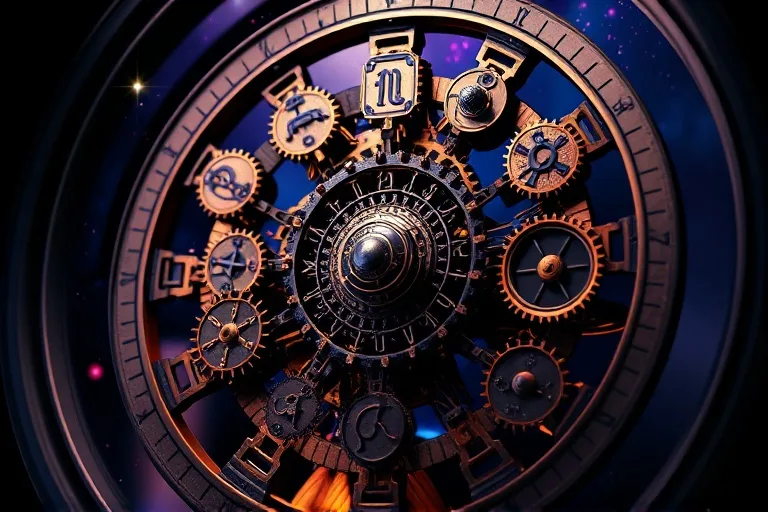
An intricate clockwork mechanism visually represents the complex and interconnected nature of astrological aspects and planetary movements in a horary chart.
Beyond direct aspects, advanced horary also examines:
- Collection of Light: When two significators do not aspect each other, but both aspect a third planet, and that third planet is stronger than both, it "collects" their light, bringing the matter to a conclusion through an intermediary.
- Translation of Light: A planet separating from an aspect with one significator and immediately applying to an aspect with the other significator "translates" the light, acting as a messenger or go-between.
- Frustration: When two significators are applying to an aspect, but a faster planet intervenes and aspects one of them before they can perfect their aspect, frustrating the outcome.
- Prohibition: Similar to frustration, but involves a third planet making an aspect to one of the significators and preventing the perfection of their mutual aspect.
Advanced Techniques: Antiscia, Fixed Stars, and Arabic Parts
To truly master complex horary questions, one must incorporate techniques that add layers of subtlety and precision:
- Antiscia and Contra-Antiscia: These are "shadow" points, reflecting a planet's position across the solsticial axis (Cancer-Capricorn). Antiscia are points of equal light, indicating hidden connections or secret support. Contra-antiscia are points of equal darkness, suggesting hidden opposition or enmity. A significator at the antiscia of another significator can indicate a secret alliance or a hidden factor influencing the outcome.
- Fixed Stars: While not primary significators, fixed stars conjunct significators or house cusps (especially the Ascendant or MC) can add significant emphasis or a specific flavor to the outcome. For example, a significator conjunct Algol might indicate a violent or unfortunate turn, while one conjunct Regulus could signify success or prominence. Their influence is often dramatic and fated.
- Arabic Parts (Lots): These are calculated points derived from the positions of planets and the Ascendant. The Part of Fortune is the most common, indicating material well-being and opportunity. However, numerous other parts exist for specific questions, such as the Part of Marriage, Part of Children, Part of Sickness, or Part of Theft. Their placement and aspects to significators can provide additional clues, especially for highly specific questions. For instance, in a question about a lost item, the Part of Theft's placement might indicate where the item is or who has it.
Incorporating these elements requires careful judgment. They should not overshadow the primary significators and aspects but rather serve as corroborating evidence or provide additional detail where the main indicators are ambiguous.
Void of Course Moon and Retrograde Planets: Nuanced Interpretations
Two conditions often cause concern in horary: a Void of Course Moon and retrograde planets. Their interpretation, however, is not always straightforwardly negative.
- Void of Course Moon: When the Moon makes no major Ptolemaic aspects to any other planet before leaving its current sign, it is considered Void of Course (VOC). Traditionally, this indicates that the matter will not come to anything, or that it will not proceed as expected. However, some traditionalists argue that a VOC Moon in a fixed sign (Taurus, Leo, Scorpio, Aquarius) can preserve the status quo, and if the querent desires no change, it can be a positive indicator. Additionally, a VOC Moon can sometimes signify that the matter is out of the querent's hands or that the situation is already resolved.
- Retrograde Planets: A retrograde significator suggests a change of mind, a reversal, a delay, or a return of something. If the querent's significator is retrograde, they might change their mind about the question or their approach. If the quesited's significator is retrograde, the subject of the question might retreat, delay, or revert to a previous state. For example, in a question about a job offer, a retrograde significator for the job might mean the offer is rescinded or significantly altered. However, a retrograde significator can be favorable if the question is about recovering something lost or returning to a previous state.
The context of the question is paramount when interpreting these conditions. A VOC Moon or retrograde planet is not an automatic "no" but rather an indicator of specific dynamics that need to be carefully considered.
Derivative Houses: Unlocking Complex Relationships
For complex questions involving third parties or relationships between non-querent entities, the concept of derivative houses is indispensable. This involves counting houses from the house representing the quesited. For example:
- If the question is about your spouse's money, your spouse is the 7th house. Their money is their 2nd house, so you count two houses from the 7th, which brings you to the 8th house (7 + 2 = 9, but in house counting, it's 7 -> 8 -> 9, so the 8th house).
- If the question is about your boss's partner, your boss is the 10th house. Their partner is their 7th house, so you count seven houses from the 10th, which brings you to the 4th house (10 + 7 = 17, subtract 12 = 5, but counting from 10: 10->11->12->1->2->3->4).
This method allows the astrologer to delineate a vast array of relationships and sub-questions within a single horary chart. It is crucial to clearly define each entity and its corresponding derivative house before beginning the interpretation. This systematic approach prevents confusion and ensures accuracy in complex scenarios.

A glowing quill pen meticulously inscribes astrological symbols onto an ethereal scroll, symbolizing the precise and insightful process of advanced horary chart interpretation.
The application of derivative houses extends to questions about abstract concepts as well. For example, if a question is about the success of a project (5th house from the 1st), its funding might be the 2nd house from the 5th (which is the 6th house of the radical chart). This level of detail allows for a granular analysis of intricate situations.
Timing Events in Horary: Precision and Nuance
One of the most sought-after aspects of horary is its ability to time events. This is typically done by measuring the degrees between the significators applying to an aspect. The unit of time (days, weeks, months, years) is determined by several factors:
- House Placement: Angular houses (1, 4, 7, 10) tend to indicate shorter timeframes (days or weeks). Succedent houses (2, 5, 8, 11) suggest moderate timeframes (weeks or months). Cadent houses (3, 6, 9, 12) imply longer timeframes (months or years).
- Planet's Motion: Swift planets indicate faster outcomes, while slow planets suggest delays.
- Sign Quality: Cardinal signs (Aries, Cancer, Libra, Capricorn) suggest quick action. Fixed signs (Taurus, Leo, Scorpio, Aquarius) imply longer duration or stubbornness. Mutable signs (Gemini, Virgo, Sagittarius, Pisces) indicate variable or moderate timing.
For example, if two significators are 5 degrees apart, applying to a trine, and are in angular houses, the event might occur in 5 days or weeks. If they are in cadent houses, it could be 5 months or even years. This requires careful judgment and experience.
Additionally, consider the Moon's applying aspects after the main perfection. The Moon's subsequent aspects can describe intervening events or further details about the timing. The final aspect the Moon makes before leaving the sign can sometimes indicate the ultimate resolution or a significant turning point.
Ethical Considerations and Limitations
As with all forms of divination, horary astrology carries significant ethical responsibilities. An advanced practitioner must:
- Respect Privacy: Avoid questions that infringe on the privacy of others without their consent.
- Avoid Harm: Do not use horary to cause harm or to engage in malicious intent.
- Maintain Objectivity: Strive for neutrality in interpretation, even if the outcome is not what the querent desires.
- Recognize Limitations: Horary provides insights into potential outcomes but does not negate free will. It describes probabilities, not absolute certainties.
- Decline Unclear Questions: If a question is poorly formulated, trivial, or not genuinely felt, it is best to decline the reading or guide the querent to refine their question.
Horary astrology, particularly at an advanced level, is a powerful tool. Its responsible application ensures that it serves as a guide for clarity and informed decision-making rather than a source of fatalism or manipulation. The astrologer acts as a translator of celestial language, and accuracy coupled with integrity is paramount.
Conclusion
Advanced horary astrology is a sophisticated system that, when applied with skill and discernment, can provide profound answers to life's most intricate questions. By moving beyond basic interpretations and embracing the nuances of planetary dignities, receptions, antiscia, fixed stars, Arabic Parts, and derivative houses, practitioners can unlock a deeper understanding of the forces at play. The ability to time events with precision further elevates horary into an invaluable predictive art.
Mastering these advanced techniques requires continuous study, practice, and a commitment to ethical principles. The journey into advanced horary is one of intellectual rigor and intuitive development, ultimately leading to a more profound connection with the celestial rhythms that govern our lives and questions.
Whether seeking clarity on personal dilemmas, professional ventures, or complex interrelationships, horary astrology offers a unique lens through which to view the unfolding tapestry of destiny. Its precision, when skillfully applied, remains unparalleled in the realm of astrological divination.
Fuente: Contenido híbrido asistido por IAs y supervisión editorial humana.


Comments
Post a Comment