
I Ching Tarot Integration: Dual Divination Approach | StarPluto
In the vast landscape of esoteric practices, the I Ching and Tarot stand as two pillars of ancient wisdom, each offering profound insights into the human condition and the currents of destiny. While distinct in their origins, methodologies, and symbolic languages, these powerful divination systems possess a remarkable potential for integration. This article delves into the fascinating world of combining the I Ching and Tarot, exploring how a dual approach can unlock deeper understanding, provide richer guidance, and enhance your spiritual journey.
A digital painting illustrating the harmonious integration of I Ching hexagrams and Tarot cards, symbolizing a unified approach to divination.
The practice of divination, at its core, is about seeking clarity, understanding patterns, and gaining perspective on life's challenges and opportunities. Both the I Ching, with its roots in ancient Chinese philosophy, and the Tarot, a mystical deck of cards with European origins, serve this purpose admirably. However, by intentionally weaving their threads together, practitioners can create a more nuanced, comprehensive, and personally resonant tapestry of insight.
This exploration will guide you through the fundamental principles of each system before unveiling practical methods for their integration. Whether you are a seasoned diviner or a curious newcomer, the synergy between the I Ching and Tarot offers a unique pathway to profound self-discovery and enlightened decision-making. Prepare to unlock a new dimension in your spiritual practice.
Understanding the I Ching: The Book of Changes
The I Ching, or "Book of Changes," is one of the oldest and most revered texts in Chinese culture, dating back over three millennia. It is not merely a fortune-telling device but a profound philosophical system that reflects the dynamic interplay of cosmic forces and human experience. Its core philosophy revolves around the concepts of Yin and Yang, representing opposing yet complementary forces that govern all phenomena.
The I Ching is composed of 64 hexagrams, each a unique six-line figure made up of solid (Yang) and broken (Yin) lines. These hexagrams are derived from combinations of eight trigrams, which are three-line figures representing fundamental aspects of nature and human life (e.g., Heaven, Earth, Water, Fire, Mountain, Lake, Wind, Thunder). Each hexagram carries a rich symbolic meaning, often accompanied by ancient commentaries and judgments that offer guidance on specific situations.
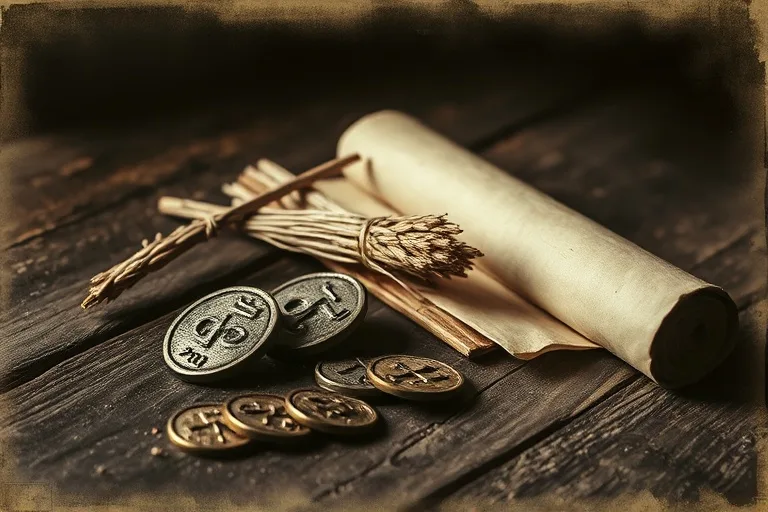
A vintage photographic still life showcasing the traditional tools for consulting the I Ching, including ancient coins and yarrow stalks.
Consulting the I Ching typically involves casting coins or manipulating yarrow stalks to generate a hexagram. The process is not random but is believed to tap into the collective unconscious, providing a symbolic representation of the inquirer's current situation and potential future developments. The resulting hexagram, along with any "changing lines" (lines that transform from Yin to Yang or vice versa), offers a dynamic prognosis, often suggesting a course of action or a shift in perspective.
Interpreting the I Ching requires contemplation and an understanding of its nuanced language. It speaks in archetypes, metaphors, and subtle suggestions, encouraging introspection rather than providing direct answers. This system excels at revealing the underlying dynamics of a situation, the cyclical nature of change, and the optimal way to align oneself with cosmic flow. For further insights into ancient wisdom, consider exploring Tarot Quantum Mechanics Intersecting Divination Reality.
Understanding the Tarot: The Mirror to the Soul
The Tarot, in contrast to the I Ching, is a deck of 78 cards, each adorned with rich symbolic imagery. Its origins can be traced to 15th-century Italy, where it began as a game before evolving into a powerful tool for self-reflection and divination. The deck is divided into two main sections: the Major Arcana and the Minor Arcana.
The 22 cards of the Major Arcana represent significant life lessons, archetypal influences, and spiritual journeys, from The Fool's innocent beginnings to The World's ultimate completion. These cards often speak to the larger themes and transformative experiences in an individual's life. The Minor Arcana, consisting of 56 cards divided into four suits (Wands, Cups, Swords, and Pentacles), reflects the everyday events, challenges, and opportunities that shape our reality. Each suit corresponds to different aspects of life: Wands to creativity and passion, Cups to emotions and relationships, Swords to intellect and conflict, and Pentacles to material concerns and practical matters.
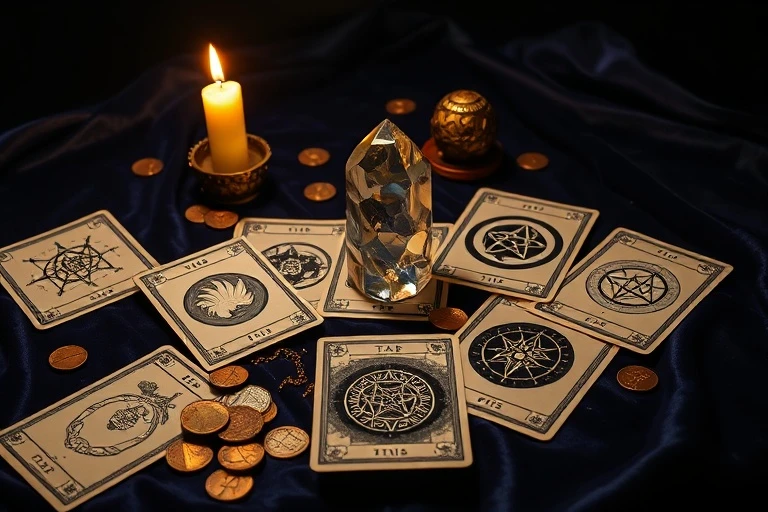
A cinematic still life featuring a Tarot card spread, a flickering candle, and a quartz crystal, embodying mystical introspection.
A Tarot reading involves shuffling the deck and laying out cards in a specific pattern, or "spread," each position in the spread representing a different facet of the inquiry (e.g., past, present, future, challenges, advice). The reader then interprets the cards based on their individual meanings, their positions in the spread, and their interplay with surrounding cards. Tarot is particularly adept at exploring psychological states, emotional landscapes, and the tangible manifestations of energy in one's life. It offers a visual narrative that can be deeply personal and emotionally resonant, acting as a mirror to the soul. For more on how symbols influence our path, consider reading about Lunar Nodes: Karmic Path in Signs and Houses.
Why Integrate I Ching and Tarot? Complementary Perspectives
The decision to integrate the I Ching and Tarot stems from their inherent complementary nature. While both are divination tools, they operate on different energetic frequencies and offer distinct types of information. The I Ching tends to provide a more philosophical, macro-level view, focusing on the underlying patterns of change, the ebb and flow of cosmic forces, and the optimal alignment with universal principles. It answers questions with a sense of destiny and the natural progression of events.
The Tarot, on the other hand, excels at offering micro-level insights, delving into the psychological, emotional, and practical aspects of a situation. It illuminates personal choices, emotional responses, and the immediate influences at play. Where the I Ching might reveal the overarching trend, the Tarot can detail the specific emotional challenges or practical steps involved. By combining them, practitioners can achieve a holistic understanding that is both expansive and deeply personal.
- Holistic View: Gain both the cosmic perspective (I Ching) and the personal, psychological perspective (Tarot).
- Enhanced Clarity: What might be abstract in one system becomes concrete in the other, and vice versa.
- Deeper Nuance: Explore the layers of meaning that a single system might not fully reveal.
- Validation: Insights from one system can validate or expand upon those from the other, building confidence in the reading.
- Personal Growth: The dual approach encourages a more comprehensive self-reflection and a broader understanding of one's path.
This integration is not about replacing one system with another but about creating a richer dialogue between them. It acknowledges that reality is multi-faceted and that different tools can illuminate different facets, ultimately leading to a more profound and actionable guidance. The synergy created by this dual approach can be particularly beneficial when facing complex decisions or seeking profound spiritual understanding. For those interested in deeper spiritual insights, consider exploring Sound Alchemy: Cellular Regeneration, Manifestation Frequencies.
Practical Methods for Integration
There are several ways to integrate the I Ching and Tarot, ranging from simple sequential readings to more complex structural overlays. The best method often depends on the nature of the question, the practitioner's comfort level with each system, and their intuitive preferences. Here are some popular and effective approaches:
Sequential Reading: Broad Strokes to Fine Details
This is perhaps the most straightforward method. Begin by consulting the I Ching for a broad, overarching perspective on your question. The hexagram and its changing lines will provide the general theme, the underlying dynamics, and the recommended attitude or course of action. Once you have a clear understanding of the I Ching's message, then turn to the Tarot.
Using the insights from the I Ching as your foundation, formulate a more specific question for the Tarot. For example, if the I Ching indicates a need for patience and perseverance (e.g., Hexagram 5, Waiting), you might ask the Tarot: "What specific emotional challenges might I face during this period of waiting?" or "What practical steps can I take to cultivate patience?" The Tarot spread will then provide detailed, actionable advice and psychological insights that elaborate on the I Ching's broader counsel.
Parallel Reading: Dual Perspectives on a Single Question
In a parallel reading, you pose the exact same question to both the I Ching and the Tarot independently. Perform an I Ching consultation, record the hexagram and its interpretation, and then perform a Tarot reading (using a standard spread like the Celtic Cross or a three-card spread) on the identical question. This method allows you to compare and contrast the insights from both systems directly.
Look for points of convergence, where both systems offer similar advice or highlight the same core issue. Also, pay attention to areas where they diverge, as these differences can provide crucial nuances. For instance, the I Ching might emphasize the impersonal forces at play, while the Tarot might focus on your personal agency and emotional state within those forces. This juxtaposition creates a rich, multi-dimensional understanding of the situation. To understand personal agency in your chart, consider Ascendant Sign: Rising Sign Calculator and Meaning.
I Ching as a Tarot Spread: Structuring Tarot with Hexagrams
This advanced technique uses the structure of an I Ching hexagram to create a unique Tarot spread. First, cast the I Ching to get your primary hexagram and its changing lines. Instead of interpreting the hexagram directly, you will use its six lines as positions for Tarot cards. Each line of the hexagram corresponds to a specific stage or aspect of the situation, from the bottom (initial stage) to the top (culmination).
You can draw six Tarot cards, one for each line, to represent the energy or advice associated with that stage. If there are changing lines in the I Ching reading, you might draw an additional Tarot card for each changing line, placing it adjacent to the primary card for that line, to represent the "changing" influence. This method allows the deep philosophical structure of the I Ching to frame the rich imagery and psychological insights of the Tarot, creating a highly integrated and profound reading experience.
Tarot as a Clarifier for I Ching: Illuminating Nuances
Sometimes, an I Ching reading can feel abstract or difficult to apply to a concrete situation. In such cases, the Tarot can serve as an excellent clarifier. After casting the I Ching and identifying the hexagram and its changing lines, if any part of the interpretation remains unclear or feels too generalized, draw one or more Tarot cards specifically to clarify that particular aspect.
For example, if the I Ching advises "perseverance" but you're unsure what that looks like in your current context, you might draw a single Tarot card asking, "What does perseverance mean for me in this situation?" The Tarot card (e.g., Strength, The Chariot, 8 of Pentacles) will provide a visual and symbolic representation that can make the I Ching's advice more tangible and actionable. This method is particularly useful for bridging the gap between the I Ching's grand cosmic statements and the practicalities of daily life.
Benefits of a Dual Divination Approach
Embracing an integrated I Ching and Tarot practice offers a multitude of benefits that can significantly enrich your divination journey and personal development. The combined wisdom of these two systems provides a depth and breadth of insight that neither can achieve alone.
| Benefit | Description |
|---|---|
| Holistic Understanding | Combines the macro-level, philosophical insights of the I Ching with the micro-level, psychological details of the Tarot, offering a complete picture. |
| Enhanced Clarity | One system can clarify ambiguities in the other, leading to more precise and actionable guidance. |
| Deeper Self-Reflection | The interplay of different symbolic languages stimulates deeper introspection and a broader perspective on personal issues. |
| Validation and Confidence | When both systems point to similar themes, it reinforces the message and builds trust in the divination process. |
| Personalized Guidance | The combination allows for a highly personalized interpretation, tailoring universal wisdom to individual circumstances. |
| Overcoming Limitations | Each system has its strengths and weaknesses; integration helps to mitigate these, providing a more robust toolset. |
| Spiritual Growth | Engaging with multiple wisdom traditions expands one's spiritual vocabulary and understanding of universal principles. |
By consciously engaging with both the I Ching's ancient wisdom and the Tarot's rich symbolism, practitioners can develop a more profound relationship with their intuition and the subtle currents of life. This dual approach encourages a dynamic and interactive form of divination, moving beyond simple fortune-telling to become a powerful practice for self-mastery and enlightened living. For more on how to unlock your inner wisdom, check out Automatic Writing Intuition: Unlocking Inner Wisdom.
Challenges and Important Considerations
While the integration of I Ching and Tarot offers immense potential, it also comes with certain challenges and considerations that practitioners should be aware of. Navigating these aspects thoughtfully will ensure a more effective and less confusing practice.
- Learning Curve: Mastering one divination system is already a journey; integrating two requires dedication and patience. It's crucial to have a foundational understanding of each system independently before attempting to combine them.
- Potential for Confusion: Receiving messages from two different symbolic languages can sometimes lead to conflicting interpretations or overwhelming information. It's important to develop a clear methodology for how you will synthesize the information.
- Time Commitment: Integrated readings typically take more time than single-system readings, both in the consultation process and in the subsequent interpretation and journaling.
- Developing Intuition: While both systems provide frameworks, the true art of integration lies in developing your intuitive capacity to connect the dots between the I Ching's hexagrams and the Tarot's imagery. This takes practice and trust in your inner guidance.
- Respecting Each System: It's vital to approach both the I Ching and Tarot with respect for their unique histories, philosophies, and symbolic integrity. The goal is synergy, not to force one system into the mold of the other.
A common pitfall is trying to make one system "prove" the other. Instead, view them as two distinct voices contributing to a larger conversation. Embrace the differences as much as the similarities, as these contrasts often hold the most profound insights. Patience and a willingness to explore are key to overcoming these challenges and unlocking the full potential of a dual divination approach. For those seeking deeper understanding of their inner self, exploring can be beneficial.
Tips for Successful Integration
To make the most of your integrated I Ching and Tarot practice, consider these practical tips:
- Start Simple: Don't try to implement the most complex integration methods right away. Begin with sequential readings or using Tarot to clarify specific I Ching lines. Gradually build up your practice as your confidence grows.
- Journal Everything: Keep a dedicated journal for your integrated readings. Record your questions, the I Ching hexagrams and their interpretations, the Tarot cards drawn, your initial thoughts, and how the two systems connect. Reviewing past readings can reveal patterns and deepen your understanding.
- Focus Your Question: A clear, well-formulated question is paramount. The more precise your inquiry, the easier it will be to interpret and integrate the answers from both systems.
- Trust Your Intuition: Ultimately, divination is a dialogue between you and the universe. Pay attention to your gut feelings, sudden insights, and personal associations with the symbols. Your intuition is the bridge that connects the two systems.
- Study Both Systems Independently: Continue to deepen your knowledge of the I Ching and Tarot as separate entities. The more you understand each system's nuances, the richer your integrated readings will become.
- Experiment with Different Decks/Translations: Just as different Tarot decks offer varied artistic interpretations, different translations of the I Ching can resonate differently. Find what works best for you.
- Create Your Own Spreads: Once you're comfortable, don't hesitate to design your own integrated spreads that combine elements of both systems in a way that feels natural and effective for you.
Remember that the journey of divination is a personal one. There is no single "right" way to integrate these powerful tools. Allow yourself to explore, experiment, and discover the methods that resonate most deeply with your own spiritual path. The combination of I Ching and Tarot can be a transformative practice, offering unparalleled guidance and insight into the intricate dance of life. For more on understanding personal destiny, explore Fixed Stars Astrology: Destiny Influence Guide.
Conclusion: The Power of Dual Divination
The integration of the I Ching and Tarot represents a sophisticated and deeply rewarding approach to divination. By combining the ancient, philosophical wisdom of the Book of Changes with the rich, psychological symbolism of the Tarot, practitioners can access a level of insight that is both expansive and intimately personal. This dual method transcends the limitations of single-system readings, offering a holistic perspective on life's challenges and opportunities.
Whether you choose to use them sequentially, in parallel, or by structuring one with the other, the synergy between these two venerable traditions can illuminate the subtle currents of destiny and empower you to make more informed choices. The journey of integrating I Ching and Tarot is one of continuous learning, intuition development, and profound self-discovery. Embrace this powerful combination, and you will find a richer, more nuanced path to understanding yourself and the universe around you.
Fuente: Contenido híbrido asistido por IAs y supervisión editorial humana.


Comments
Post a Comment