
Progressed Chart Astrology: Evolving Self Life Path Guide | StarPluto
Progressed chart astrology offers a profound lens through which to understand our evolving self and life path over time. While the natal chart captures the cosmic snapshot at the moment of birth, representing our inherent potential and psychological blueprint, the progressed chart illustrates how that potential unfolds and matures throughout life. It is not a prediction of external events in the same way transits might be, but rather a symbolic representation of our internal growth, psychological shifts, and the unfolding of our destiny.
This guide delves into the intricate world of progressed charts, explaining their fundamental principles, key components, and practical applications. By understanding the dynamics of secondary progressions, individuals can gain invaluable insights into their personal evolution, identify periods of significant internal change, and align with their authentic life path. It's a journey of self-discovery that reveals the rhythm of our soul's development, moving beyond static birth energies to embrace the fluid nature of existence.
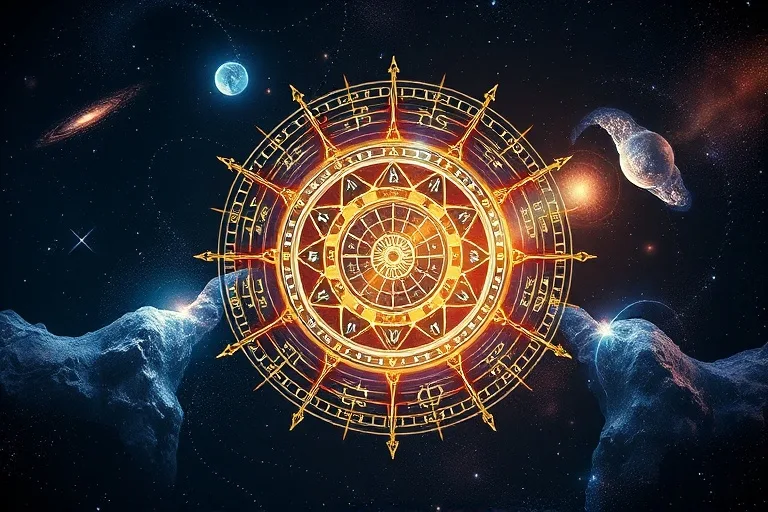
The cosmic clock of the progressed chart, illustrating the continuous evolution of the self and life's journey.
The concept of progression in astrology is rooted in the idea that time itself carries symbolic meaning. Just as a seed contains the blueprint of a mighty tree, the natal chart holds the potential for our entire life's journey. Progressions act as a slow-motion film of this unfolding, revealing the internal landscape as it transforms. This method is particularly powerful for understanding psychological development, shifts in identity, and the timing of major life transitions that originate from within.
Unlike fast-moving transits, which represent external planetary influences, progressions reflect an internal clock, a deeper, more personal rhythm. They show us where our energy is being directed, what lessons we are learning, and how our core being is adapting to life's experiences. This makes progressed charts an indispensable tool for self-reflection and personal growth, offering guidance on when to initiate new ventures, when to consolidate, and when to release old patterns.
Understanding Progressed Chart Astrology
Progressed chart astrology, primarily utilizing secondary progressions, is a predictive technique that advances the natal chart symbolically forward in time. The most common method, secondary progressions, uses the "day for a year" principle: each day after birth corresponds to one year of life. For instance, if you are 30 years old, your progressed chart would be calculated based on the planetary positions 30 days after your birth.
This symbolic movement of planets and house cusps creates a dynamic chart that evolves alongside the individual. It's crucial to understand that the progressed chart does not replace the natal chart; rather, it builds upon it. The natal chart remains the foundation, representing our core essence, while the progressed chart shows how that essence is expressed and transformed through lived experience.
The slow pace of progressions means that changes are gradual and deeply felt. A progressed planet might stay in a sign or house for many years, indicating a prolonged period of development in that area of life. This contrasts sharply with transits, where planets can move through signs and houses much more quickly, bringing about more immediate and often external events.
The progressed chart is particularly insightful for understanding:
- Internal Psychological Development: How our personality, desires, and emotional landscape mature.
- Shifts in Identity: The evolution of our self-perception and how we present ourselves to the world.
- Unfolding Life Purpose: The gradual revelation and alignment with our deeper calling.
- Periods of Growth and Stagnation: Identifying cycles of expansion, consolidation, or necessary introspection.
By overlaying the progressed chart onto the natal chart, astrologers can identify significant aspects forming between progressed planets and natal planets, as well as between progressed planets themselves. These aspects highlight periods of heightened internal activity and potential for growth, often coinciding with major life turning points.
Key Components of the Progressed Chart
Analyzing a progressed chart involves examining several key components, each offering unique insights into the individual's evolving journey. Understanding these elements is fundamental to interpreting the chart's message.
The most significant components include:
- Progressed Sun: Represents the evolving core identity and life purpose. Its movement through signs and houses indicates shifts in self-expression and what drives us.
- Progressed Moon: Symbolizes our changing emotional needs, habits, and inner world. The progressed Moon moves relatively quickly, changing signs every 2.5 years, marking more frequent emotional shifts.
- Progressed Mercury: Shows the evolution of our communication style, thought processes, and learning interests.
- Progressed Venus: Reflects changes in our values, relationships, aesthetic preferences, and what we find pleasurable.
- Progressed Mars: Indicates shifts in our drive, assertiveness, energy levels, and how we pursue our goals.
- Progressed Ascendant (Rising Sign): This is one of the most powerful indicators of how our outer personality and presentation to the world are evolving. When the progressed Ascendant changes signs, it often marks a significant shift in identity.
- Progressed Midheaven (MC): Represents the evolution of our career, public image, and life direction. Changes here can coincide with major professional shifts or changes in public recognition.
Outer planets (Jupiter, Saturn, Uranus, Neptune, Pluto) move so slowly by progression that they often remain in the same sign for an entire lifetime. Their significance in progressed charts primarily lies in the aspects they form to natal planets or other progressed planets, rather than their sign changes.

An ancient almanac and compass symbolize the intricate components and calculations of astrological charts.
The house cusps also progress, indicating shifts in the areas of life where our energy is focused. When a progressed planet enters a new house, it signifies a new focus for that planet's energy. Similarly, when a progressed house cusp changes signs, it indicates a new approach or perspective on that area of life.
Understanding these components allows for a nuanced interpretation of an individual's developmental journey. Each element contributes to a holistic picture of internal transformation, guiding individuals through their evolving self-awareness and life experiences. The interplay between these progressed elements and the natal chart forms the core of this powerful astrological technique.
The Significance of Progressed Planets
Each progressed planet carries a unique message about our internal evolution. The inner planets—Sun, Moon, Mercury, Venus, and Mars—are particularly active in progressed charts due to their faster apparent motion, offering frequent insights into our personal development.
The Progressed Sun is perhaps the most significant. Its movement into a new sign marks a profound shift in our fundamental identity and purpose, often lasting around 30 years. When the progressed Sun enters a new sign, we begin to embody the qualities of that sign more consciously, integrating them into our core being. For example, a progressed Sun moving from Cancer to Leo might indicate a shift from a more nurturing, introspective focus to a more expressive, confident, and leadership-oriented identity.
The Progressed Moon, as mentioned, changes signs approximately every 2.5 years and houses every 2-3 years. These shifts highlight our fluctuating emotional needs, our comfort zones, and the areas of life where we seek emotional fulfillment. A progressed Moon in the 7th house, for instance, might indicate a period where relationships become a primary focus for emotional security and growth.
Progressed Mercury reveals how our thought processes, communication, and learning styles evolve. A change in sign or house for progressed Mercury can coincide with new intellectual interests, a shift in how we express ourselves, or a period of intense learning. Similarly, Progressed Venus indicates changes in our values, relationship patterns, and what we seek in love and pleasure. A progressed Venus changing signs can signify a new approach to romance or a re-evaluation of what we truly value.
Finally, Progressed Mars shows how our drive and assertiveness mature. Its movement can highlight periods when we feel more energized to pursue specific goals, or when our approach to conflict and action undergoes a significant transformation. The slower outer planets, while not changing signs often, become powerful when they form aspects to natal or progressed planets, triggering deep, transformative internal processes.
Interpreting Progressed Houses and Aspects
Beyond the planets themselves, the houses and aspects in a progressed chart provide crucial context for understanding our evolving life path. Just as planets change signs, the house cusps also progress, altering the areas of life that become activated and where our focus shifts.
When a Progressed House Cusp moves into a new sign, it signifies a new approach or attitude towards the themes of that house. For example, if your 2nd house cusp (finances, values) progresses from Taurus to Gemini, you might find yourself exploring more diverse income streams or becoming more adaptable in your financial strategies. The movement of the Progressed Ascendant and Midheaven, as discussed, are particularly impactful, marking significant shifts in personal identity and public life direction.
Progressed Aspects are arguably the most dynamic and telling elements of a progressed chart. These are angles formed between:
- Progressed Planet to Natal Planet: These aspects indicate periods when the energy of a natal planet is activated and integrated into our evolving self. For example, a progressed Venus conjunct natal Mars might signify a period of increased romantic activity or a more assertive approach to relationships.
- Progressed Planet to Progressed Planet: These aspects highlight internal developmental stages where different parts of our evolving psyche interact. A progressed Sun square progressed Moon, for instance, could indicate a period of internal tension between our conscious identity and emotional needs.
- Progressed Planet to Natal Angle (Ascendant, Descendant, MC, IC): These are powerful indicators of major life turning points, as they bring the internal shifts represented by the progressed planet into our outer life and identity. A progressed Jupiter conjunct natal Midheaven could mark a period of significant career expansion or public recognition.
The nature of the aspect (conjunction, square, trine, opposition, etc.) further refines the interpretation, indicating whether the energy is harmonious, challenging, or transformative. Understanding these intricate relationships allows for a deeper comprehension of the internal processes driving our life's narrative.
Progressed Lunation Cycles: New Moons and Full Moons
One of the most significant cycles within progressed chart astrology is the progressed lunation cycle, which tracks the relationship between the Progressed Sun and the Progressed Moon. This cycle, lasting approximately 29.5 years, mirrors the lunar cycle and represents a complete phase of emotional and identity development.
A Progressed New Moon occurs when the Progressed Sun and Progressed Moon conjoin in the same sign and house. This is a highly potent period, marking the beginning of a new 29.5-year cycle of emotional and identity growth. It's a time for planting new seeds, setting intentions for the next cycle, and often coincides with a profound internal reset or a new direction in life. The sign and house where this New Moon occurs will highlight the themes that will be central to the individual's development for the coming decades.
Conversely, a Progressed Full Moon happens approximately 14-15 years after the New Moon, when the Progressed Sun and Progressed Moon oppose each other. This phase brings a culmination of the themes initiated at the New Moon. It's a period of illumination, awareness, and often a crisis of consciousness where what was planted at the New Moon comes to fruition or demands a significant adjustment. Relationships often play a key role during a progressed Full Moon, as they reflect back to us our emotional realities and identity shifts.
An abstract painting depicting the vibrant and transformative journey of life and self-discovery.
Other phases of the progressed lunation cycle, such as the first quarter, second quarter, and balsamic phase, also hold significance. Each phase represents a different stage of development, from building and expanding to reviewing and releasing. Understanding these cycles provides a powerful framework for navigating life's internal ebb and flow, recognizing when to push forward and when to retreat for reflection.
How Progressed Charts Differ from Transits
While both progressed charts and transits are predictive astrological techniques, they operate on different principles and offer distinct types of information. Confusing the two can lead to misinterpretations of astrological forecasts.
The fundamental difference lies in their nature:
- Transits: These involve the current positions of the planets in the sky as they move over time, forming aspects to the planets and points in your natal chart. Transits represent external energies and events that influence us from the outside. They are often associated with opportunities, challenges, and specific occurrences in our daily lives. Transits can be fast-moving (Moon, Mercury, Venus, Mars) or slow-moving (Jupiter, Saturn, Uranus, Neptune, Pluto), with their impact varying in duration and intensity.
- Progressions: As established, these are symbolic movements of the natal chart planets and points, reflecting internal psychological development and the unfolding of our inherent potential. Progressions represent internal shifts, maturation, and the gradual evolution of our identity and purpose. Their effects are typically more subtle, long-lasting, and felt on a deeper, subjective level.
Think of it this way: if your life is a play, transits are the external stage directions, the props, and the other actors you interact with. Progressions, on the other hand, are the internal monologue of your character, how your motivations change, and how you grow and adapt from within. Both are vital for a complete understanding of your life's narrative.
A significant life event might have both strong transits and progressed aspects occurring simultaneously. For example, a career change could be triggered by a powerful transit of Uranus to your Midheaven (external opportunity/disruption) while your progressed Sun moves into your 10th house (internal drive to pursue a new career path). The combination of both techniques provides a richer, more comprehensive astrological picture.
Practical Applications of Progressed Chart Analysis
The insights gained from progressed chart analysis are highly practical and can be applied to various aspects of life, aiding in personal development and decision-making.
Some key applications include:
- Self-Discovery and Personal Growth: Progressions illuminate periods of significant internal change, helping individuals understand why they feel different or are drawn to new interests. This self-awareness fosters personal growth and authenticity.
- Career and Vocation: Shifts in the progressed Midheaven or progressed Sun can indicate evolving career aspirations or a readiness to pursue a new professional path that aligns more closely with one's maturing identity.
- Relationships: Progressed Venus and progressed Moon movements, as well as aspects to the 7th house, can highlight periods of relationship focus, new romantic interests, or significant shifts in existing partnerships. They reveal our evolving needs in connection.
- Timing Major Life Decisions: While not prescriptive, progressed charts can indicate optimal times for internal readiness to make major life changes, such as moving, starting a family, or undertaking significant personal projects.
- Understanding Life Cycles: The progressed lunation cycle, in particular, provides a powerful framework for understanding the ebb and flow of our emotional and identity development over decades, helping us to navigate each phase with greater consciousness.
- Creative Expression: Progressed Mercury and Venus can indicate periods of heightened creativity or a shift in artistic interests and expression.
By integrating progressed chart insights with natal chart potentials and current transits, individuals can gain a holistic understanding of their journey. It empowers them to make conscious choices that are in harmony with their deepest internal rhythms and evolving self.
Common Misconceptions About Progressed Astrology
Despite its profound utility, progressed astrology is sometimes misunderstood. Clarifying these common misconceptions is essential for a correct and effective application of this technique.
Here are some common misunderstandings:
- Progressions Predict External Events: While internal shifts often lead to external changes, progressions primarily describe internal development. They show *why* you're ready for a change, not necessarily *what* the change will be or *when* it will manifest externally. Transits are better for predicting external events.
- Progressions Overrule the Natal Chart: The natal chart remains the foundation of all astrological analysis. Progressions are a layer of interpretation built upon this foundation, showing how natal potentials unfold, not replacing them.
- Only Major Aspects Matter: While conjunctions, squares, and oppositions are often the most noticeable, trines and sextiles also indicate periods of effortless growth and opportunity. Even minor aspects can highlight subtle but significant internal shifts.
- Progressions are Always Positive: Like all astrological influences, progressions can represent challenging periods. A progressed square or opposition might indicate internal tension or a need to confront difficult aspects of oneself, leading to growth through struggle.
- Every Progressed Aspect is a Major Event: Many progressed aspects are subtle, reflecting gradual internal shifts rather than dramatic turning points. The impact depends on the planets involved, the houses, and the overall context of the chart.
By dispelling these myths, individuals can approach progressed chart analysis with a more accurate understanding, leveraging its power for genuine self-awareness and conscious evolution. It's a tool for deep introspection, not a crystal ball for predicting every detail of the future.
In conclusion, progressed chart astrology offers a unique and invaluable perspective on the journey of life. It reveals the dynamic interplay between our inherent potential and our evolving reality, guiding us through the intricate dance of personal growth and destiny. By embracing its insights, we can navigate our life path with greater awareness, purpose, and self-understanding.
Source: Hybrid content assisted by AIs and human editorial supervision.


Comments
Post a Comment