
Sabian Symbols Astrology: Esoteric Meanings Degrees | StarPluto
The Sabian Symbols represent a unique and profound system within astrology, offering an esoteric lens through which to interpret the meaning of each of the 360 degrees of the zodiac. Far from being mere fortune-telling devices, these symbols provide a rich tapestry of imagery and narrative that can unlock deeper psychological, spiritual, and evolutionary insights into an individual's natal chart or any astrological event. Their interpretive power lies in their ability to transcend conventional astrological keywords, inviting a more intuitive and symbolic understanding of cosmic influences.
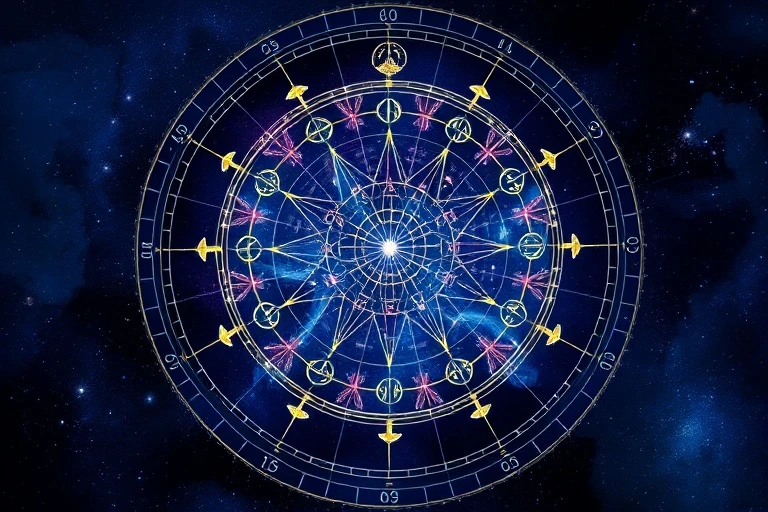
A digital painting illustrating the intricate and esoteric nature of Sabian Symbols within a celestial map, highlighting their profound astrological significance.
Developed in 1925, the Sabian Symbols were channeled by clairvoyant Elsie Wheeler and meticulously recorded by astrologer Marc Edmund Jones. Later, they were popularized and extensively interpreted by Dane Rudhyar, who integrated them into his system of humanistic and transpersonal astrology. This system posits that each degree of the zodiac carries a specific, archetypal image or scenario, offering a symbolic key to understanding the underlying purpose and potential challenges associated with planetary placements or house cusps at that particular degree.
Understanding the Sabian Symbols requires moving beyond a literal interpretation and engaging with their metaphorical and archetypal dimensions. Each symbol acts as a miniature story or a snapshot of a universal human experience, reflecting the energetic quality of that specific zodiacal point. They provide a layer of nuance and depth that traditional astrological interpretations often cannot capture, making them an invaluable tool for advanced astrological analysis and self-discovery.
Table of Contents
- History and Origin of the Sabian Symbols
- How Sabian Symbols Work
- Interpreting the Sabian Symbols
- Examples by Zodiac Sign
- Practical Application in Astrology
- Criticisms and Controversies
- Conclusion
History and Origin of the Sabian Symbols
The genesis of the Sabian Symbols is as intriguing as their interpretations. They were created on November 17, 1925, in Balboa Park, San Diego, California, through a unique collaboration between clairvoyant Elsie Wheeler and astrologer Marc Edmund Jones. Wheeler, who was blind, possessed a remarkable psychic ability to visualize symbolic images when presented with specific astrological degrees.
Jones, a prominent figure in American astrology, sought to create a set of symbols that would provide a deeper, more qualitative understanding of astrological degrees beyond their quantitative numerical value. He believed that each degree held a unique energetic signature, and the Sabian Symbols were intended to capture these subtle distinctions. The process involved Jones shuffling 360 cards, each representing a degree of the zodiac, and Wheeler, in a trance-like state, describing the images she perceived for each card as it was presented to her.
An antique engraving depicting an open astrological manuscript, symbolizing the historical roots of esoteric knowledge and symbolic interpretation.
The entire process took only a few hours, resulting in 360 distinct symbolic images, one for each degree from Aries 1 to Pisces 30. Jones meticulously recorded each symbol, and his initial work laid the foundation for future interpretations. However, it was the work of Dane Rudhyar, a French-American astrologer, composer, and philosopher, that truly brought the Sabian Symbols to prominence.
Rudhyar, a proponent of humanistic and transpersonal astrology, saw in the Sabian Symbols a powerful tool for psychological and spiritual growth. He published his seminal work, "An Astrological Mandala: The Cycle of Transformations and Its 360 Symbolic Phases," in 1973, offering his profound interpretations of each symbol. Rudhyar's approach emphasized the evolutionary and transformative potential embedded within each symbol, viewing them as archetypal patterns of human experience and consciousness. His interpretations are widely regarded as the definitive resource for understanding the deeper meanings of the Sabian Symbols, moving beyond simple descriptions to explore their philosophical and psychological implications.
How Sabian Symbols Work
The Sabian Symbols operate on the principle that every degree of the zodiac possesses a unique vibrational quality and symbolic message. When a planet, ascendant, midheaven, or any other significant point in a natal chart falls on a particular degree, the corresponding Sabian Symbol provides an additional layer of insight into that point's meaning. It's crucial to understand that these symbols are not meant to replace traditional astrological interpretations but rather to enrich and deepen them.
To use the Sabian Symbols, one first needs to determine the exact degree of a planetary placement or house cusp. Astrological software or ephemerides typically provide these precise degree readings. For example, if a planet is at 15 degrees and 20 minutes of Aries, you would look up the symbol for Aries 16 degrees. The convention is to round up to the next whole degree, as the symbol describes the entire degree that is being entered or activated.
Each symbol is a short, evocative phrase or image. For instance, Aries 16 degrees is "Aries 16: A PUCKISH BOY, OR 'PUTTO', REVEALING TO A TEACHER A COLLECTION OF ANCIENT SPECIMENS." This isn't a literal prediction but an archetypal scenario that speaks to themes of youthful curiosity, the discovery of hidden knowledge, the transmission of wisdom, and the blending of innocence with profound insight.
The power of the Sabian Symbols lies in their ability to stimulate intuition and symbolic thinking. They encourage the astrologer and the individual to engage with the image, meditate on its various facets, and discern how its themes resonate with their life experiences and the specific astrological placement in question. They offer a narrative framework, suggesting potential life paths, inherent qualities, and the nature of challenges or opportunities.
The symbols are not static; their meaning can evolve and reveal different layers depending on the context of the chart and the individual's stage of life. They are particularly useful for understanding the subtle nuances of planetary aspects, providing a qualitative description of the interaction between two planets or points. By integrating the Sabian Symbols, astrologers can offer more personalized, insightful, and spiritually oriented readings.
Interpreting the Sabian Symbols
Interpreting the Sabian Symbols is an art that blends intuition with a deep understanding of archetypal psychology and astrological principles. It moves beyond simple keyword associations, inviting a more holistic and narrative approach to chart analysis. The key is to engage with the symbol's imagery and allow its story to unfold in relation to the specific planetary or house placement.

An abstract 3D render depicting a cosmic vortex, symbolizing the deep introspection and unveiling of hidden meanings inherent in symbolic interpretation.
When interpreting a symbol, consider the following aspects:
- The Core Image: What is the central scene or object? What immediate feelings or associations does it evoke?
- The Action or State: Is there movement, interaction, or a particular state of being depicted? This often reveals the dynamic quality of the degree.
- Archetypal Themes: What universal human experiences or archetypes are suggested? Themes of struggle, growth, community, isolation, creation, destruction, etc.
- Polarities and Dualities: Many symbols contain inherent tensions or contrasts. Understanding these can reveal the spectrum of experiences associated with the degree.
- Context of the Placement: How does the symbol relate to the planet it describes (e.g., Mars for action, Venus for relationships, Moon for emotions) or the house it falls in (e.g., 1st house for self, 7th house for partnerships)?
Dane Rudhyar's interpretations are particularly valuable because they provide a humanistic and evolutionary perspective. He often describes the "keyword" or "central meaning" of each symbol, followed by a detailed explanation of its positive, negative, and transformative potentials. Rudhyar emphasizes that the symbols are not fixed destinies but rather invitations to conscious participation in one's life process.
For example, consider "Leo 1: BLOOD BLOWS AHEAD AND A PERSON IS DROWNED." At first glance, this seems ominous. However, Rudhyar interprets this as a symbol of "RADICAL REORIENTATION," suggesting a necessary, often intense, purification or release of past patterns to make way for a new phase of self-expression. It speaks to the dramatic, often challenging, beginnings associated with the first degree of a fixed sign like Leo, demanding a complete break from the old to embrace the new.
The process of interpretation is highly personal and subjective, requiring the astrologer to synthesize the symbol's imagery with their knowledge of astrology and their understanding of the individual. It's a dialogue between the symbol, the chart, and the human experience, leading to profound insights into character, purpose, and destiny.
Examples by Zodiac Sign
To illustrate the diversity and depth of the Sabian Symbols, let's explore a few examples across different zodiac signs. These are just brief glimpses; a full interpretation would delve much deeper into Rudhyar's extensive analyses.
| Zodiac Sign & Degree | Sabian Symbol | Key Interpretation (Simplified) |
|---|---|---|
| Aries 1° | A WOMAN HAS RISEN FROM THE OCEAN. A SEAL IS EMBRACING HER. | Emergence of new forms of consciousness, a fresh start after deep immersion, the embrace of primal nature. |
| Taurus 10° | A RED CROSS NURSE. | Selfless service, compassion, healing, dedication to humanitarian causes, practical care. |
| Gemini 20° | A CAFETERIA. | Choice, variety, social interaction, the ability to select what one needs from many options, self-service. |
| Cancer 15° | A GROUP OF PEOPLE WHO HAVE EATEN TOO MUCH AND BROKEN THE FAST. | Breaking taboos, indulgence, the release of inhibitions, a return to natural impulses after restriction. |
| Leo 25° | A LARGE CAMEL IS SEEN CROSSING THE DESERT. | Resilience, endurance, self-sufficiency, the ability to navigate challenging environments, spiritual journey. |
| Virgo 5° | A MAN BECOMING AWARE OF NATURE SPIRITS AND NORMALLY UNSEEN SPIRITUAL AGENCIES. | Heightened perception, connection to the unseen world, spiritual awakening, sensitivity to subtle energies. |
| Libra 1° | A BUTTERFLY PRESERVED AND MADE PERFECT WITH A DART THROUGH IT. | The idealization of form, the pursuit of perfection, the sacrifice of dynamic life for static beauty, artistic expression. |
| Scorpio 10° | A SHIP SAILING INTO THE OPEN SEA. | Venturing into the unknown, courage, exploration, the pursuit of new experiences, breaking free from limitations. |
| Sagittarius 20° | MEN CUTTING ICE FROM A FROZEN STREAM. | Resourcefulness, practical application of knowledge, overcoming obstacles, providing for future needs. |
| Capricorn 15° | IN A HOSPITAL, THE CHILDREN'S WARD IS FILLED WITH TOYS. | Healing through joy, comfort in adversity, the importance of play and innocence, collective care. |
| Aquarius 5° | A COUNCIL OF ANCESTORS IS SEEN RECEIVING THE HOMAGE OF A YOUNG MAN. | Respect for tradition, ancestral wisdom, seeking guidance from the past, the continuity of lineage. |
| Pisces 10° | AN AVIATOR SAILS THROUGH THE AIR. | Transcendence, spiritual aspiration, freedom from earthly limitations, a broad perspective, visionary thinking. |
These examples demonstrate how each symbol, though concise, can open up a vast field of interpretation, touching upon various aspects of human experience and potential. They encourage a holistic view, where the astrological placement is seen not just as an energy, but as a living narrative.
Practical Application in Astrology
The practical application of Sabian Symbols in astrology extends beyond simple chart interpretation, offering a powerful tool for self-reflection, personal growth, and understanding life's cyclical patterns. Astrologers often integrate them into various forms of analysis to provide deeper, more nuanced insights.
- Natal Chart Interpretation: The most common use is to interpret planets, ascendant, midheaven, and house cusps. The symbol for a planet's degree can reveal the specific flavor or archetypal challenge/gift associated with that planetary energy in the individual's life. For example, a Mercury placement on a certain degree might indicate a unique way of thinking or communicating, as described by its Sabian Symbol.
- Transits and Progressions: When a transiting or progressed planet activates a degree in the natal chart, examining the Sabian Symbol for that degree can shed light on the nature of the experience. It can describe the archetypal story unfolding during that period, offering guidance on how to navigate the energies.
- Synastry and Composite Charts: In relationship astrology, the Sabian Symbols can illuminate the dynamics between two individuals. The symbols for key points in synastry (e.g., one person's Sun conjunct another's Moon) or composite charts can describe the core purpose or challenges of the relationship.
- Electional Astrology: For choosing auspicious times for events, the Sabian Symbols of the Ascendant or other key placements at a chosen moment can provide additional confirmation or insight into the underlying potential of the elected time.
- Horary Astrology: In horary questions, the symbol for the Ascendant or the significator of the question can offer a symbolic answer or a deeper understanding of the question's essence.
- Personal Meditation and Affirmation: Individuals can meditate on the Sabian Symbols relevant to their chart, using them as prompts for self-discovery, journaling, or creating affirmations aligned with the symbol's positive potential. This fosters a deeper connection to their inner wisdom and life purpose.
The symbols act as a bridge between the concrete reality of life events and the abstract, archetypal forces at play. They encourage a more intuitive and qualitative approach to astrology, moving away from rigid definitions towards a fluid, symbolic understanding of the cosmos and its influence on human experience. By engaging with the Sabian Symbols, astrologers and enthusiasts alike can unlock richer layers of meaning in any astrological chart.
Criticisms and Controversies
Despite their widespread use and profound impact on humanistic astrology, the Sabian Symbols have not been without their share of criticisms and controversies. Like any esoteric system, their subjective nature and method of creation have drawn scrutiny from various corners, both within and outside the astrological community.
- Subjectivity of Interpretation: One of the primary criticisms is the highly subjective nature of interpreting the symbols. While this is also a strength, allowing for deep personal resonance, it can lead to varied and sometimes contradictory interpretations. Critics argue that without a clear, objective framework, the symbols can be bent to fit any narrative, diminishing their predictive or analytical value.
- Method of Creation: The clairvoyant channeling method used by Elsie Wheeler, while fascinating, is often cited as a point of contention. Skeptics question the scientific validity and reproducibility of such a process, suggesting that the symbols might be more a product of Wheeler's subconscious or the collective unconscious at that specific time, rather than universally inherent meanings of degrees.
- Lack of Empirical Evidence: As with much of astrology, empirical evidence supporting the direct correlation between Sabian Symbols and life events is scarce. This makes them difficult to validate through conventional scientific methods, leading some to dismiss them as anecdotal or purely psychological constructs.
- Over-Interpretation: There's a risk of over-interpreting or forcing a connection between a symbol and a life event, especially for those new to the system. This can lead to confirmation bias, where individuals seek to find the symbol's meaning in every aspect of their lives, rather than using it as a guide for deeper reflection.
- Cultural Bias: The symbols were channeled in a specific cultural context (early 20th-century America). Some critics argue that while Dane Rudhyar's interpretations aimed for universality, the imagery itself might carry a Western cultural bias, potentially limiting its direct applicability or resonance for individuals from vastly different cultural backgrounds.
Despite these criticisms, proponents of the Sabian Symbols emphasize their value as a heuristic tool for self-discovery and spiritual insight. They argue that the symbols are not meant to be literal but archetypal, tapping into universal patterns of consciousness. For many, their power lies precisely in their ability to bypass the rational mind and speak directly to the intuition, offering a unique language for the soul's journey. The ongoing debate highlights the tension between empirical and esoteric approaches to understanding the cosmos and human experience.
Conclusion
The Sabian Symbols stand as a testament to the rich and multifaceted nature of astrological interpretation. Born from a unique clairvoyant collaboration and refined through the profound philosophical insights of Dane Rudhyar, they offer a powerful, symbolic language for understanding the esoteric meanings embedded within each degree of the zodiac. Far from being a rigid system of prediction, they serve as archetypal narratives that illuminate the psychological, spiritual, and evolutionary potentials inherent in any astrological chart placement.
Their value lies in their capacity to transcend conventional astrological keywords, inviting a deeper, more intuitive engagement with cosmic influences. By meditating on these vivid images, individuals and astrologers alike can unlock nuanced insights into life's challenges, opportunities, and overarching purpose. While they may face criticisms regarding their subjective nature and lack of empirical validation, their enduring popularity among serious astrological students and practitioners speaks to their profound ability to resonate with the human experience.
Ultimately, the Sabian Symbols are more than just astrological tools; they are keys to unlocking a richer, more symbolic understanding of ourselves and our journey through life. They encourage us to look beyond the surface, to embrace the metaphorical, and to find meaning in the intricate dance between destiny and free will. For those seeking to deepen their astrological practice and embark on a path of profound self-discovery, the Sabian Symbols offer an invaluable and endlessly fascinating resource.
Fuente: Contenido híbrido asistido por IAs y supervisión editorial humana.


Comments
Post a Comment