
Advanced Planetary Dignities: Optimizing Auspicious Timings
Electional astrology is a specialized branch of astrological practice focused on identifying the most auspicious moment to initiate an endeavor. Unlike natal astrology, which analyzes the chart of birth, or horary astrology, which answers specific questions, electional astrology seeks to "elect" a moment in time that holds the greatest potential for success and favorable outcomes for a given action. This discipline is rooted in the belief that every moment carries a unique energetic signature, and by aligning our actions with favorable cosmic currents, we can significantly enhance the likelihood of achieving our desired results. The core principle involves selecting a precise time when the planetary positions and aspects are most harmonious for the specific purpose at hand.
While basic electional astrology often considers general planetary placements and major aspects, advanced practice delves deeply into the nuanced concept of planetary dignities. These dignities describe the strength, comfort, and effectiveness of a planet within a particular zodiac sign or house. A planet's dignity indicates its ability to act freely and beneficently, or conversely, its struggle and potential for malefic influence. Understanding and meticulously applying these advanced dignities is paramount for optimizing electional charts, moving beyond superficial considerations to craft truly powerful and propitious timings. This comprehensive guide explores these advanced concepts, providing a framework for their practical application.
 A celestial mechanism depicting the intricate alignment of planets and astrological symbols, crucial for understanding auspicious timings.
Understanding Essential Dignities: The Foundation
Essential dignities refer to a planet's inherent strength or weakness based on its zodiacal placement. These are fundamental to traditional astrology and provide the bedrock for any electional analysis. A planet operating from a position of essential dignity is considered to be "at home" or "exalted," allowing it to express its nature positively and effectively. Conversely, a planet in detriment or fall is weakened, struggling to manifest its potential constructively.
The primary essential dignities include Rulership, Exaltation, Detriment, and Fall. Understanding these is non-negotiable for any serious electional astrologer. These positions dictate the fundamental quality of a planet's influence, regardless of other factors. For instance, Venus in Libra (its rulership) will inherently function more smoothly in matters of relationships and aesthetics than Venus in Aries (its detriment).
- Rulership (Domicile): A planet is in its rulership when it is in the sign it naturally governs. This is its strongest position, where it acts with full authority and comfort. For example, Mars rules Aries and Scorpio.
- Exaltation: This is a position where a planet is highly honored and expresses its nature with great power and prominence, often in a more refined or amplified way than in its domicile. The Sun is exalted in Aries, for instance.
- Detriment: A planet is in detriment when it is in the sign opposite its rulership. Here, it is weakened and operates outside its comfort zone, often leading to challenges or difficulties in its expression. Venus in Aries is in detriment.
- Fall: This is the sign opposite its exaltation. A planet in fall is considered to be in its weakest and most challenging position, where its energies are diminished or misdirected. The Sun is in fall in Libra.
Beyond these four, minor essential dignities like Triplicity, Term, and Face (or Decan) also contribute to a planet's overall strength. While less potent than rulership or exaltation, they can provide crucial "tie-breaking" factors in complex elections, especially when multiple planets are involved or when a planet lacks major dignity. The accumulation of these minor dignities can significantly bolster a planet's effectiveness, turning a moderately placed planet into a capable one for the matter at hand.
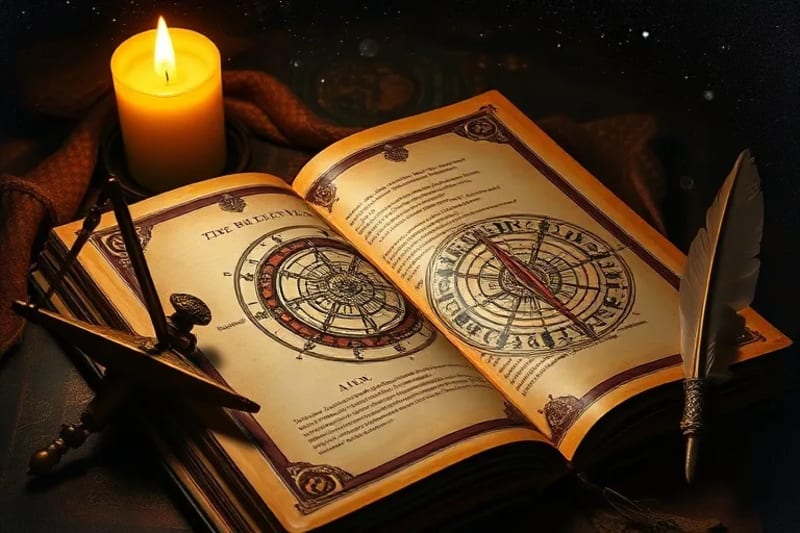 An open astrological text, illuminated by candlelight, revealing complex charts and an astrolabe, symbolizing deep study.
The concept of mutual reception is also a powerful essential dignity. This occurs when two planets are in each other's signs of rulership or exaltation. For example, Mars in Libra and Venus in Aries are in mutual reception by rulership. This creates a supportive and cooperative dynamic between the two planets, allowing them to "help" each other, even if one or both are in detriment. Mutual reception can significantly mitigate challenging placements and should always be sought in electional charts, particularly for matters involving two distinct planetary significations.
Understanding the nuanced interplay of these essential dignities is the first step in mastering electional astrology. It's not enough to simply know where a planet is; one must grasp how comfortable and effective it is in that position. This foundational knowledge allows for a more sophisticated selection of timings, ensuring that the primary planetary significators for an event are operating from a position of inherent strength and positive expression.
Delving into Accidental Dignities: Contextual Strength
While essential dignities describe a planet's inherent nature, accidental dignities refer to its strength or weakness based on its position within the chart's houses, its motion, and its relationship to other celestial bodies. These dignities are "accidental" because they are not intrinsic to the planet itself but depend on the specific chart configuration. A planet with strong essential dignity can still be hampered by poor accidental dignity, and vice-versa. Optimizing electional charts demands a careful balance of both.
The most significant accidental dignities relate to house placement. Planets in angular houses (1st, 4th, 7th, 10th) are considered strongest, as they are "on the angles" and have immediate impact. Succedent houses (2nd, 5th, 8th, 11th) offer moderate strength, providing support and resources. Cadent houses (3rd, 6th, 9th, 12th) are generally considered weakest, as planets here are receding from the angles and may struggle to manifest effectively. The 12th house, in particular, can signify hidden obstacles or self-undoing.
Other crucial accidental dignities involve planetary motion and condition:
- Direct Motion: Planets moving direct are generally stronger and more effective than those in retrograde. Retrograde planets can signify delays, reversals, or internal processes, which are usually undesirable for initiating new ventures.
- Speed: Planets moving faster than their average speed are considered more potent and capable of swift action. Slow-moving planets might indicate a more gradual or delayed outcome.
- Cazimi: A planet is Cazimi when it is within 17 minutes of arc of the Sun. This is a highly fortunate position, where the planet is "in the heart of the Sun," receiving great strength and clarity. It is often sought for critical elections.
- Combustion: A planet within 8.5 degrees of the Sun (but not Cazimi) is combust. This is a weakening position, where the planet's energies are "burned up" or obscured by the Sun's light, making it less effective.
- Under the Sun's Beams: A planet within 17 degrees of the Sun (but outside combustion) is considered "under the beams," still somewhat weakened but less severely than combustion.
- Phasis: A planet that is just emerging from or going into visibility after conjunction with the Sun. An emerging planet (oriental) is often considered stronger and more active.
- Hayz: A complex dignity related to a planet's sect (day or night chart) and its position above or below the horizon. A diurnal planet in a day chart above the horizon, or a nocturnal planet in a night chart below the horizon, gains strength.
- Joy: A planet is in its joy when it is in a house where it is traditionally considered to be particularly comfortable and effective. For example, Mercury joys in the 1st house, Venus in the 5th, Mars in the 6th, Jupiter in the 11th, Saturn in the 12th, and the Moon in the 3rd. The Sun has no house of joy.
The concept of Sect is crucial for understanding accidental dignities. In a day chart (Sun above the horizon), diurnal planets (Sun, Jupiter, Saturn) are naturally stronger, while nocturnal planets (Moon, Venus, Mars) are weaker. In a night chart (Sun below the horizon), the opposite is true. Mercury is versatile and gains strength by being with the sect leader. Aligning the Lord of the Matter with its sect can significantly enhance its power and beneficence.
Another advanced consideration is Antiscia and Contrasciscia. These are points in the zodiac that have equal light or shadow, respectively, based on their distance from the solstices. A planet conjunct another planet's antiscium or contrascium can form a subtle, hidden connection, acting like a conjunction or opposition. In electional astrology, a benefic planet's antiscium conjunct the Lord of the Matter can offer hidden support, while a malefic's antiscium could indicate concealed challenges.
The Lord of the Matter and its Significance
In electional astrology, identifying the Lord of the Matter is the absolute first step after defining the purpose of the election. The Lord of the Matter is the planet that astrologically signifies the core subject or outcome of the endeavor. For example, if electing a time for a marriage, Venus (relationships) and the 7th house ruler (partnership) would be key significators. For a business launch, Mercury (commerce, communication), Jupiter (growth, expansion), and the ruler of the 2nd (finances) or 10th (career, public image) house might be considered.
Once identified, the Lord of the Matter must be as dignified as possible, both essentially and accidentally. Its strength directly correlates with the success and ease of the undertaking. A strong Lord of the Matter ensures that the core intention of the election has the cosmic backing to flourish. Conversely, a weak or afflicted Lord of the Matter can undermine the entire endeavor, regardless of other favorable placements.
Key considerations for the Lord of the Matter:
- Strong Essential Dignity: Ideally, the Lord of the Matter should be in its rulership or exaltation. Failing that, it should have significant minor dignities (triplicity, term, face).
- Strong Accidental Dignity: It should be in an angular house (1st, 10th, 7th, 4th), moving direct, and ideally fast in motion. Being Cazimi or in its house of joy further enhances its accidental strength.
- Benefic Aspects: The Lord of the Matter should receive harmonious aspects (trines, sextiles) from benefic planets (Jupiter, Venus) and avoid harsh aspects (squares, oppositions) from malefics (Mars, Saturn). Conjunctions with benefics are highly desirable.
- Avoid Afflictions: It should not be combust, under the beams, retrograde, or in a cadent house (especially the 12th, 6th, or 8th, which can signify illness, debt, or hidden enemies).
The Moon also plays a critical role in electional astrology, often considered the co-significator of the matter, representing the unfolding of events and the general flow. Its condition, aspects, and house placement are almost as important as the Lord of the Matter. A well-dignified and well-aspected Moon that is applying to a benefic planet or the Lord of the Matter is highly sought after. The Moon should ideally be waxing and not void of course.
Advanced Considerations and Nuances
Beyond the foundational essential and accidental dignities, several advanced techniques add layers of precision to electional astrology. These nuances distinguish a truly optimized election from a merely good one, allowing for a more robust and resilient chart against potential challenges. Integrating these elements requires a deep understanding of traditional astrological principles and careful chart analysis.
- Fixed Stars: Certain fixed stars, when conjunct the Ascendant, Midheaven, Sun, Moon, or the Lord of the Matter, can impart significant influence. Stars like Regulus (power, success) or Spica (riches, honor) can elevate an election to exceptional levels. However, malefic fixed stars must be avoided.
- Arabic Parts (Lots): These are calculated points in a chart that represent specific areas of life (e.g., Part of Fortune, Part of Spirit). Ensuring the relevant Arabic Part for the election is well-placed and aspected can further strengthen the chart. For a financial endeavor, the Part of Fortune should be strong.
- Refranation and Frustration: These are concepts related to applying aspects. Refranation occurs when a planet changes signs before perfecting an aspect. Frustration happens when a faster planet perfects an aspect with a third planet before perfecting its aspect with a slower planet. Both can indicate delays or failures in the desired outcome.
- Prohibition: Similar to frustration, where a third, often malefic, planet intervenes to prevent an aspect from perfecting, thereby blocking the desired outcome. These intervening aspects are critical to identify and avoid.
- Translation of Light and Collection of Light: These are powerful mechanisms for connecting planets that do not directly aspect each other. Translation of light occurs when a faster planet separates from one planet and applies to another, carrying the influence of the first to the second. Collection of light happens when two planets both apply to a third, slower planet, which then "collects" their light and brings their influences together. These can be used to create beneficial connections where none exist directly.
- Delineating the Ascendant and its Ruler: The Ascendant represents the native or the beginning of the matter. Its ruler should be strong, well-dignified, and well-aspected. A strong Ascendant ruler ensures the "person" or "project" itself has vitality and a good start.
The interaction between the electional chart and the native's natal chart is another advanced layer. While an electional chart should stand on its own, its resonance with the native's birth chart can amplify or diminish its effects. For instance, an election where the Lord of the Matter aspects a benefic in the native's natal chart can be particularly potent. Conversely, an election that triggers natal afflictions might be less effective or bring unexpected challenges. This requires a comparative analysis, often called synastry for elections.
 A golden seed growing towards a constellation, representing the manifestation of auspicious beginnings and optimized outcomes.
Practical Application in Electional Charts
Applying these advanced dignities in practice requires a systematic approach. The process is iterative, involving careful consideration of multiple factors and often requiring compromise, as a "perfect" chart is rarely attainable. The goal is to maximize benefic influences and minimize malefic ones, focusing on the core significators of the event.
A typical workflow for advanced electional astrology:
- Define the Purpose Clearly: What is the specific action or event? What outcome is desired? This determines the Lord of the Matter and relevant houses.
- Identify Key Significators: Determine the planetary ruler(s) of the matter, the Ascendant ruler, and the Moon.
- Prioritize Essential Dignities: Ensure the key significators are in rulership or exaltation if possible. Look for mutual receptions. Avoid detriment and fall for these planets.
- Optimize Accidental Dignities: Place key significators in angular or succedent houses. Ensure they are direct, fast, and preferably Cazimi or in joy. Align with sect if possible.
- Manage Aspects: Seek applying trines and sextiles from benefics (Jupiter, Venus) to key significators. Avoid applying squares, oppositions, and conjunctions from malefics (Mars, Saturn, Uranus, Neptune, Pluto).
- Moon's Condition: Ensure the Moon is waxing, not void of course, and applying to a benefic or the Lord of the Matter. Avoid lunar aspects to malefics.
- Incorporate Advanced Techniques: Check for beneficial fixed star conjunctions, strong Arabic Parts, and favorable translations or collections of light. Avoid refranation, frustration, and prohibition.
- Refine and Compromise: No chart is perfect. Prioritize the most critical elements for the specific election. Sometimes, a strong Lord of the Matter outweighs a slightly less ideal Moon, or vice-versa, depending on the nature of the event.
For example, when electing a time for a wedding, the Ascendant ruler and Venus (for love, partnership) should be strong in essential and accidental dignities. They should be in harmonious aspect to each other and to the ruler of the 7th house (marriage partner). The Moon should be waxing, in a fertile sign, and applying to a benefic. Avoiding Mars or Saturn in angular houses or afflicting the significators is crucial to prevent conflict or delays. The Part of Marriage should also be well-placed and aspected.
Another example for a business launch: Mercury (commerce) and Jupiter (growth) are key. They should be strong by dignity, in angular houses (especially the 10th for public image, 2nd for finances). The ruler of the 10th house should be well-placed. The Moon should be applying to Mercury or Jupiter, ideally in an earth sign for stability or a fire sign for dynamism, depending on the business nature. Avoid retrograde Mercury at all costs for new communications or contracts.
Ethical Considerations and Limitations
While electional astrology is a powerful tool for optimizing outcomes, it is not a magic bullet. It operates within the framework of free will and karmic predispositions. An astrologically auspicious timing can certainly enhance success, but it cannot guarantee it if the underlying effort, intention, or personal karma is misaligned. Ethical practice dictates that astrologers communicate these limitations clearly to clients.
It is crucial to avoid using electional astrology for purposes that are harmful, manipulative, or go against the natural flow of life. The aim is to align with cosmic energies for constructive purposes, not to force outcomes that are not meant to be. For instance, electing a time for a divorce should focus on minimizing harm and ensuring a fair separation, rather than "winning" at all costs. The astrologer's role is to guide towards optimal timing for positive growth and development.
Furthermore, practical constraints often limit the "perfect" election. Life events rarely wait for the ideal celestial alignment. Therefore, electional astrologers must be adept at identifying the "best possible" time within a given window, rather than insisting on an unattainable ideal. This involves prioritizing the most critical dignities and aspects relevant to the specific endeavor, making informed compromises when necessary.
The continuous study of traditional texts and modern applications is essential for refining one's electional skills. The subtle interplay of dignities, aspects, and planetary conditions offers a lifetime of learning. By mastering these advanced principles, practitioners can provide invaluable guidance, helping individuals and organizations embark on their ventures with the highest possible cosmic support.
The art of electional astrology, as described in classical texts such as those by William Lilly and Guido Bonatti, emphasizes the meticulous assessment of planetary strength and disposition. Bonatti's "Liber Astronomiae" dedicates extensive sections to the conditions that render planets strong or weak, asserting that "a planet well-dignified and strong in the house of the matter signifies a good end to the thing." This foundational principle underscores the enduring relevance of essential and accidental dignities in determining propitious moments.
Modern research continues to explore the statistical correlations between electional charts and event outcomes, blending traditional wisdom with empirical analysis. While not always conclusive, these studies highlight the potential for enhanced success when key astrological principles, particularly those concerning planetary dignities, are rigorously applied. The synthesis of historical practice and contemporary validation strengthens the case for advanced electional techniques.
Fuente: Contenido híbrido asistido por IAs y supervisión editorial humana.


Comments
Post a Comment