
Psychomagia Rituals: Unblocking Karmic Transformation
Psychomagia Rituals: Unblocking Karmic Transformation Through Esoteric Practices
Psychomagia, a unique therapeutic and spiritual discipline conceived by the Chilean-French artist and filmmaker Alejandro Jodorowsky, offers a profound approach to healing psychological and ancestral wounds. It operates on the premise that the unconscious mind, much like a child, understands and responds to symbolic acts rather than rational discourse. By performing carefully designed symbolic rituals, individuals can address deep-seated traumas, karmic patterns, and ancestral burdens that manifest as psychological blocks, physical ailments, or recurring negative life circumstances. This practice bridges the realms of art, psychology, and esotericism, providing a pathway for transformative personal growth.
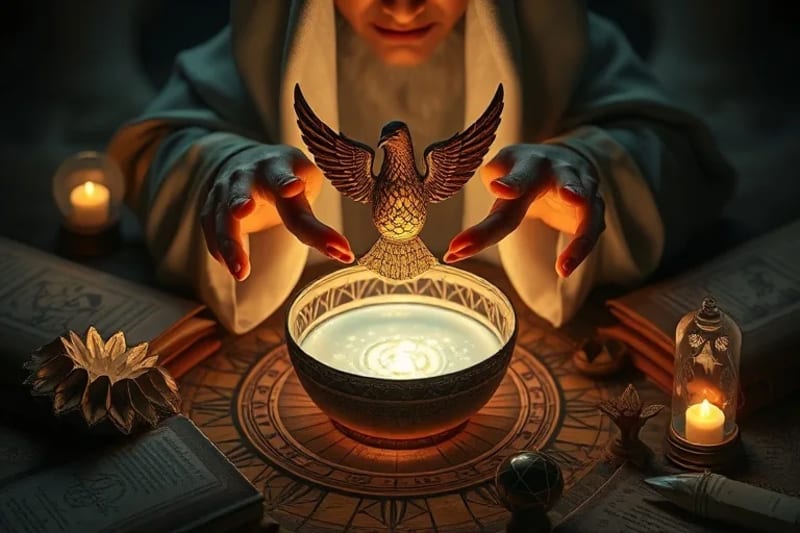 A mystical figure performing a symbolic act with a carved wooden bird, surrounded by ancient texts and crystals, representing the profound spiritual work of Psychomagia.
At its core, Psychomagia is about enacting a metaphor in the physical world to resolve an inner conflict. Jodorowsky, drawing from his extensive knowledge of Tarot, alchemy, Zen Buddhism, and psychoanalysis, developed this method as a means to bypass the rational mind and speak directly to the unconscious. The rituals are not arbitrary acts but are meticulously crafted based on an individual's personal history, family tree (metagenealogy), and current psychological state. The goal is to release unhealthy attachments and energetic blocks that prevent individuals from living a full and authentic life.
What is Psychomagia? Defining the Practice
- What is Psychomagia? Defining the Practice
- Foundational Principles: The Unconscious and Symbolic Language
- The Role of Metagenealogy in Identifying Karmic Patterns
- Designing a Psychomagical Act: From Diagnosis to Ritual
- Examples of Psychomagical Acts and Their Intentions
- Benefits and Transformative Potential of Psychomagia
- Psychomagia and Other Esoteric Practices
- Ethical Considerations and the Importance of Guidance
Psychomagia can be understood as a form of "spiritual surgery" that uses art and symbolism to heal the soul. It acknowledges that many of our current struggles are not merely personal but are echoes of unresolved issues passed down through generations. These "karmic" or ancestral patterns can manifest as fears, phobias, financial difficulties, relationship problems, or even chronic illnesses. Unlike traditional talk therapy, which aims to bring unconscious conflicts to conscious awareness through verbalization, Psychomagia seeks to resolve them directly through action.
Jodorowsky's approach is rooted in the belief that the universe is interconnected, and that every action, especially a symbolic one performed with intention, has resonance. The acts are designed to be shocking, absurd, or deeply personal, ensuring they leave a lasting impression on the unconscious. This direct communication with the deeper self allows for a rapid and often profound shift in perception and behavior, leading to genuine soul growth and liberation from limiting beliefs.
Foundational Principles: The Unconscious and Symbolic Language
The efficacy of Psychomagia rests heavily on its foundational principles, primarily the understanding of the unconscious mind and its susceptibility to symbolic language. Jodorowsky posits that the unconscious does not differentiate between symbolic reality and material reality. For instance, if a person feels suffocated by their mother's expectations, a psychomagical act might involve burying a symbolic representation of that expectation. To the unconscious, this act of burial is as real as physically separating from the mother, thus initiating a healing process.
This concept aligns with various spiritual traditions that emphasize the power of ritual and intention. The acts are often performed in secret or in a highly personal context, reinforcing their sacred nature. They are designed to be irreversible, meaning once performed, the unconscious has registered the change, and the individual is expected to integrate this new reality into their conscious life. The profound impact stems from the emotional and psychological commitment invested in the symbolic act.
 An abstract digital painting depicting intertwined threads of light and shadow breaking apart, symbolizing the release of old karmic patterns and the formation of new, vibrant energies.
Moreover, Psychomagia acknowledges the interconnectedness of the individual with their family lineage and the collective unconscious. Jodorowsky often refers to the "family tree" as a living entity that influences each member. Unresolved conflicts, unspoken secrets, or unfulfilled desires of ancestors can manifest as "mandates" or "curses" that unconsciously guide the lives of their descendants. Psychomagia aims to identify and symbolically sever these negative influences, allowing the individual to forge their own path free from inherited burdens.
The Role of Metagenealogy in Identifying Karmic Patterns
Metagenealogy is a cornerstone of Psychomagia, serving as the diagnostic tool to uncover the ancestral roots of an individual's problems. It involves a deep exploration of the family tree, not just in terms of names and dates, but in terms of significant events, traumas, professions, illnesses, and relationships that have occurred across generations. Jodorowsky believes that patterns repeat themselves, and by understanding these repetitions, one can identify the specific ancestral "wound" that needs healing.
During a metagenealogical analysis, the practitioner helps the individual map out their family tree, paying close attention to:
- Repeated Names: Indicating a desire to "resurrect" or honor an ancestor, often carrying their unfinished business.
- Significant Dates: Birthdays, deaths, marriages, or accidents that recur across generations, suggesting a "date trap" or a karmic echo.
- Unfulfilled Desires or Traumas: Ancestors who died young, had unfulfilled artistic ambitions, or suffered great injustices, whose energy might be seeking expression or resolution through a descendant.
- Family Secrets: Unspoken truths or taboos that create a heavy atmosphere or unconscious guilt within the family system.
This detailed mapping helps to pinpoint the exact nature of the karmic block. For example, if a client consistently struggles with financial instability, metagenealogy might reveal an ancestor who lost everything or was unjustly disinherited. The psychomagical act would then be designed to symbolically rectify this ancestral injustice, thereby freeing the client from the inherited pattern of scarcity. This process of deep introspection and historical detective work is crucial before any ritual can be prescribed.
Designing a Psychomagical Act: From Diagnosis to Ritual
The creation of a psychomagical act is a highly personalized and intuitive process, typically guided by an experienced psychomagician. It begins with the diagnosis, often through metagenealogy, Tarot readings, dream analysis, or simply deep conversation. Once the core issue and its ancestral roots are identified, the practitioner designs a symbolic act that directly addresses the unconscious problem. The act must be concrete, poetic, and often surprising, to effectively communicate with the unconscious.
Key elements considered in designing an act include:
- Symbolism: Every object, color, location, and action within the ritual holds symbolic meaning relevant to the client's issue.
- Emotional Intensity: The act should evoke strong emotions, whether fear, joy, disgust, or liberation, to ensure its impact on the unconscious.
- Irreversibility: The act should be designed so that it cannot be undone, signifying a definitive break or transformation.
- Secrecy: Often, the act is performed in private, emphasizing its personal and sacred nature, free from external judgment.
- Sacrifice: Sometimes, the act requires a form of sacrifice – time, effort, or a personal item – to demonstrate commitment and intention.
The practitioner acts as a guide, helping the client understand the symbolic language of the act and its intended effect. The client is then responsible for performing the act with full awareness and intention. The integration phase, after the act is performed, is equally crucial. It involves observing changes in one's life, thoughts, and feelings, and consciously choosing to live in alignment with the new reality created by the psychomagical intervention. This can be supported by practices like daily affirmations or meditation.
Examples of Psychomagical Acts and Their Intentions
Psychomagical acts are incredibly diverse, tailored to each individual's specific needs. Here are a few hypothetical examples to illustrate their nature:
| Problem Addressed | Hypothetical Psychomagical Act | Symbolic Intention |
|---|---|---|
| Feeling suffocated by parental expectations. | Write down all expectations on paper, burn it, mix ashes with earth, and plant a seed. | Symbolically destroying old mandates and planting the seed of one's own desires and growth. |
| Ancestral pattern of poverty or financial struggle. | Bury a valuable coin or piece of jewelry in a prosperous area, making a silent vow to break the cycle. | Sacrificing to honor ancestral lack, while planting the intention for future abundance and breaking the inherited scarcity mindset. |
| Inability to find love due to past heartbreaks. | Create a doll representing past lovers, dress it in wedding attire, then ceremonially bury it in a "graveyard" of past relationships. | Symbolically "marrying off" and burying past relationships to clear the path for new love, acknowledging and honoring their place in history. |
| Chronic physical pain with no clear medical cause. | Draw the pain on a piece of paper, then physically tear it into tiny pieces and scatter them in a flowing river. | Externalizing and releasing the pain, allowing it to be carried away and dissolved by the natural flow of life. |
These examples highlight the often poetic and sometimes provocative nature of Psychomagia. The effectiveness lies not in the literal outcome of the act, but in its profound psychological and unconscious impact. The client's belief and commitment to the act are paramount for its success. It's a powerful demonstration of the mind's ability to heal itself through symbolic action.
Benefits and Transformative Potential of Psychomagia
The transformative potential of Psychomagia is vast, offering benefits that extend beyond mere psychological relief. Individuals who engage with this practice often report profound shifts in their lives, including:
- Emotional Liberation: Releasing long-held emotional burdens, fears, and anxieties that have roots in personal or ancestral trauma.
- Breaking Negative Cycles: Disrupting recurring patterns of failure, unhealthy relationships, or self-sabotage that have plagued generations.
- Enhanced Self-Awareness: Gaining deeper insight into one's true desires, motivations, and the unconscious forces that have shaped their life.
- Physical Healing: In some cases, chronic physical ailments with psychosomatic origins can alleviate or disappear after a successful psychomagical act.
- Increased Creativity and Vitality: Unblocking creative flow and experiencing a renewed sense of energy and purpose as ancestral burdens are shed.
- Improved Relationships: Healing family dynamics and fostering healthier connections with others by resolving internal conflicts.
- Spiritual Growth: A deeper connection to one's spiritual path and a sense of alignment with their true destiny.
The impact is often immediate and deeply felt, though the full integration of the changes can take time. It's a journey of self-discovery that empowers individuals to take active roles in their own healing, moving from victimhood to conscious creation. The process can feel intensely personal and sacred, leading to a profound sense of authenticity and freedom.
Psychomagia and Other Esoteric Practices
Psychomagia is deeply intertwined with various esoteric practices, which Jodorowsky often uses as diagnostic tools or as complementary elements to the acts themselves. Tarot, for instance, is not just a divination tool but a symbolic language that can reveal the unconscious landscape of an individual and their family tree. A Tarot reading can help pinpoint the specific archetypal energies at play in a person's life, guiding the design of the psychomagical act.
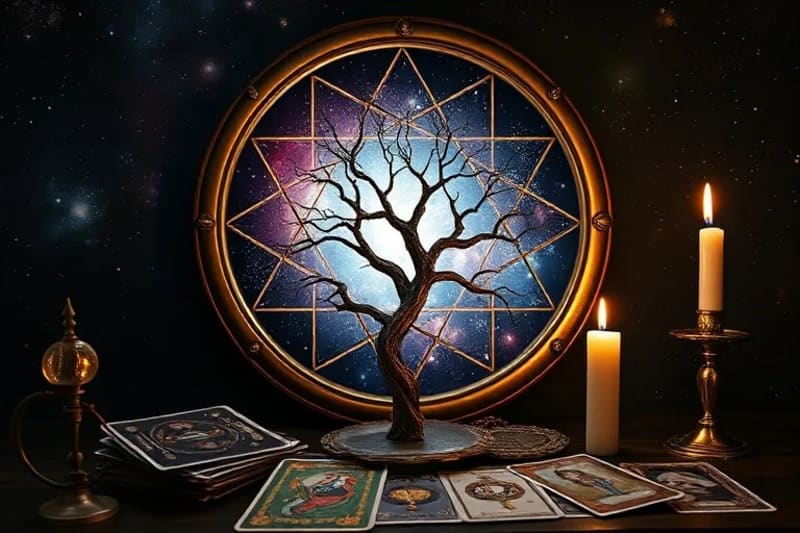 A surrealist still-life featuring an antique mirror reflecting a galaxy, a glass family tree sculpture with a detached branch, scattered tarot cards, and a burning candle, symbolizing the tools and concepts of esoteric practices.
Dream interpretation also plays a significant role. Dreams are seen as direct messages from the unconscious, offering clues about inner conflicts and potential solutions. By analyzing recurring dream symbols or particularly vivid dreams, a psychomagician can gain further insight into the client's psychological state and tailor an act that resonates deeply with their inner world. This holistic approach ensures that the intervention is comprehensive and addresses the individual on multiple levels—psychological, emotional, and spiritual.
Other esoteric elements like numerology, astrology (especially understanding planetary retrogrades or critical degrees), and even the study of sacred geometry can inform the psychomagical process. These tools provide different lenses through which to understand the intricate web of personal and ancestral influences. They help to create a rich symbolic vocabulary for the acts, making them more potent and effective in unblocking karmic transformation.
Ethical Considerations and the Importance of Guidance
While Psychomagia offers powerful tools for transformation, it is not without its ethical considerations and the critical need for proper guidance. Jodorowsky himself emphasizes that these acts should ideally be prescribed by an experienced psychomagician who has a deep understanding of human psychology, symbolism, and the potential impact of such interventions. Attempting to perform psychomagical acts without proper guidance can be ineffective or, in some cases, even detrimental if not approached with the right intention and understanding.
Key ethical points include:
- Informed Consent: The client must fully understand the nature of the act, its symbolic meaning, and their commitment to it.
- Non-Harm: Acts should never involve harming oneself, others, or animals. The symbolism is paramount, not literal harm.
- Respect for Boundaries: The psychomagician must respect the client's emotional and psychological boundaries, never forcing an act that feels uncomfortable or inappropriate.
- Integration Support: Providing support for the client to integrate the changes brought about by the act into their daily life.
- Confidentiality: Maintaining strict confidentiality regarding the client's personal history and the details of their acts.
The role of the psychomagician is not to impose solutions but to facilitate the client's own healing journey. They act as a mirror, reflecting the unconscious patterns and suggesting symbolic actions that the client's own soul is ready to undertake. This collaborative and respectful approach ensures that Psychomagia remains a powerful and ethical path to unblocking karmic transformation and achieving profound personal liberation.
Psychomagia, as a therapeutic art, finds its legal and ethical framework within the broader context of alternative and complementary therapies. While not universally regulated by traditional medical or psychological bodies, practitioners are generally expected to adhere to principles of informed consent, client welfare, and professional integrity.
In many jurisdictions, practices falling outside conventional medicine operate under consumer protection laws, requiring transparency about services offered and expected outcomes. Practitioners often establish their own ethical guidelines, drawing from principles of non-maleficence and beneficence, similar to those found in established psychological counseling or spiritual guidance. The emphasis on symbolic action over physical intervention generally keeps Psychomagia distinct from practices requiring medical licenses, focusing instead on its artistic and spiritual dimensions.
In conclusion, Psychomagia offers a radical yet deeply effective method for addressing deep-seated psychological and ancestral issues. By embracing the power of symbolic action and the wisdom of the unconscious, individuals can embark on a transformative journey, unblocking karmic patterns and reclaiming their authentic selves. It stands as a testament to the idea that healing can be an art, a ritual, and a profound act of self-creation.
Explore More Esoteric Wisdom
- Advanced Dignities Horary Electional Astrology
- Critical Degrees Fixed Stars: Fated Events Astrology
- Dream Incubation Starlight: Harnessing Daily Horoscopes
- MC Ruler Aspects: Public Persona, Career Path Guide
- Snake Horse Compatibility: Chinese Zodiac Insights
- Altar Building Guide: Sacred Space for Ritual
- Daily Horoscopes: Personalized Zodiac Insights
- Planetary Dignities Synastry: Relationship Dynamics Power
- Advanced Synastry Nodal Vertex Connections
- Bibliomancy Divination Sacred Texts Intuitive Opening
- Yods Grand Crosses: Decoding Complex Astrological Patterns
- Panda Antivirus Pro 2010: Advanced & Efficient Protection
- Colombian Commercial Code: Pledge Without Tenure Creditor
- Abadejo: Pez Trisopterus Luscus
- Astrología Horaria: Precise Cosmic Answers
- Arquetipos Zodiacales: Hero's Journey, Personal Transformation
- Astrología Védica Profunda: Yogas Dhana Abundancia
- Santísima Trinidad Liturgia: Profound Spiritual Journey
- Santo Rosario: Profound Glorious Mysteries
- Nostradamus: Prophet or Astrologer?
Source: Hybrid content assisted by AI and human editorial supervision.


Comments
Post a Comment