
Tarot Esoteric Geometry: Unlocking Universal Truths Sacred Shapes
The Tarot, often perceived as a system of divination, is far more than a mere fortune-telling tool; it is a profound repository of esoteric knowledge, intricately woven with universal truths. At its core, beyond the symbolic imagery and archetypal narratives, lies a sophisticated framework of esoteric geometry. This hidden dimension reveals the fundamental patterns and structures that govern existence, offering a deeper understanding of the cosmos and the human psyche. By exploring the sacred shapes embedded within each card and the overall structure of the deck, practitioners can unlock layers of meaning that transcend conventional interpretations, connecting with the foundational principles of reality itself.
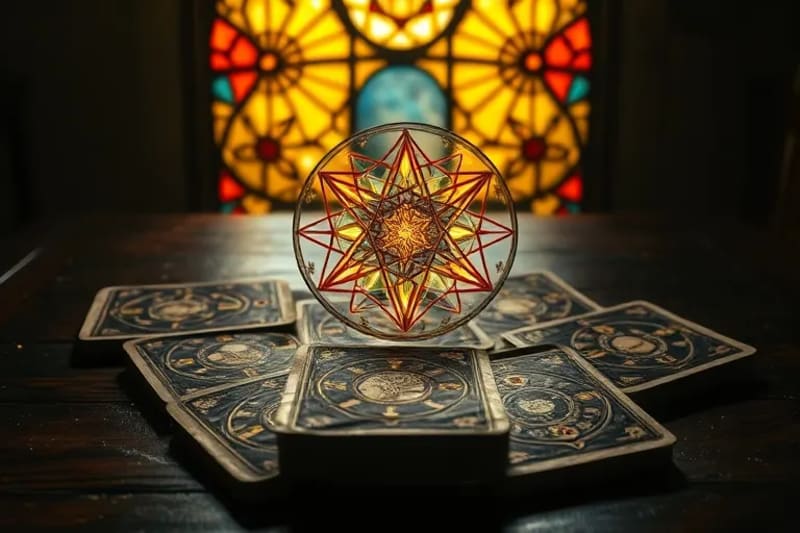
Precursors intellectuales, diagramas fundamentales y representaciones conceptuales que forjaron la visión de los principios esotéricos del Tarot.
Esoteric geometry, also known as sacred geometry, is the study of the spiritual meanings of shapes and proportions. It posits that certain geometric patterns are fundamental to the creation and structure of everything in the universe, from atomic particles to galaxies. When applied to the Tarot, these geometric principles transform the cards from simple pictures into dynamic energetic blueprints. Each line, curve, and arrangement within a Tarot image, and even the layout of the cards in a spread, carries specific energetic and symbolic weight, reflecting cosmic laws and spiritual dynamics. This advanced perspective moves beyond surface-level symbolism, inviting a more profound engagement with the Tarot as a tool for self-discovery and universal comprehension.
Table of Contents
- Historical Roots of Sacred Geometry in Tarot
- Fundamental Geometric Forms and Their Tarot Meanings
- Sacred Ratios and Proportions in Tarot Design
- The Tree of Life: A Kabbalistic Blueprint for Tarot
- Tarot Spreads as Geometric Energy Fields
- Enhancing Tarot Readings Through Geometric Understanding
- Conclusion: The Enduring Wisdom of Tarot's Sacred Shapes
Historical Roots of Sacred Geometry in Tarot
The origins of sacred geometry can be traced back to ancient civilizations across the globe, from Egypt and Mesopotamia to Greece and India. Philosophers like Pythagoras and Plato extensively explored the mathematical and spiritual significance of geometric forms, believing them to be the blueprints of creation. These ancient teachings influenced various esoteric traditions, including Hermeticism, Kabbalah, and alchemy, all of which contributed to the foundational philosophy behind the Tarot. The earliest known Tarot decks, such as the Visconti-Sforza deck, already contained subtle geometric arrangements and symbolic structures that hinted at these deeper connections, even if not explicitly stated.
During the Renaissance, a period marked by a revival of classical learning and esoteric thought, the integration of sacred geometry into art, architecture, and philosophical systems became more pronounced. This era saw the flourishing of Neoplatonism and Hermeticism, which emphasized the interconnectedness of the macrocosm and microcosm through divine proportions. Tarot, emerging within this intellectual climate, naturally absorbed these geometric principles. The arrangement of figures, the composition of scenes, and even the division of the cards into Major and Minor Arcana reflect an underlying geometric order designed to convey universal truths in a visually accessible format. Understanding this historical context is crucial for appreciating the intentionality behind the geometric symbolism in Tarot.
Fundamental Geometric Forms and Their Tarot Meanings
Each fundamental geometric shape carries a specific energetic signature and corresponds to various archetypal meanings within the Tarot. Recognizing these shapes within the card imagery allows for a more nuanced and profound interpretation, connecting the individual card to universal principles. These forms are not merely decorative but are essential components of the cards' energetic and symbolic language.
The Circle: Unity and Wholeness
The circle, without beginning or end, is the ultimate symbol of unity, eternity, wholeness, and the divine. In Tarot, it often represents cycles, completion, and spiritual perfection. Cards like The World (XXI) prominently feature circular elements, signifying the culmination of a journey and the integration of all experiences into a unified whole. The Ouroboros, a snake eating its tail, found in some versions of The World card, is a powerful circular symbol of eternal return and self-sufficiency. The circle also appears in the halos of divine figures, emphasizing their spiritual completeness and connection to the divine source. It can also represent the cosmic egg, the primordial source from which all creation emerges, embodying pure potential and infinite possibilities.
The Triangle: Creation and Manifestation
The triangle is a dynamic shape representing trinity, creation, manifestation, and spiritual ascension. Pointing upwards, it symbolizes aspiration, spirit, and the masculine principle; pointing downwards, it signifies receptivity, matter, and the feminine principle. The union of these two forms the Hexagram, a symbol of balance. In Tarot, triangles can be found in the composition of many cards, such as The Emperor (IV), whose throne often forms a triangular shape, representing authority and stability. The Magician (I) often has one hand pointing to the sky and the other to the earth, forming an invisible triangle that symbolizes the channeling of divine energy into manifestation. This duality of direction also reflects the alchemical principle of "as above, so below," emphasizing the connection between the spiritual and material realms.
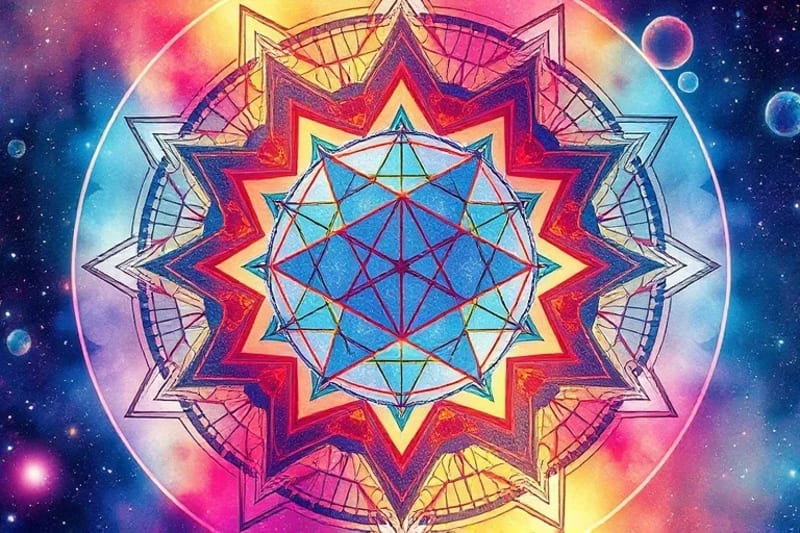
A conceptual watercolor rendering of interconnected geometric forms, symbolizing the intricate patterns of universal energy.
The Square: Stability and Materiality
The square, with its four equal sides and right angles, symbolizes stability, order, practicality, and the material world. It represents the four elements (Earth, Air, Fire, Water), the four cardinal directions, and the physical realm. In Tarot, squares are often found in the architecture of buildings, the structure of thrones, or the framing of scenes. The Empress (III) and The Emperor (IV) often sit on cubic or square thrones, emphasizing their connection to earthly power, fertility, and structured authority. The four suits of the Minor Arcana (Wands, Cups, Swords, Pentacles) can also be seen as representing the four corners of a square, each governing a different aspect of material existence. This shape grounds the spiritual concepts of the Tarot in tangible reality, indicating the need for structure and foundation.
The Pentagram: Spirit and Humanity
The pentagram, a five-pointed star, is a powerful symbol of humanity, the five senses, and the spirit controlling matter. It represents the perfect human form, with four limbs and a head, and the five elements (including Spirit as the fifth). In Tarot, the pentagram is most explicitly seen in the suit of Pentacles (or Coins), where it symbolizes material wealth, physical well-being, and earthly achievements. The suit itself is a direct representation of this geometric form's influence on the physical plane. When inverted, the pentagram can symbolize spirit subservient to matter, or a descent into chaos, though its primary use in Tarot is upright, signifying harmony and spiritual protection. This symbol also ties into the concept of the microcosm, representing the individual human being as a reflection of the larger cosmos.
The Hexagram: Union and Balance
The hexagram, a six-pointed star formed by two interlocking triangles (one pointing up, one pointing down), is a universal symbol of the union of opposites, balance, and the macrocosm/microcosm. It represents the harmonious integration of spirit and matter, masculine and feminine, heaven and earth. While not always overtly depicted, its principles are subtly embedded in cards that speak of synthesis and equilibrium, such as Temperance (XIV), which often shows an angel blending two liquids, symbolizing the fusion of opposing forces. The Star (XVII) also embodies the hexagram's essence through its celestial imagery and the flow of energy between the divine and earthly realms. The hexagram encapsulates the idea of perfect balance, a state of cosmic harmony where all forces are integrated and aligned, leading to profound spiritual insight and understanding.
Sacred Ratios and Proportions in Tarot Design
Beyond basic shapes, the Tarot also incorporates sacred ratios and proportions, which imbue the cards with an inherent sense of beauty, balance, and divine order. These mathematical relationships are believed to be fundamental to the aesthetic and energetic harmony of the universe, and their presence in Tarot is a testament to its deep esoteric roots. Understanding these ratios can reveal the subtle design choices that contribute to the cards' profound impact.
The Golden Ratio (Phi)
The Golden Ratio, approximately 1.618, is a mathematical constant found throughout nature, art, and architecture. It is believed to represent perfect aesthetic balance and divine proportion. Many classical Tarot decks, particularly those with a strong artistic foundation, subtly incorporate the Golden Ratio in their composition. The placement of key figures, the division of the card into foreground and background, or the proportions of objects within the scene often adhere to this ratio. This creates a visually pleasing and harmonically resonant image that subconsciously communicates a sense of inherent order and truth. The Golden Ratio is not just about beauty; it's about the underlying structure of reality, making its presence in Tarot a powerful, if often unnoticed, element of its esoteric design.
The Fibonacci Sequence
Closely related to the Golden Ratio, the Fibonacci Sequence (0, 1, 1, 2, 3, 5, 8, 13, ...) is a series where each number is the sum of the two preceding ones. This sequence appears in countless natural phenomena, from the spirals of seashells to the branching of trees. In Tarot, the Fibonacci sequence can be observed in the numerical progression of the Minor Arcana, which follows a natural growth pattern from Ace to Ten. While not a direct geometric shape, the sequence provides a numerical structure that underpins the geometric development within the deck. The progression of the cards, particularly in the pip cards, often reflects a natural, organic unfolding that mirrors the Fibonacci spiral, symbolizing growth, evolution, and the cyclical nature of existence. This numerical harmony reinforces the idea that Tarot is a microcosm of the universe's inherent order.
The Tree of Life: A Kabbalistic Blueprint for Tarot
One of the most profound geometric frameworks influencing the Tarot is the Kabbalistic Tree of Life. This intricate diagram, composed of ten spheres (Sephiroth) and twenty-two connecting paths, is a map of creation, representing the emanations of the divine and the journey of the soul. The twenty-two Major Arcana cards are often directly mapped onto the twenty-two paths of the Tree of Life, each card representing a specific energetic connection or spiritual lesson. This mapping provides a geometric and numerical structure that links the archetypal energies of the Tarot to a comprehensive system of cosmic understanding.
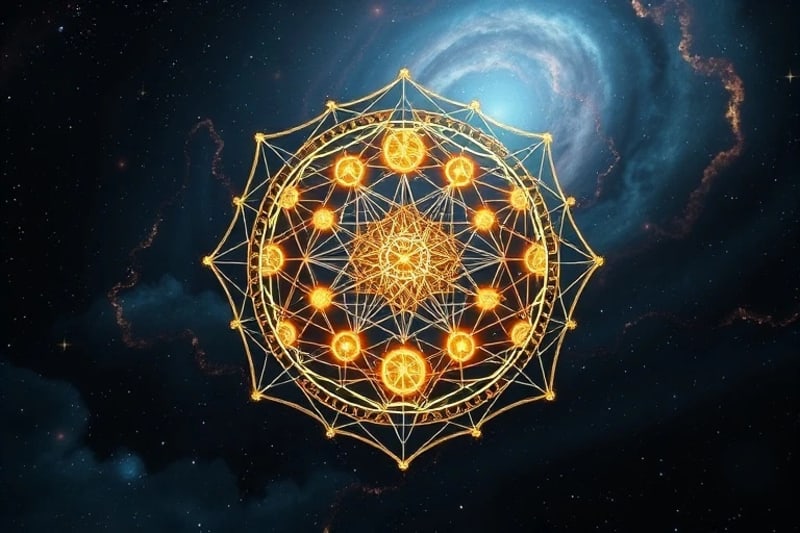
A vivid 3D rendering of the Tree of Life, illustrating the interconnectedness of cosmic principles through geometric light forms.
Each Sephirah on the Tree of Life represents a divine attribute or aspect of God, and the paths between them symbolize the active principles that connect these attributes. By aligning the Major Arcana with these paths, the Tarot gains an additional layer of geometric and philosophical depth. For instance, the Fool (0) is often associated with the path connecting Kether (Crown) to Chokmah (Wisdom), representing the initial spark of consciousness and the journey into the unknown. The Magician (I) might correspond to the path from Kether to Binah (Understanding), symbolizing the power of manifestation through divine will. This geometric overlay transforms Tarot reading into a dynamic exploration of the soul's journey through the various stages of creation and understanding, offering insights into the energetic flow of the universe.
The Tree of Life also provides a framework for understanding the Minor Arcana, with each suit corresponding to one of the four Kabbalistic worlds (Atziluth, Briah, Yetzirah, Assiah) and the ten pips of each suit reflecting the ten Sephiroth within that world. This intricate system demonstrates how the Tarot, through its geometric and numerical structure, functions as a complete cosmological model. Further exploring these connections can deepen one's understanding of ancient wisdom for predictive astrology and the intricate interplay of cosmic forces. The geometric precision of the Tree of Life, when applied to Tarot, transforms the deck into a powerful meditative and divinatory tool, capable of revealing the most profound universal truths.
Tarot Spreads as Geometric Energy Fields
The geometric influence in Tarot extends beyond individual cards to the way cards are arranged in spreads. Each Tarot spread, whether a simple three-card reading or a complex Celtic Cross, forms a unique geometric pattern that acts as an energetic field. This field is not arbitrary; it is designed to channel and interpret information in a specific way, creating a microcosm of the querent's situation within a structured energetic framework. The positions of the cards within the spread, and the relationships between them, are geometrically significant, influencing the flow of interpretation.
Consider the Celtic Cross spread, a popular and complex layout. Its central cross and surrounding staff form a dynamic geometric configuration that represents the querent's current situation, challenges, influences, and potential outcomes. The cross itself is a fundamental geometric symbol of intersection and balance, while the staff represents the journey and evolution. Each card's position within this geometric matrix informs its meaning, creating a narrative that is both linear and interconnected. Similarly, a simple three-card spread (past, present, future) forms a linear or triangular relationship, emphasizing progression and cause-and-effect. Even planetary aspects in astrology, like conjunctions or oppositions, create geometric patterns in a birth chart, influencing energetic dynamics in a similar way. The geometric arrangement of the cards in a spread is not just a layout; it's a sacred space, an energetic grid through which universal truths can be accessed and understood.
The choice of spread can therefore be seen as a deliberate act of creating a specific geometric resonance. Different geometric patterns are better suited for different types of questions or insights. A circular spread might be used for exploring cycles or holistic views, while a linear spread might be better for understanding a clear progression of events. The geometric integrity of the spread ensures that the reading is not just a collection of individual card meanings but a coherent, energetically charged narrative. This advanced understanding of spreads transforms them into powerful tools for energetic mapping and divination, providing a deeper connection to the underlying cosmic order.
Enhancing Tarot Readings Through Geometric Understanding
Integrating esoteric geometry into Tarot readings elevates the practice from simple card interpretation to a profound spiritual exploration. By recognizing the geometric forms and ratios within the cards and spreads, practitioners can access deeper layers of meaning and energetic insights. This approach encourages a more intuitive and holistic understanding, moving beyond memorized card meanings to a direct perception of universal principles at play. For instance, when encountering a card with prominent circular elements, a reader attuned to geometry might emphasize themes of completion, unity, or cyclical patterns, regardless of the card's conventional interpretation.
To apply this knowledge, a reader can begin by consciously observing the geometric compositions of each card. Are there dominant triangles, squares, or circles? How are these shapes interacting? What sacred ratios might be subtly influencing the imagery? This visual analysis, combined with an understanding of the geometric meanings, can unlock fresh perspectives. For example, the presence of a pentagram in a card not from the Pentacles suit might highlight themes of human potential or the spirit's influence over matter in an unexpected context. This geometric lens provides an additional layer of information, enriching the narrative of the reading and offering more precise guidance. It also aligns well with understanding the strategic and intellectual aspects of Pallas Athena astrology, which emphasizes pattern recognition and strategic thinking.
Furthermore, understanding the geometric structure of spreads allows for a more intentional choice of layout and a deeper interpretation of card relationships. If a querent is seeking clarity on a complex, multifaceted issue, a spread that forms a complex geometric pattern like the Tree of Life spread might be more appropriate than a simple linear one. The energetic connections between cards, as defined by their geometric positions, become clearer, revealing underlying dynamics that might otherwise be missed. This holistic approach transforms the Tarot into a powerful tool for self-reflection and spiritual growth, enabling practitioners to truly unlock universal truths through its sacred shapes. The integration of esoteric symbolism and AI art also highlights how these ancient patterns continue to resonate in modern interpretations.
Conclusion: The Enduring Wisdom of Tarot's Sacred Shapes
The esoteric geometry of Tarot offers a profound pathway to understanding the intricate workings of the universe and the human experience. By delving into the sacred shapes, ratios, and structures embedded within the cards and their arrangements, practitioners can move beyond superficial interpretations to grasp the fundamental principles that govern existence. The circle, triangle, square, pentagram, and hexagram are not merely abstract forms; they are living symbols that resonate with universal energies, reflecting the divine blueprint of creation. The integration of the Kabbalistic Tree of Life further solidifies Tarot's role as a comprehensive cosmological model, capable of mapping the spiritual journey and revealing the interconnectedness of all things.
This advanced perspective transforms the Tarot from a simple divinatory tool into a sophisticated system of spiritual philosophy and energetic mapping. It invites a deeper engagement with the cards, encouraging readers to perceive the underlying order and harmony that permeate every aspect of the deck. By consciously working with the geometric dimensions of Tarot, individuals can enhance their readings, gain profound insights into their own lives and the world around them, and ultimately unlock the universal truths that sacred shapes have held for millennia. The enduring wisdom of Tarot's esoteric geometry continues to guide seekers on their path to self-discovery and enlightenment, proving that the most profound truths are often found in the simplest, yet most sacred, forms.
Further Exploration
- Mars Astrology: Drive, Passion, Conflict Chart Guide
- Western Chinese Astrology: Holistic Self-Discovery Guide
- Zodiac Decanates: Deeper Personality Layers Explained
- Chinese Zodiac Baby Names: Elemental & Auspicious Meanings
- Urban Geomancy Lunar Mansions: Aligning City Dwellings Cosmic Energies
- Synodic Cycles Inner Planets: Growth & Relationships
- Aura Cleansing Strengthening: Practical Energy Protection Techniques
- Quantum Physics Celestial Mechanics: Universe Predictive System
- Metal Goat Chinese Zodiac: Resilience, Creativity
- Pendulum Dowsing: Intuitive Answers and Energy Detection
- Lunar Nodes Aspects: Karmic Connections in Birth Chart
- Lucky Numbers & Colors: Chinese Zodiac Guide
Source: Hybrid content assisted by AI and human editorial supervision.


Comments
Post a Comment