
Mundane Astrology Predicting Global Events: Cosmic Insights | StarPluto
Mundane astrology is a specialized branch of astrology dedicated to forecasting global events, national affairs, and collective human experiences. Unlike natal astrology, which focuses on individual birth charts, mundane astrology examines the astrological charts of nations, cities, and significant global moments to predict trends in politics, economics, weather patterns, and social movements. It offers a unique lens through which to understand the intricate dance between celestial mechanics and earthly occurrences, providing a framework for anticipating large-scale shifts that impact entire populations.
This ancient practice considers planetary alignments, eclipses, and the ingress of planets into zodiac signs as indicators of major historical turning points and societal transformations. By studying these cosmic configurations, mundane astrologers aim to decode the underlying energetic currents that shape our world, from periods of peace and prosperity to times of conflict and crisis. It is a discipline that requires a deep understanding of both astrological principles and historical context, seeking patterns that repeat across centuries.
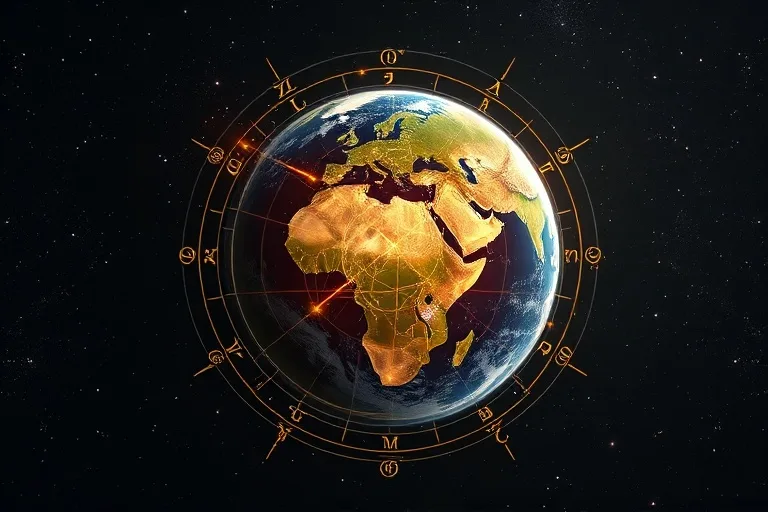
The Earth viewed from space, encircled by intricate astrological symbols, symbolizing the profound Tarot Quantum Mechanics Intersecting Divination Reality on global events and human destiny.
The practice of mundane astrology is not about predicting specific events with absolute certainty, but rather about identifying periods of heightened potential for certain types of developments. It provides a framework for understanding the ebb and flow of collective consciousness and the forces that drive historical cycles. For those interested in the broader patterns of human civilization and the cosmic backdrop against which they unfold, mundane astrology offers a fascinating and often insightful perspective.
- Historical Context: Understanding how past astrological configurations correlated with historical events.
- Planetary Cycles: Analyzing the long-term movements of outer planets (Jupiter, Saturn, Uranus, Neptune, Pluto).
- National Charts: Interpreting the birth charts of nations and significant political entities.
- Eclipses and Ingresses: Recognizing their role as triggers for major shifts.
Understanding Mundane Astrology
Mundane astrology derives its name from the Latin word "mundus," meaning "world." It is the study of how celestial phenomena correlate with events on Earth at a collective level, encompassing nations, societies, and the planet itself. This field extends beyond personal horoscopes to analyze the larger cosmic rhythms that influence global affairs, making it a powerful tool for understanding historical trends and potential future developments.
The core premise is that just as individuals have a birth chart reflecting their potential and life path, so too do nations and significant organizations. These "national charts" are typically cast for the moment of a country's founding, the signing of its constitution, or other pivotal historical events. By analyzing these charts in conjunction with current planetary transits, astrologers can gain insights into a nation's destiny, challenges, and periods of growth.
Key to mundane astrology is the understanding that planetary energies manifest differently on a collective scale. For instance, a challenging aspect between two planets that might indicate personal struggle in a natal chart could signify economic recession, political unrest, or natural disasters when viewed through a mundane lens. This shift in interpretation requires a specialized knowledge base and a nuanced approach to astrological symbolism.
Historical Roots and Evolution
The origins of mundane astrology can be traced back to ancient civilizations, particularly in Mesopotamia, Egypt, and China. Early astrologers observed the heavens not just for personal guidance but also to predict agricultural yields, the rise and fall of empires, and the fate of kings and nations. These ancient practices laid the groundwork for the sophisticated systems that would later develop in Hellenistic, Indian, and Arabic astrology.
In ancient Babylon, omens derived from celestial observations were routinely used to advise rulers on matters of state, war, and public welfare. The Egyptians similarly integrated astrological observations into their understanding of the Nile's flooding cycles and the prosperity of their kingdom. The Chinese developed a complex system of that deeply influenced their imperial decisions and calendar systems, often predicting periods of famine or rebellion.

An ancient astrolabe rests upon a detailed parchment map, illustrating the historical methods used for Astro-Economics: Predicting Financial Markets Planetary Cycles through celestial observation.
During the Hellenistic period, mundane astrology became more systematized, with astrologers like Ptolemy detailing techniques for predicting weather, epidemics, and political events in his influential work, "Tetrabiblos." The Islamic Golden Age saw further advancements, as scholars translated and expanded upon Greek and Indian texts, applying astrological principles to the vast Islamic empire. These traditions have continued to evolve, influencing modern mundane astrology and its application to contemporary global challenges.
Core Principles and Techniques
Mundane astrology employs several core principles and techniques to analyze and predict global events. These methods often involve casting charts for specific moments in time or for the "birth" of a collective entity. Understanding these foundational elements is crucial for grasping how mundane astrologers derive their insights.
One primary technique involves the analysis of Ingress Charts. These charts are cast for the moment the Sun enters each cardinal sign (Aries, Cancer, Libra, Capricorn), marking the beginning of a new season. The Aries ingress, in particular, is considered highly significant as it marks the astrological New Year and is often used to forecast trends for the entire year ahead for specific regions or the world at large.
Another critical element is the study of Eclipses (solar and lunar). Eclipses are often seen as powerful harbingers of change, marking periods of heightened activity, revelations, or significant turning points. Their influence can last for several months or even years, depending on their strength and the specific astrological houses they fall into within a mundane chart. The path of an eclipse across the globe is also considered, indicating which regions will be most affected.
Great Conjunctions, especially those involving Jupiter and Saturn, are also profoundly important. These conjunctions, occurring approximately every 20 years, have historically been associated with major shifts in political power, economic cycles, and societal structures. The element in which these conjunctions occur (e.g., Earth, Air, Fire, Water) can indicate the nature of the changes to come, such as a shift from material focus to intellectual pursuits.
Furthermore, mundane astrologers pay close attention to the charts of nations, often referred to as National Charts. These charts are typically calculated for the moment a nation declares independence, establishes its constitution, or undergoes a significant political transformation. By tracking transits and progressions to these national charts, astrologers can anticipate periods of national growth, challenge, or transformation. For example, the chart for the United States is often cast for July 4, 1776, at the moment of the Declaration of Independence.
Finally, the analysis of Planetary Cycles, particularly those of the outer planets (Uranus, Neptune, Pluto), provides insights into long-term societal trends. Uranus is associated with revolution and technological advancement, Neptune with spiritual shifts and collective illusions, and Pluto with profound transformation, death, and rebirth. Their slow movements and rare aspects can signify generational changes and epochal events.
Key Planetary Cycles and Configurations
The movements and interactions of planets form the backbone of mundane astrological predictions. Certain cycles and configurations are particularly potent in signaling global shifts. Understanding these celestial rhythms is crucial for interpreting the larger narrative of world events.
The Jupiter-Saturn Cycle, occurring every 20 years, is one of the most significant. Historically, these conjunctions have marked the beginning of new socio-political and economic eras. For instance, the "Great Mutation" when these conjunctions shift elements (e.g., from Earth signs to Air signs), which happens every 200 years, is often associated with profound shifts in human thought and societal organization. The most recent Great Mutation occurred in December 2020, shifting into Air signs, potentially signaling a new era focused on information, technology, and social justice.
The cycles involving the outer planets—Uranus, Neptune, and Pluto—are even longer and denote deeper, more fundamental changes. The Uranus Cycle (84 years) is linked to periods of innovation, rebellion, and sudden disruption. When Uranus forms significant aspects, particularly with other outer planets or points in national charts, it can trigger technological breakthroughs, political revolutions, or unexpected societal upheavals.
The Neptune Cycle (165 years) governs themes of spirituality, collective consciousness, idealism, and illusion. Neptune's transits can bring about periods of spiritual awakening, artistic flourishing, or, conversely, widespread deception, epidemics, and confusion. Its influence often blurs boundaries and can dissolve old structures, paving the way for new collective dreams and realities.

A shattered crystal ball reflects a turbulent global landscape, symbolizing the complex and often unpredictable nature of and challenges.
Finally, the Pluto Cycle (248 years) represents deep transformation, power dynamics, death, and rebirth. Pluto's transits are associated with profound systemic changes, the exposure of hidden truths, and the restructuring of power. These periods can be intense, leading to the collapse of old orders and the emergence of new paradigms, often involving significant global conflicts or shifts in geopolitical influence.
Other important configurations include planetary retrogrades, especially those of Mercury, which can indicate periods of communication breakdowns or delays in global negotiations. The interaction of these cycles, creating complex aspect patterns, provides astrologers with a rich tapestry of information to interpret the unfolding narrative of world events. Each cycle contributes a unique energetic signature to the collective experience, shaping the course of history.
Areas of Mundane Astrological Prediction
Mundane astrology applies its principles to a wide array of global phenomena, offering insights into various sectors that shape human civilization. The scope of its predictions is vast, touching upon nearly every aspect of collective life.
- Politics and Geopolitics: This is perhaps the most prominent area. Mundane astrologers analyze charts of nations, leaders, and significant political events to forecast elections, international relations, conflicts, and peace treaties. Planetary aspects to national charts can indicate periods of political stability or unrest, shifts in power, and the emergence of new alliances.
- Economics and Finance: Astrological cycles are often correlated with economic booms and busts, stock market fluctuations, and global financial trends. The Jupiter-Saturn cycle, for instance, is closely watched for its influence on economic expansion and contraction. Mercury retrogrades can sometimes coincide with market corrections or communication issues in financial sectors.
- Natural Disasters and Weather: Certain planetary configurations, especially those involving water signs and mutable crosses, are sometimes linked to extreme weather events, earthquakes, floods, and other natural disasters. Eclipses can also be significant triggers for seismic activity or unusual weather patterns in specific regions.
- Social Movements and Public Health: Mundane astrology can shed light on periods of social change, protests, and shifts in public opinion. Neptune's influence, for example, is often associated with collective idealism, spiritual movements, or, conversely, widespread confusion and epidemics. Uranus can signify periods of social liberation or rebellion against established norms.
- Technological Advancements: Uranus, the planet of innovation and breakthroughs, is a key player in predicting periods of rapid technological development. Its aspects can coincide with major scientific discoveries, the introduction of groundbreaking technologies, and shifts in how societies interact with information and communication.
By integrating these diverse areas of analysis, mundane astrology attempts to construct a holistic picture of global trends, providing a framework for understanding the interconnectedness of cosmic forces and earthly manifestations. It seeks to identify the underlying energetic patterns that shape our collective human experience.
Ethical Considerations and Skepticism
Like any predictive practice, mundane astrology faces its share of ethical considerations and skepticism. The responsibility of interpreting global trends carries significant weight, and how these interpretations are presented is crucial. Astrologers must navigate the fine line between providing insightful analysis and avoiding alarmism or deterministic pronouncements.
One primary ethical concern is the potential for misinterpretation or misuse of predictions. Forecasting challenging periods, such as economic downturns or periods of conflict, can inadvertently cause panic or influence decisions in ways that might not be beneficial. Therefore, responsible mundane astrologers emphasize the probabilistic nature of their forecasts, framing them as tendencies or potentials rather than certainties.
Skepticism towards mundane astrology often stems from a lack of empirical evidence and the difficulty of scientifically validating its claims. Critics argue that correlations between celestial events and global occurrences can be attributed to confirmation bias or coincidence. They point to the vast number of variables involved in global events, making it challenging to isolate astrological influence as a sole or primary cause.
However, proponents argue that astrology offers a symbolic language for understanding complex patterns, rather than a purely scientific model. They emphasize the qualitative insights it provides into the energetic undercurrents of history and human behavior. Many astrologers view their work as a form of pattern recognition and symbolic interpretation, helping to contextualize events within a larger cosmic framework.
Ethical practice also involves acknowledging the limitations of astrological prediction. No astrologer can predict every specific event, nor should they claim to. Instead, the focus is on identifying overarching themes and periods of heightened potential. This approach encourages preparedness and conscious engagement with global challenges, rather than passive acceptance of a predetermined fate. The goal is to illuminate possibilities, not to dictate outcomes.
Modern Applications and Future Outlook
In the modern era, mundane astrology continues to find relevance, adapting its ancient techniques to contemporary global challenges and opportunities. Its applications extend beyond mere prediction to offer a framework for strategic planning, historical analysis, and understanding collective psychological shifts.
One significant modern application is in the analysis of geopolitical trends. Astrologers often examine the charts of nations, international organizations, and major political figures to anticipate periods of conflict, cooperation, or significant policy changes. This can provide a unique perspective for political analysts and historians seeking to understand the deeper forces at play in world affairs. For instance, the electional astrology branch can be used to determine auspicious times for treaties or declarations.
Economically, mundane astrology is sometimes used by financial analysts to identify potential market shifts, commodity price fluctuations, and periods of economic expansion or contraction. While not a substitute for traditional economic models, it can offer an additional layer of insight into cyclical patterns that might otherwise be overlooked. The long-term cycles of Jupiter and Saturn, in particular, are often correlated with major economic epochs.
Furthermore, mundane astrology can be applied to understanding broad societal changes and cultural shifts. The influence of outer planets like Uranus, Neptune, and Pluto on collective consciousness can explain phenomena such as the rise of new social movements, shifts in artistic expression, or changes in public values. This offers a valuable tool for sociologists and cultural commentators.
The future outlook for mundane astrology involves a continued integration with other fields of study, from history and political science to economics and psychology. As global interconnectedness increases, the need for comprehensive frameworks to understand complex world events becomes more pressing. While remaining a niche field, mundane astrology offers a unique, macro-level perspective that can complement conventional analyses, providing a deeper understanding of the cosmic influences that shape our shared human journey.
Conclusion
Mundane astrology stands as a profound and ancient discipline, offering a cosmic perspective on the intricate tapestry of global events. From its historical roots in early civilizations to its modern applications, it provides a unique framework for understanding the cyclical nature of human history, geopolitical shifts, economic trends, and societal transformations. By analyzing planetary alignments, eclipses, and the charts of nations, astrologers aim to decipher the energetic currents that shape our collective destiny.
While facing valid skepticism and demanding a high degree of ethical responsibility, mundane astrology continues to offer valuable insights into the broader patterns of our world. It encourages a deeper awareness of the interconnectedness between celestial phenomena and earthly affairs, inviting us to view global challenges and opportunities through a wider, more profound lens. As we navigate an increasingly complex world, the wisdom embedded in mundane astrology can serve as a guide, helping us to anticipate, understand, and perhaps even influence the unfolding narrative of human civilization.
Fuente: Contenido híbrido asistido por IAs y supervisión editorial humana.


Comments
Post a Comment