
Mutual Reception Astrology: Planetary Cooperation Chart Strength | StarPluto
In the intricate tapestry of astrological charts, certain configurations stand out for their profound implications, offering deeper layers of understanding into an individual's psyche, destiny, and potential. Among these, mutual reception is a concept of paramount importance, representing a powerful symbiotic relationship between two planets. This celestial exchange significantly enhances their cooperative function, amplifying their influence and often acting as a bridge between different areas of life within the natal chart. Far from being a mere theoretical curiosity, mutual reception provides a dynamic lens through which to interpret how planetary energies interact, mitigate challenges, and unlock inherent strengths.
Understanding mutual reception moves beyond isolated planetary placements, delving into the interconnectedness of the astrological cosmos. It reveals how two seemingly disparate planetary forces can work in tandem, supporting each other's expression and creating a more integrated and robust energetic flow. This advanced astrological concept is crucial for anyone seeking to deepen their comprehension of chart dynamics, offering insights into how inherent talents can be maximized and potential obstacles navigated with greater ease. Its presence often indicates areas of natural talent, resilience, or a unique ability to synthesize diverse experiences into a cohesive life path.

A cosmic dance of energy exchange, symbolizing the powerful synergy of mutual reception in an astrological chart.
Table of Contents
- The Core Mechanism of Mutual Reception
- Types of Mutual Reception
- Interpreting Mutual Reception in a Natal Chart
- Mutual Reception in Synastry
- Practical Application and Case Studies
- The Importance of Essential Dignities
- Advanced Considerations
The Core Mechanism of Mutual Reception
At its heart, mutual reception occurs when two planets are placed in each other's signs of rulership, exaltation, or sometimes other essential dignities. This creates a reciprocal relationship where each planet "hosts" the other, allowing them to function as if they were in their own sign or a particularly strong position. Imagine two friends exchanging houses: while each is in the other's home, they still feel a sense of belonging and can operate with a degree of comfort and authority, even if it's not their primary residence.
This astrological phenomenon is akin to a cosmic telephone line connecting two planetary energies. Instead of acting independently, they become interdependent, often working together to achieve common goals or express themes related to both their natures and the houses they occupy. The strength of this connection means that the qualities of both planets are interwoven, influencing each other's expression and creating a unique blend of energies that can be exceptionally potent in a person's life.
The concept of Tarot Quantum Mechanics Intersecting Divination Reality is fundamental to understanding mutual reception. A planet is considered "dignified" when it is in a sign where it can express its nature most effectively. Rulership (domicile) and exaltation are the strongest forms of dignity. When two planets exchange these positions, they essentially lend each other their strength, creating a powerful energetic circuit within the chart.
Types of Mutual Reception
While the core principle remains consistent, mutual reception can manifest through different forms of essential dignity, each carrying its own specific flavor and intensity. The most commonly recognized and potent types are by rulership and by exaltation.
By Rulership (Domicile)
This is the strongest and most harmonious form of mutual reception. It occurs when two planets are in each other's signs of rulership. For example, if Mars is in Libra and Venus is in Aries, they are in mutual reception by rulership. Mars rules Aries, and Venus rules Libra. In this scenario, Mars, while in Venus's sign, gains some of Venus's diplomatic and aesthetic qualities, while Venus, in Mars's sign, acquires some of Mars's assertiveness and drive. They essentially "govern" each other's territories, leading to a highly cooperative and integrated expression of their energies.
- Example: Mars in Libra and Venus in Aries.
- Effect: Harmonious exchange, planets act as if in their own signs, enhancing their natural functions.
- Outcome: Strong integration of themes related to both planets and the houses they occupy.
By Exaltation
Mutual reception by exaltation occurs when two planets are in each other's signs of exaltation. Exaltation is a position where a planet is particularly honored and can express its best qualities, though perhaps with a more specific or intense focus than rulership. An example would be Saturn in Libra (where Saturn is exalted) and Venus in Pisces (where Venus is exalted). This type of reception also fosters cooperation, allowing the planets to uplift each other, albeit with a slightly different nuance than rulership. The energies are often expressed with a sense of heightened purpose or a more refined manifestation.
- Example: Saturn in Libra and Venus in Pisces.
- Effect: Planets uplift each other, expressing their higher qualities with intensity.
- Outcome: Potential for significant achievement or refined expression in areas related to both planets.
Other Essential Dignities (Triplicity, Term, Face)
While less potent than rulership or exaltation, mutual reception can theoretically occur through other essential dignities such as triplicity, term, or face. These are more subtle forms of planetary strength. For instance, if Jupiter is in a sign where Mercury has triplicity, and Mercury is in a sign where Jupiter has triplicity, a mutual reception by triplicity exists. These types of receptions offer a more nuanced and supportive, rather than dominant, form of cooperation. They might indicate underlying support systems or subtle talents that come to the fore when needed, but they do not carry the same weight as reception by rulership or exaltation.

Ancient astrological instruments linked by ethereal light, representing the deep connections within a natal chart.
Interpreting Mutual Reception in a Natal Chart
The presence of mutual reception in a natal chart is a significant indicator, suggesting a natural flow and collaboration between the involved planetary energies. Its interpretation requires a holistic approach, considering the planets involved, the signs they occupy, and the houses they rule and reside in.
Enhanced Planetary Function
When planets are in mutual reception, they are said to be "helping" each other. This means that even if a planet is in a sign considered its detriment or fall, the mutual reception can significantly mitigate these challenging placements. The planets act as conduits for each other, allowing their core functions to be expressed more effectively and with greater support. For example, a Mercury in Pisces (fall) in mutual reception with a Jupiter in Gemini (detriment) might still allow for insightful communication, as Jupiter's expansive wisdom supports Mercury's intuitive understanding, and Mercury's quick wit aids Jupiter's philosophical exploration.
Bridging Houses and Aspects
Mutual reception often creates a strong link between the houses ruled by the involved planets and the houses they occupy. This can indicate that themes from these areas of life are deeply interconnected and influence each other. For instance, if the ruler of the 2nd house (finances) is in the 7th house (relationships) and the ruler of the 7th house is in the 2nd house, it suggests that financial matters and relationships are inextricably linked, often supporting or challenging each other. The mutual reception acts as a dynamic aspect, facilitating communication and interaction between these life areas, even if no traditional aspect exists between the planets.
Impact on Personality and Destiny
Individuals with strong mutual receptions often exhibit a natural ability to integrate the energies of the involved planets. This can manifest as a unique talent, a specific personality trait, or a recurring theme in their life path. They might possess an innate understanding or facility in areas where these planets and houses intersect. This configuration can point to a destiny where the individual is called to harmonize these energies, using them as a foundation for growth and achievement. It often signifies a built-in support system within the chart, offering resilience and an ability to adapt.
Challenges and Nuances
While generally beneficial, mutual reception is not without its nuances. The planets involved still retain their fundamental natures. If one of the planets is a malefic (e.g., Mars or Saturn) and is poorly aspected, the mutual reception might intensify the challenges, making them more pervasive across the linked houses. However, it also provides a mechanism for managing these challenges through the cooperative effort of the planets. The key is to understand how the energies are being channeled and to consciously work with them, rather than against them.
Mutual Reception in Synastry
Beyond the individual chart, mutual reception plays a fascinating role in Tarot Quantum Mechanics Intersecting Divination Reality, the art of comparing two natal charts to understand relationship dynamics. When two individuals share a mutual reception between their charts, it indicates a strong, inherent connection and a natural understanding between them.
Enhancing Relationship Dynamics
In synastry, mutual reception suggests that the individuals involved naturally complement each other, often fulfilling roles that the other person needs. For example, if Person A has Mars in Libra and Person B has Venus in Aries, they share a mutual reception. Person A's Mars (action, drive) is influenced by Venus (harmony, diplomacy), and Person B's Venus (love, values) is influenced by Mars (passion, assertiveness). This can lead to a dynamic where Person A brings a diplomatic approach to action, which Person B appreciates, while Person B brings passionate assertiveness to their values, which Person A finds attractive. This creates a powerful energetic feedback loop, fostering deep understanding and support.
Areas of Shared Strength and Understanding
The houses involved in a synastric mutual reception highlight the areas of life where this cooperation is most evident. If the reception involves planets ruling communication houses, the couple might have an exceptional ability to understand each other's thoughts and feelings. If it involves planets ruling financial houses, they might be naturally adept at managing shared resources. This aspect of mutual reception in synastry often points to a relationship that feels fated or deeply aligned, where each partner instinctively knows how to support and enhance the other.
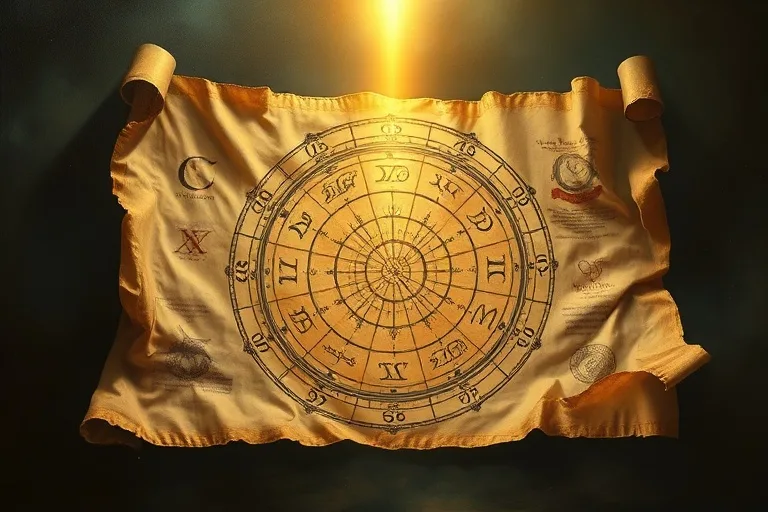
An antique scroll revealing an astrological birth chart, symbolizing the profound insights gained from chart analysis.
Practical Application and Case Studies
To truly grasp the significance of mutual reception, it's helpful to explore practical examples of how it manifests in a natal chart. These hypothetical case studies illustrate the dynamic interplay of planetary energies.
Example 1: Mars in Libra, Venus in Aries (Mutual Reception by Rulership)
Consider an individual with Mars in Libra and Venus in Aries. Mars, the planet of action and assertion, is in Venus's sign of diplomacy and balance. Venus, the planet of love and values, is in Mars's sign of passion and directness. This person might approach conflict with a desire for fairness (Mars in Libra) but also with a passionate conviction (Venus in Aries) to uphold their values. Their relationships (Venus) are likely to be characterized by both a strong desire for harmony and a need for passionate engagement. They may be a "velvet glove, iron fist" type, capable of both charm and assertive action. This reception can make them a natural negotiator or a passionate advocate for justice, blending strength with grace.
Example 2: Sun in Aquarius, Uranus in Leo (Mutual Reception by Rulership)
Here, the Sun (ego, identity) is in Aquarius, ruled by Uranus (innovation, rebellion). Uranus (individuality, change) is in Leo, ruled by the Sun (self-expression, creativity). This person's identity (Sun) is deeply tied to their unique and often unconventional ideas (Aquarius/Uranus). They express their individuality (Uranus) through creative and often dramatic means (Leo/Sun). They might be a visionary leader, an eccentric artist, or someone who champions humanitarian causes with a flair for the dramatic. Their sense of self is intrinsically linked to their ability to innovate and stand out, and their creative expression often serves a larger, collective purpose. This mutual reception empowers both the Sun and Uranus, making the individual a powerful force for change and self-expression.
The Importance of Essential Dignities
Mutual reception cannot be fully appreciated without a solid understanding of essential dignities. These are the ways in which planets are considered strong or weak based on the sign they occupy. Rulership (domicile) is when a planet is in the sign it governs, like Mars in Aries. Exaltation is a sign where a planet functions exceptionally well, like the Sun in Aries. Detriment is when a planet is in the sign opposite its rulership, making it challenging to express its energy, like Mars in Libra. Fall is the sign opposite its exaltation, also a difficult placement, like the Sun in Libra.
Mutual reception acts as a powerful corrective or enhancer within this system. Even if a planet is in detriment or fall, a mutual reception can "rescue" it, allowing it to operate with significantly more strength and effectiveness. It's like giving a struggling planet a direct line to its home base, even if it's currently in enemy territory. This makes mutual reception a crucial factor in evaluating the overall strength and potential of a natal chart, often revealing hidden resources and innate resilience that might otherwise be overlooked.
Advanced Considerations
For advanced astrologers, several additional factors can refine the interpretation of mutual reception, adding layers of complexity and nuance to its meaning.
Mutual Reception with Retrograde Planets
When one or both planets in mutual reception are retrograde, their cooperative energy takes on an introspective or internal quality. The exchange might be less outwardly expressed and more focused on internal processing, re-evaluation, or a unique, non-linear approach to the themes involved. While still beneficial, the expression might be delayed, refined over time, or manifest in ways that defy conventional expectations. This can indicate a deep, karmic connection between the two planetary energies, requiring a more conscious effort to integrate.
Aspects to Mutual Reception Pairs
The aspects formed to the planets in mutual reception are also highly significant. A planet forming a harmonious aspect (trine, sextile) to one of the planets in reception will also indirectly support the other, creating a larger network of positive influence. Conversely, challenging aspects (square, opposition) can introduce friction or tension into the cooperative dynamic, requiring conscious effort to resolve. The mutual reception itself can act as a buffer, helping to mediate difficult aspects by providing an underlying current of support and understanding between the involved energies.
Understanding these advanced layers allows for a more sophisticated and accurate interpretation of the chart, revealing the subtle ways in which planetary energies conspire to shape an individual's journey. Mutual reception is not just a static placement; it's a dynamic process of exchange that evolves throughout life, offering continuous opportunities for growth and self-discovery.
In conclusion, mutual reception is a cornerstone concept in advanced astrology, illuminating the profound interconnectedness of planetary energies within a natal chart. It signifies a powerful cooperative bond, enhancing planetary function, bridging disparate life areas, and often pointing to inherent strengths and unique talents. Whether by rulership or exaltation, its presence suggests a natural flow of energy that can mitigate challenges and amplify potential. For those delving into the deeper mysteries of the cosmos, recognizing and interpreting mutual reception offers invaluable insights into the intricate dance of destiny and the boundless possibilities of the human spirit.
Fuente: Contenido híbrido asistido por IAs y supervisión editorial humana.


Comments
Post a Comment