
Sacred Geometry Metatron's Cube Flower: Decoding Ancient Symbols | StarPluto
Sacred Geometry is a profound ancient science that explores the fundamental patterns and relationships governing the universe, from the micro to the macro cosmos. It posits that certain geometric shapes and proportions are not merely aesthetic but represent the very blueprint of creation, revealing the divine order inherent in all things. Within this intricate field, two symbols stand out for their complexity and spiritual significance: the Flower of Life and Metatron's Cube. These symbols are not just beautiful designs; they are considered keys to understanding the universe's energetic structure and the interconnectedness of all existence.
This comprehensive guide delves into the depths of Sacred Geometry, decoding the mysteries of Metatron's Cube and the Flower of Life. We will explore their historical origins, mathematical precision, and the spiritual interpretations that have captivated mystics, scientists, and artists for millennia. Understanding these symbols offers a unique perspective on the cosmos and our place within it, inviting a deeper connection to the universal patterns that shape reality.
- What is Sacred Geometry?
- The Flower of Life Unveiled: Symbol of Creation
- Decoding Metatron's Cube: The Blueprint of the Universe
- Platonic Solids and Their Universal Significance
- The Golden Ratio and Fibonacci Sequence: Nature's Code
- Sacred Geometry in Nature, Art, and Architecture
- Spiritual and Metaphysical Interpretations
- Modern Relevance and Practical Applications
- Conclusion: The Enduring Wisdom of Sacred Geometry
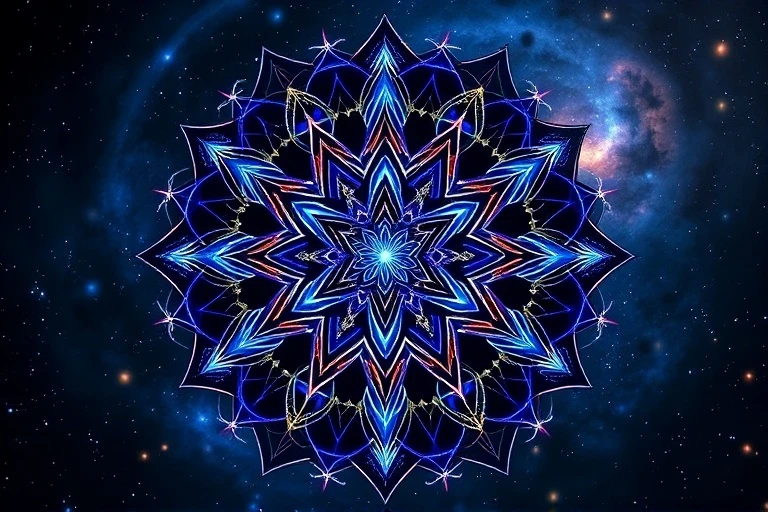
The intricate patterns of Mesoamerican Astrology AI Oracles Bridging Ancient Modern, such as Metatron's Cube and the Flower of Life, are believed to be the fundamental blueprints of existence.
What is Sacred Geometry?
Sacred Geometry is the study of the spiritual meaning of various shapes and patterns found in nature and the cosmos. It is considered a language of the universe, revealing the hidden order and interconnectedness of all things. Ancient civilizations, from the Egyptians to the Greeks and beyond, recognized and incorporated these principles into their art, architecture, and spiritual practices.
The core idea is that certain geometric forms are not arbitrary but are fundamental to the creation and structure of reality. These patterns are observed in everything from the molecular structure of DNA to the spiral of galaxies, suggesting a universal design principle. Understanding sacred geometry can lead to insights into the nature of existence, consciousness, and the divine.
Historically, figures like Pythagoras and Plato extensively explored these concepts, believing that mathematics and geometry were pathways to divine knowledge. Pythagoras, for instance, saw numerical ratios as the basis of musical harmony and cosmic order. Plato, in his work Timaeus, associated the five Platonic Solids with the fundamental elements of the universe, a concept deeply intertwined with sacred geometry.
The Flower of Life Unveiled: Symbol of Creation
The Flower of Life is one of the most ancient and revered symbols of sacred geometry, found in various cultures and religions across the globe. It consists of multiple overlapping circles, forming a flower-like pattern with perfect symmetry. This symbol is believed to represent the cycle of creation and the interconnectedness of all life forms.
Its origins can be traced back thousands of years, with notable examples found in the Temple of Osiris at Abydos, Egypt, dating back at least 6,000 years, and in ancient Assyrian, Asian, and European cultures. The symbol's universality suggests a shared understanding of fundamental cosmic principles among diverse civilizations.
The construction of the Flower of Life begins with a single circle, representing the "seed of life" or the initial divine spark. From this center, a second circle is drawn, its center on the circumference of the first. This process continues, creating an intricate pattern that expands outwards, symbolizing the unfolding of creation from a single source. Within its pattern, one can find other significant geometric shapes, including the Vesica Piscis, the Seed of Life, and the Egg of Life.
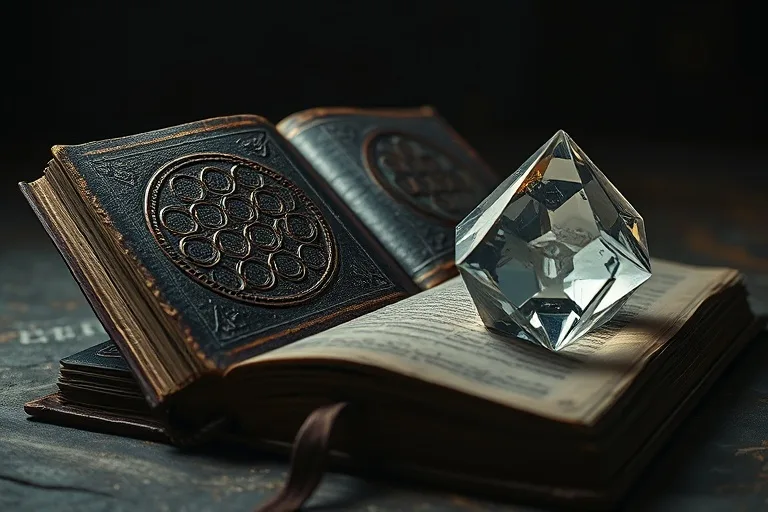
Ancient texts and artifacts often feature the Tarot Quantum Mechanics Intersecting Divination Reality, hinting at its deep spiritual and mathematical significance across cultures.
The Vesica Piscis, formed by the intersection of two circles, is seen as the geometric representation of the "womb of creation" or the union of opposing forces. It is also the basis for the eye, the fish, and many religious symbols. The Seed of Life, composed of seven overlapping circles, is considered the fundamental structure from which the Flower of Life and all other geometric forms emerge.
The Flower of Life is not just a static image; it is a dynamic representation of the universe's continuous creative process. It embodies the interconnectedness of all living beings and the fundamental unity that underlies apparent diversity. Many believe meditating on this symbol can help individuals connect with universal consciousness and understand the deeper patterns of existence.
Decoding Metatron's Cube: The Blueprint of the Universe
Metatron's Cube is another powerful symbol within sacred geometry, derived directly from the Flower of Life. It is named after Archangel Metatron, who, in certain mystical traditions, is considered the scribe of God and the keeper of the Akashic records. The cube is believed to contain all the geometric patterns of creation, including the five Platonic Solids.
To construct Metatron's Cube, one starts with the Seed of Life and expands it to the Flower of Life. Then, all the centers of the circles in the Flower of Life are connected with straight lines. This process reveals a complex, three-dimensional structure that encompasses all the fundamental shapes of the universe. It is often seen as a map of creation, illustrating how energy and information are organized into physical forms.
The significance of Metatron's Cube lies in its ability to contain the Platonic Solids, which are considered the building blocks of matter. These five three-dimensional shapes—the tetrahedron, hexahedron (cube), octahedron, dodecahedron, and icosahedron—are perfectly symmetrical and represent the fundamental elements of the cosmos. Their presence within Metatron's Cube suggests that this single symbol holds the blueprint for all physical reality.
Platonic Solids and Their Universal Significance
The Platonic Solids are a set of five convex regular polyhedra, meaning their faces are congruent regular polygons, and the same number of faces meet at each vertex. These shapes were extensively studied by the ancient Greeks, particularly Plato, who linked them to the classical elements and the structure of the cosmos.
- Tetrahedron (4 faces): Associated with the element of Fire, symbolizing willpower and courage.
- Hexahedron or Cube (6 faces): Linked to the element of Earth, representing stability and foundation.
- Octahedron (8 faces): Corresponds to the element of Air, signifying balance and integration.
- Icosahedron (20 faces): Connected to the element of Water, embodying fluidity and emotion.
- Dodecahedron (12 faces): Associated with the element of Aether (Spirit or Universe), representing the cosmos and divine thought.
The fact that these fundamental shapes can be extracted from Metatron's Cube underscores its role as a master blueprint. It suggests that the universe is constructed from these basic geometric forms, which then combine to create all the complexity we observe. This concept bridges the gap between the abstract world of geometry and the tangible reality of physical matter.
The Golden Ratio and Fibonacci Sequence: Nature's Code
Beyond the specific symbols like the Flower of Life and Metatron's Cube, sacred geometry also encompasses universal mathematical principles such as the Golden Ratio (Phi, approximately 1.618) and the Fibonacci Sequence. These mathematical relationships are found ubiquitously in nature, from the spiral arrangement of sunflower seeds to the branching of trees and the proportions of the human body.
The Fibonacci Sequence (0, 1, 1, 2, 3, 5, 8, 13, ...) is a series where each number is the sum of the two preceding ones. When the ratio of consecutive Fibonacci numbers is taken, it approximates the Golden Ratio. This ratio is considered aesthetically pleasing and harmonious, which is why it has been used in art and architecture for centuries, from the Parthenon to Renaissance paintings.
The presence of the Golden Ratio and Fibonacci Sequence in natural growth patterns, such as the spiraling of shells or the arrangement of leaves on a stem, reinforces the idea of a universal, intelligent design. These mathematical constants are not random but appear to be fundamental to the efficient and beautiful organization of life. They connect the microscopic world of cellular growth to the macroscopic patterns of galaxies, illustrating the consistent application of geometric principles throughout the cosmos.
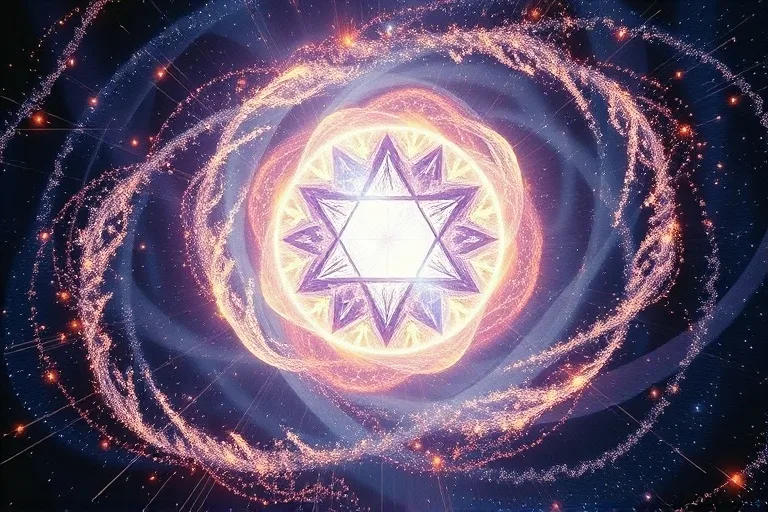
The universe's intricate design, often represented by Tarot Quantum Mechanics Intersecting Divination Reality, reflects the deep principles of sacred geometry.
Sacred Geometry in Nature, Art, and Architecture
The influence of sacred geometry extends far beyond abstract symbols; it is visibly present in the natural world and has been consciously applied in human creations throughout history. From the microscopic to the macroscopic, these patterns are everywhere.
In nature, we can observe sacred geometry in:
- Plants: The spiral arrangement of leaves (phyllotaxis), the branching patterns of trees, and the structure of flower petals often follow Fibonacci sequences and Golden Ratio proportions.
- Animals: The spiraling shell of a nautilus, the hexagonal cells of a beehive, and the intricate patterns on butterfly wings all exhibit geometric precision.
- Crystals: The molecular structure of crystals naturally forms perfect geometric shapes, reflecting the underlying order of matter.
- Celestial Bodies: The orbits of planets, the formation of galaxies, and the patterns of storms often display spiral and spherical geometries.
In human endeavors, sacred geometry has been a guiding principle for:
- Architecture: Ancient temples, cathedrals, and monuments like the Pyramids of Giza and the Parthenon were constructed using sacred geometric principles to achieve harmony, balance, and spiritual resonance.
- Art: Renaissance artists like Leonardo da Vinci consciously incorporated the Golden Ratio into their masterpieces, believing it created ideal proportions and aesthetic beauty.
- Music: The ratios found in sacred geometry are also reflected in musical harmony, with specific intervals and chords creating pleasing sounds based on mathematical relationships.
The pervasive presence of these patterns suggests that sacred geometry is not merely a human construct but an inherent aspect of the universal design. It speaks to a profound connection between mathematics, nature, and the spiritual realm.
Spiritual and Metaphysical Interpretations
Beyond their mathematical and aesthetic qualities, sacred geometric symbols carry deep spiritual and metaphysical interpretations. They are often seen as tools for meditation, personal transformation, and connecting with higher consciousness. The Flower of Life, for instance, is considered a symbol of unity and the interconnectedness of all life, fostering a sense of belonging and universal love.
Metatron's Cube, with its inclusion of the Platonic Solids, is often used for energetic clearing and protection. It is believed to help individuals understand their true potential and align with the divine blueprint of their soul. Many spiritual practitioners use these symbols in their healing work, meditation practices, and energy grids to amplify intentions and create sacred spaces.
The study of sacred geometry can also lead to a deeper understanding of the nature of reality itself. By recognizing the underlying geometric order, individuals may perceive the universe as a coherent, intelligent system rather than a chaotic one. This perspective can foster a sense of awe, wonder, and spiritual awakening, encouraging a more harmonious relationship with the cosmos.
Modern Relevance and Practical Applications
In contemporary times, the principles of sacred geometry continue to find relevance and application in various fields. Designers, architects, and artists often draw inspiration from these timeless patterns to create aesthetically pleasing and harmonious environments. The use of Golden Ratio proportions in graphic design, web layouts, and product design is common due to its inherent appeal to the human eye.
In the realm of wellness and personal development, sacred geometry symbols are used for their energetic properties. Many believe that wearing or placing these symbols in one's environment can promote balance, harmony, and spiritual growth. They are incorporated into jewelry, artwork, and even water energizers, based on the idea that geometric patterns can influence energy fields.
Furthermore, the study of sacred geometry can be a powerful tool for self-discovery and intellectual stimulation. It encourages critical thinking, pattern recognition, and a holistic view of the universe. As we continue to explore the mysteries of quantum physics and the nature of consciousness, the ancient wisdom embedded in sacred geometry may offer new insights and perspectives.
Conclusion: The Enduring Wisdom of Sacred Geometry
Sacred Geometry, with its profound symbols like the Flower of Life and Metatron's Cube, offers a timeless lens through which to view the universe. It reveals an underlying order, a divine blueprint that connects all aspects of existence, from the smallest atom to the largest galaxy. These patterns are not mere coincidences but fundamental expressions of creation, embodying mathematical precision and spiritual depth.
By exploring these ancient symbols, we gain a deeper appreciation for the harmony and interconnectedness of everything around us. Whether through historical study, artistic creation, or spiritual practice, sacred geometry invites us to recognize the universal language of form and proportion, fostering a sense of wonder and a profound connection to the cosmic dance of creation. The wisdom embedded in these geometric forms continues to resonate, offering guidance and inspiration for those seeking to understand the deeper truths of existence.
Fuente: Contenido híbrido asistido por IAs y supervisión editorial humana.


Comments
Post a Comment