
Predictive Ecological Astrology: Celestial Mechanics Environmental Shifts
Predictive Ecological Astrology represents a fascinating, albeit nascent, interdisciplinary field that seeks to understand and forecast environmental shifts through the lens of celestial mechanics. This approach posits that the intricate dance of planets, stars, and other celestial bodies exerts subtle yet profound influences on Earth's climate, geological activity, and biological ecosystems. Far from traditional weather forecasting, ecological astrology delves into long-term patterns and macro-environmental trends, attempting to identify correlations that might otherwise remain unseen.
The underlying premise is that Earth is not an isolated entity but an integral part of a larger cosmic system, constantly interacting with and responding to the energetic signatures of its celestial neighbors. By analyzing planetary cycles, alignments, and specific astrological configurations, practitioners aim to uncover potential periods of increased seismic activity, significant weather anomalies, shifts in biodiversity, or even broader climatic changes. This article will explore the foundational concepts, methodologies, and potential implications of this intriguing field, acknowledging its speculative nature while highlighting its potential for fostering a deeper connection between humanity and the cosmos.
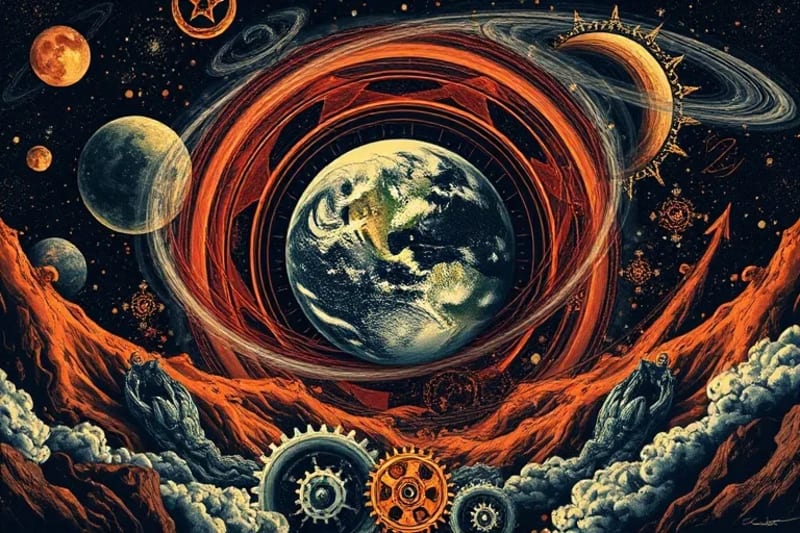
A stunning depiction of Earth's atmospheric and terrestrial systems intertwined with celestial phenomena, illustrating the core concept of ecological astrology.
Table of Contents
- Historical Roots of Celestial-Terrestrial Connection
- Core Principles: Celestial Mechanics and Earth Systems
- Planetary Cycles and Environmental Rhythms
- The Role of Fixed Stars and Galactic Influences
- Methodologies in Ecological Astrology
- Challenges and Criticisms
- Ethical Considerations and Responsible Forecasting
- Future Directions: Integrating Modern Science and Ancient Wisdom
Historical Roots of Celestial-Terrestrial Connection
The idea that celestial bodies influence terrestrial events is not new; it forms the bedrock of ancient astrological traditions across diverse cultures. From Mesopotamia to ancient China, civilizations meticulously observed planetary movements and correlated them with agricultural cycles, floods, droughts, and even societal upheavals. Early astronomers and astrologers were often one and the same, their observations forming the basis of both scientific understanding and spiritual belief systems.
In ancient Greece, philosophers like Plato and Aristotle discussed the concept of a "cosmic sympathy," where all parts of the universe were interconnected. The Stoics further developed this idea, suggesting that celestial events could serve as omens or indicators of earthly occurrences. These historical perspectives, while not directly "ecological" in the modern sense, laid the groundwork for understanding Earth as part of a larger, interconnected cosmic whole, a principle central to predictive ecological astrology today.
Many indigenous cultures worldwide still maintain traditions that link celestial phenomena to environmental patterns. For instance, certain star alignments might indicate optimal planting times, predict the arrival of specific animal migrations, or warn of impending weather shifts. These traditional knowledge systems, passed down through generations, often contain empirical observations that resonate with the contemporary exploration of celestial-terrestrial correlations.
Core Principles: Celestial Mechanics and Earth Systems
At its core, predictive ecological astrology operates on the principle that the gravitational, electromagnetic, and potentially other subtle energetic fields of celestial bodies can influence Earth's natural systems. Celestial mechanics, the branch of astronomy that deals with the motions of celestial objects, provides the framework for understanding these interactions. While mainstream science primarily acknowledges the Moon's gravitational pull on tides and the Sun's radiation as primary drivers of Earth's systems, ecological astrology extends this view to include other planets and their configurations.
The theory suggests that specific planetary alignments, aspects (angles between planets), and transits (current planetary positions relative to a fixed point, like Earth's geographical location) can create energetic resonances that affect Earth's various layers: its atmosphere, hydrosphere, lithosphere, and biosphere. For example, certain hard aspects involving outer planets like Uranus, Neptune, or Pluto are sometimes correlated with periods of increased geological instability or significant climatic shifts.
While the exact mechanisms remain largely theoretical and require further investigation, proponents often point to phenomena such as solar flares impacting Earth's magnetic field, or the subtle gravitational tugs of gas giants influencing the Sun's activity, which in turn affects Earth. The challenge lies in isolating these subtle influences from the myriad of other complex factors that drive environmental change.

A symbolic representation of Earth's delicate balance, influenced by both scientific principles and astrological energies.
Here is a table summarizing some hypothesized planetary aspects and their potential ecological correlations:
| Planetary Aspect | Hypothesized Ecological Correlation | Associated Phenomena |
|---|---|---|
| Uranus-Pluto Square/Opposition | Periods of intense geological upheaval and rapid environmental transformation. | Increased seismic activity, volcanic eruptions, significant climate shifts, technological impacts on nature. |
| Saturn-Neptune Conjunction/Square | Challenges related to water resources, pollution, and infectious diseases. | Floods, droughts, ocean acidification, spread of pathogens, resource scarcity. |
| Jupiter-Saturn Conjunction | Major shifts in socio-economic and political structures, often impacting resource management and land use. | Changes in agricultural practices, shifts in global climate policy, resource distribution issues. |
| Mars-Uranus Aspects | Sudden, disruptive events, often involving fire or electrical phenomena. | Wildfires, extreme storms, technological failures with environmental consequences. |
| Lunar Nodes Transits | Evolutionary shifts in collective consciousness regarding environmental issues. | Periods of heightened environmental activism, new scientific discoveries, policy changes. |
Planetary Cycles and Environmental Rhythms
Each planet has a distinct orbital period, creating cycles that, in ecological astrology, are believed to resonate with specific environmental rhythms on Earth. For instance, slower-moving outer planets like Uranus (84-year cycle), Neptune (165-year cycle), and Pluto (248-year cycle) are associated with long-term, generational shifts and profound transformations. Their conjunctions, squares, and oppositions are often highlighted as markers for significant environmental turning points.
The Jupiter-Saturn conjunction cycle, occurring approximately every 20 years, is traditionally linked to major socio-political and economic shifts. In an ecological context, these cycles might correlate with changes in global resource management, agricultural policies, or the emergence of new environmental paradigms. Historical data is often examined to see if these conjunctions align with observable patterns in climate or resource availability.
Even faster-moving planets, while not dictating long-term trends, can act as triggers or amplifiers for events within larger cycles. For example, a Mars transit over a sensitive point in an ecological chart might coincide with a sudden, intense weather event or a localized environmental disturbance. The Moon's phases, well-known for their influence on tides, are also considered for their subtle effects on rainfall patterns and biological rhythms.
The Role of Fixed Stars and Galactic Influences
Beyond the planets of our solar system, ecological astrology also considers the influence of fixed stars and broader galactic energies. Fixed stars, despite their immense distance, are believed to transmit specific energetic qualities that can modify or amplify planetary influences. Certain prominent fixed stars, when conjunct with planets or sensitive points in an ecological chart, are hypothesized to correlate with unique environmental phenomena.
For example, the fixed star Algol is often associated with intense, disruptive, and sometimes violent energies, which in an ecological context might manifest as extreme weather events or sudden geological shifts. Similarly, the Galactic Center, a powerful energy source at the heart of our Milky Way galaxy, is thought to represent a point of profound evolutionary influence, potentially impacting long-term planetary and environmental consciousness. You can learn more about these influences in Guided Meditation Interdimensional Travel Consciousness.
The precession of the equinoxes, a slow wobble of Earth's axis that shifts the vernal equinox point through the zodiacal constellations over thousands of years, is another critical factor. This grand cycle defines astrological "ages" (e.g., the Age of Pisces, the Age of Aquarius) and is believed to correspond with overarching shifts in global consciousness, cultural paradigms, and, by extension, humanity's relationship with the environment. Understanding these vast cycles helps frame the smaller planetary influences within a larger cosmic narrative.
Methodologies in Ecological Astrology
The methodologies employed in predictive ecological astrology often involve complex calculations and interpretations, drawing from traditional astrological techniques adapted for environmental analysis. Here are some key techniques:
- Mundane Astrology: This branch of astrology focuses on global events, nations, and collective phenomena. Ecological astrologers apply mundane techniques to analyze charts for specific geographical locations, charting planetary ingresses into zodiac signs and houses related to land, water, and resources.
- Ingress Charts: Charts cast for the moment the Sun enters cardinal signs (Aries, Cancer, Libra, Capricorn) are often used to forecast trends for the upcoming season or quarter. These are analyzed for environmental indicators relevant to the region.
- Eclipse Cycles: Solar and lunar eclipses are considered potent energetic events that can trigger significant changes. Ecological astrologers study the path of eclipses and the planetary configurations at the time of an eclipse to identify areas and themes that might experience environmental shifts.
- Planetary Returns and Cycles: Analyzing the return charts of planets (e.g., a Jupiter return every 12 years) or the synodic cycles between planets (e.g., Jupiter-Saturn conjunctions) provides insights into recurring environmental patterns and their evolutionary trajectory.
- Astrocartography: While often used for personal relocation, astrocartography can also be applied to identify geographical zones that are particularly sensitive or responsive to specific planetary energies, potentially indicating areas prone to certain environmental events.

A futuristic and analytical visual representing the subtle yet powerful energetic connections between celestial bodies and Earth's diverse regions.
The interpretation of these charts involves a blend of traditional astrological symbolism and a deep understanding of ecological processes. For example, a strong Neptune influence might point to issues related to water (floods, pollution) or subtle, unseen forces affecting ecosystems, while Uranus might indicate sudden, disruptive changes or technological impacts on the environment.
Challenges and Criticisms
Predictive ecological astrology faces significant challenges and criticisms, primarily from the scientific community. The lack of empirically verifiable mechanisms for how distant planets, beyond their gravitational and solar radiation effects, could directly influence specific environmental events is a major hurdle. Mainstream science relies on testable hypotheses and repeatable experiments, which are difficult to design for astrological correlations.
Critics often point to the "confirmation bias," where practitioners might selectively focus on correlations that fit their theories while overlooking countless instances where no such correlation exists. The complexity of Earth's climate system, driven by numerous interacting variables (solar radiation, ocean currents, atmospheric composition, human activity), makes it challenging to isolate any single celestial influence as a definitive cause.
Furthermore, the language of astrology is often symbolic and qualitative, making it difficult to translate into the quantitative, predictive models favored by modern environmental science. Bridging this gap requires rigorous statistical analysis and a willingness from both sides to explore new paradigms. Despite these criticisms, the field continues to attract interest from those seeking alternative perspectives on environmental forecasting and a deeper, more holistic understanding of Earth's place in the cosmos.
Ethical Considerations and Responsible Forecasting
Given the sensitive nature of environmental issues, ethical considerations are paramount in predictive ecological astrology. Forecasting potential disasters or significant environmental shifts carries a responsibility to avoid fear-mongering or inducing panic. Predictions should be presented as probabilities or potential trends, encouraging preparedness and proactive measures rather than fatalism.
The primary goal should be to foster a greater awareness of our interconnectedness with the cosmos and to inspire responsible stewardship of our planet. Ecological astrological insights, if utilized constructively, could potentially serve as an additional layer of information for environmental planners and policymakers, prompting them to consider broader temporal cycles and subtle influences.
It is crucial for practitioners to maintain transparency about the speculative nature of their work and to emphasize that astrological correlations are not replacements for established scientific methods but rather complementary perspectives that invite deeper inquiry. The focus should be on education and empowerment, encouraging individuals and communities to align with natural rhythms and contribute positively to Earth's well-being.
Future Directions: Integrating Modern Science and Ancient Wisdom
The future of predictive ecological astrology lies in its potential to integrate ancient wisdom with modern scientific inquiry. This could involve developing more sophisticated statistical models to test correlations between planetary cycles and environmental data sets, utilizing advanced computational tools to analyze vast amounts of information. Interdisciplinary collaboration between astrologers, climate scientists, geologists, and biologists could open new avenues for research and understanding.
Exploring subtle energy fields, such as electromagnetic resonances or quantum entanglement, might provide theoretical frameworks for how celestial influences could manifest on Earth. As our understanding of the universe expands, so too might our ability to perceive and measure previously undetectable connections. The field could also benefit from a more standardized approach to data collection and interpretation, allowing for peer review and comparative studies.
Ultimately, predictive ecological astrology offers a unique perspective that challenges conventional boundaries and invites a more holistic view of our planet. By seeking patterns in the cosmic dance, it encourages us to see Earth not just as a physical entity but as a living system intricately woven into the fabric of the universe. This perspective, regardless of its predictive accuracy, can foster a deeper reverence for nature and a renewed commitment to environmental harmony.
The ongoing exploration of how celestial mechanics influence Earth's environment is a testament to humanity's enduring quest to understand its place in the cosmos. Whether viewed as a scientific frontier or a spiritual endeavor, ecological astrology provides a rich tapestry of ideas for contemplating our planet's future in relation to the grand cycles of the universe. For more on how cosmic energies impact our lives, consider exploring Tarot Quantum Mechanics Intersecting Divination Reality.
Fuente: Contenido híbrido asistido por IAs y supervisión editorial humana.


Comments
Post a Comment