
Zodiac Synastry: Planetary Aspects in Relationships | StarPluto
Zodiac synastry is a profound branch of astrology dedicated to understanding the intricate dynamics between two individuals by comparing their natal charts. Far beyond simple Sun sign compatibility, synastry delves into the complex interplay of planets, houses, and, most crucially, the aspects formed between them. This advanced analytical technique offers unparalleled insights into the strengths, challenges, and underlying energetic currents that define any relationship, whether romantic, familial, or professional.
By overlaying one person's birth chart onto another's, astrologers can identify specific points of connection and friction, revealing patterns of attraction, conflict, mutual support, and areas for growth. The core of synastry lies in interpreting how the planets in one chart "activate" or "respond" to the planets in the other, creating a unique energetic blueprint for the relationship itself. Understanding these planetary aspects is not merely about predicting outcomes but about fostering deeper self-awareness and empathy within the partnership.
Table of Contents
- Introduction to Synastry: The Art of Chart Comparison
- Key Planetary Aspects in Synastry: Conjunctions, Oppositions, Trines, and More
- Sun-Moon Aspects: The Core of Emotional Connection
- Mercury, Venus, and Mars Aspects: Communication, Affection, and Drive
- Jupiter and Saturn Aspects: Growth, Stability, and Karma
- Uranus, Neptune, and Pluto Aspects: Transformative and Evolutionary Dynamics
- Ascendant, Descendant, and Midheaven in Synastry
- Practical Application of Synastry: Beyond Compatibility Scores
- Ethical Considerations in Synastry Interpretation
Introduction to Synastry: The Art of Chart Comparison
Synastry, derived from the Greek words "syn" (together) and "astron" (star), literally means "stars together." It is the astrological technique of comparing two or more natal charts to determine the nature of the relationship between the individuals involved. This method goes far beyond superficial compatibility readings, offering a deep dive into the psychological, emotional, and spiritual connections.
The fundamental premise of synastry is that each person's birth chart is a unique energetic blueprint, and when two such blueprints interact, they create a third, distinct energy field—that of the relationship itself. By analyzing how the planets and points in one chart aspect those in another, we can discern where natural harmony exists, where growth opportunities lie, and where potential friction points may arise.
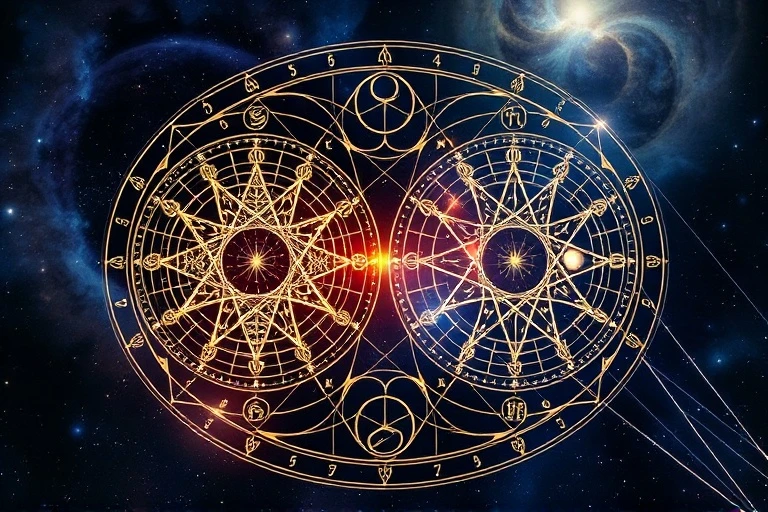
Unlike composite charts, which blend two charts into a single "relationship chart," synastry maintains the individuality of each person's chart while observing their interaction. This allows for a nuanced understanding of how each partner experiences the relationship and how their individual needs and patterns are met or challenged by the other. It’s a powerful tool for self-discovery within the context of partnership.
Key Planetary Aspects in Synastry: Conjunctions, Oppositions, Trines, and More
Planetary aspects are the angular relationships between planets in a chart, measured in degrees. In synastry, these aspects are formed when a planet in one person's chart forms an angle to a planet or point in another person's chart. Each aspect carries a unique energetic signature, influencing the nature of the interaction.
- Conjunction (0°): Represents a strong merging of energies. When two planets are conjunct, their functions become intertwined, creating a powerful area of focus or intensity in the relationship. It can signify shared purpose, deep understanding, or an overwhelming influence.
- Opposition (180°): Indicates a dynamic of polarity, awareness, and balance. Oppositions bring a push-pull effect, where partners may see each other as reflections or opposites. It can lead to great complementarity or significant tension, requiring conscious effort to integrate diverse perspectives.
- Trine (120°): A harmonious and flowing aspect, signifying ease, natural understanding, and mutual support. Trines often represent areas where partners effortlessly uplift and appreciate each other, fostering a sense of comfort and grace.
- Square (90°): A challenging aspect that creates tension, friction, and dynamic action. Squares highlight areas of conflict, misunderstanding, or necessary growth. While often uncomfortable, they can be powerful catalysts for change and development within the relationship.
- Sextile (60°): A harmonious and opportunistic aspect, indicating ease of communication and shared interests. Sextiles offer opportunities for cooperation and mutual benefit, though they may require some conscious effort to activate fully.
- Quincunx/Inconjunct (150°): An awkward or challenging aspect that requires adjustment and adaptation. Quincunxes indicate areas where energies don't naturally blend, leading to a feeling of being "out of sync" or requiring constant recalibration.
Beyond these major aspects, minor aspects like the semi-sextile (30°), semi-square (45°), sesquiquadrate (135°), and quintile (72°) also contribute to the nuanced tapestry of synastry, though their influence is often more subtle. The orb (the allowable deviation from the exact degree) is also crucial, with tighter orbs indicating stronger influences.
Sun-Moon Aspects: The Core of Emotional Connection
The Sun and Moon are arguably the most vital planets in synastry, representing the core identity (Sun) and emotional nature (Moon). Aspects between one person's Sun and the other's Moon are particularly telling about the fundamental compatibility and emotional resonance in a relationship.
| Aspect | Interpretation in Synastry (Sun-Moon) |
|---|---|
| Sun Conjunct Moon | Deep emotional understanding, natural rapport, feeling "at home" with each other. A strong sense of shared identity and purpose. |
| Sun Oppose Moon | Dynamic attraction and complementarity. Partners often balance each other, but can also experience tension due to differing needs or expressions. |
| Sun Trine Moon | Harmonious emotional flow, mutual respect, and easy acceptance. A comfortable and supportive connection where feelings are easily expressed and understood. |
| Sun Square Moon | Significant emotional friction and challenges in understanding each other's core needs. Requires conscious effort to bridge gaps and resolve conflicts, but can lead to profound growth. |
| Sun Sextile Moon | Opportunities for emotional support and understanding. Partners can easily communicate their feelings and find common ground, fostering a positive atmosphere. |
These aspects reveal the fundamental emotional compatibility. A strong Sun-Moon connection often forms the bedrock of a lasting and fulfilling relationship, providing a sense of security and mutual appreciation. Conversely, challenging Sun-Moon aspects can indicate areas where partners must work harder to understand and validate each other's core being and emotional landscape.
Mercury, Venus, and Mars Aspects: Communication, Affection, and Drive
The personal planets—Mercury, Venus, and Mars—govern crucial aspects of daily interaction and attraction. Their inter-chart aspects illuminate how partners communicate, express affection, and pursue their desires.

- Mercury Aspects: Govern communication styles, intellectual compatibility, and how partners exchange ideas. Harmonious Mercury aspects (trine, sextile) facilitate easy understanding and stimulating conversations. Challenging aspects (square, opposition) can lead to misunderstandings, differing thought processes, or communication breakdowns. A Mercury conjunction can signify shared intellectual interests or a very similar way of thinking.
- Venus Aspects: Reveal how partners express and receive love, their aesthetic preferences, and their values. Strong Venus aspects (conjunction, trine, sextile) often indicate mutual attraction, shared enjoyment, and a harmonious approach to affection. Difficult aspects (square, opposition) might point to differing values, tastes, or ways of showing love, potentially leading to emotional friction.
- Mars Aspects: Indicate sexual chemistry, drive, ambition, and how partners assert themselves and handle anger. Dynamic Mars aspects (conjunction, trine, sextile) can create strong passion, shared goals, and energetic cooperation. Challenging aspects (square, opposition) can manifest as power struggles, arguments, or conflicts over desires and actions.
The interplay of these planets is crucial for the day-to-day functioning and enjoyment of a relationship. For instance, a strong Venus-Mars connection is often a hallmark of romantic attraction and sexual compatibility, while Mercury aspects dictate the ease with which partners can resolve issues and connect intellectually. For more on Mesoamerican Astrology AI Oracles Bridging Ancient Modern, delve deeper into their individual meanings.
Jupiter and Saturn Aspects: Growth, Stability, and Karma
Jupiter and Saturn are the social planets, influencing our broader worldview, opportunities, responsibilities, and karmic lessons. Their synastric aspects speak to the long-term potential, stability, and growth trajectory of a relationship.
- Jupiter Aspects: When Jupiter from one chart aspects a planet in another, it tends to bring expansion, optimism, good fortune, and a sense of shared adventure. Harmonious Jupiter aspects (conjunction, trine, sextile) can indicate mutual growth, shared philosophical outlooks, and a feeling of abundance. Challenging aspects (square, opposition) might point to overindulgence, unrealistic expectations, or differing beliefs that need to be reconciled. Jupiter often acts as a benevolent influence, bringing joy and opportunity.
- Saturn Aspects: Saturn is the planet of commitment, structure, responsibility, and karmic lessons. Saturn aspects in synastry are often considered foundational, indicating areas where the relationship will be tested, strengthened, or where one partner imposes structure on the other. Harmonious Saturn aspects (trine, sextile) suggest stability, loyalty, and a strong sense of commitment and mutual support in responsibilities. Challenging aspects (conjunction, square, opposition) can bring feelings of restriction, criticism, obligation, or heavy burdens. These aspects often highlight areas where hard work and maturity are required, but they can also forge incredibly resilient bonds.
The interaction between Jupiter and Saturn in synastry is crucial for understanding the balance between freedom and commitment, expansion and contraction within a partnership. A well-integrated Jupiter-Saturn dynamic can provide both growth and stability, creating a relationship that is both inspiring and enduring. Explore more about Tarot Quantum Mechanics Intersecting Divination Reality to understand how planets exert their influence.
Uranus, Neptune, and Pluto Aspects: Transformative and Evolutionary Dynamics
The outer planets—Uranus, Neptune, and Pluto—operate on a generational and transpersonal level, bringing themes of revolution, idealism, and profound transformation to relationships. Their aspects in synastry often indicate the deeper, more unconscious forces at play.
- Uranus Aspects: Uranus brings excitement, unpredictability, and a desire for freedom. In synastry, Uranus aspects can electrify a relationship, introducing novelty and breaking conventions. Harmonious aspects (trine, sextile) can foster intellectual stimulation, shared innovative ideas, and a sense of liberating individuality. Challenging aspects (conjunction, square, opposition) might lead to instability, sudden changes, or a feeling of being unsettled or restricted by the partner. Uranus often challenges the status quo, pushing partners to evolve.
- Neptune Aspects: Neptune introduces themes of idealism, spirituality, compassion, and sometimes illusion or confusion. Harmonious Neptune aspects (trine, sextile) can create a deeply spiritual bond, profound empathy, and shared dreams. Challenging aspects (conjunction, square, opposition) may lead to unrealistic expectations, boundary issues, deception, or a blurring of identities. Neptune encourages transcendence but can also dissolve boundaries if not handled consciously.
- Pluto Aspects: Pluto is the planet of transformation, power, death, and rebirth. Pluto aspects in synastry signify intense, often karmic, connections that bring about profound change. Harmonious aspects (trine, sextile) can indicate deep psychological understanding, shared transformative experiences, and powerful healing. Challenging aspects (conjunction, square, opposition) can manifest as power struggles, control issues, jealousy, or intense psychological confrontations. Pluto forces partners to confront their deepest fears and undergo profound personal evolution.
While the outer planets can bring intense and sometimes difficult experiences, they are also responsible for the most profound growth and transformation within a relationship. They push individuals beyond their comfort zones, leading to spiritual and psychological evolution. Understanding these aspects can help partners navigate the deeper currents of their shared journey. For further exploration, consider how influences these profound connections.
Ascendant, Descendant, and Midheaven in Synastry
Beyond the planets, the angles of the natal chart—the Ascendant (AC), Descendant (DC), Midheaven (MC), and Imum Coeli (IC)—play a crucial role in synastry, defining how individuals meet, interact publicly, and experience their private lives together.
- Ascendant-Descendant Axis: The Ascendant represents our outward personality, how we initiate contact, and our physical appearance. The Descendant (opposite the Ascendant) represents our approach to relationships and what we seek in a partner. When one person's planet aspects the other's Ascendant or Descendant, it creates a powerful pull. For example, one person's Sun conjunct the other's Descendant often indicates a strong sense of recognition and an ideal partner dynamic.
- Midheaven-Imum Coeli Axis: The Midheaven (MC) signifies our public image, career, and life direction, while the Imum Coeli (IC) represents our roots, home life, and private self. Aspects to these points in synastry can reveal how partners influence each other's public ambitions or private sense of security. A planet conjunct the MC can indicate a partner who significantly impacts one's career or public standing, while a planet conjunct the IC might suggest a deep, nurturing connection to one's home and family life. Learn more about Psycho-Astrology: Jungian Psychology Natal Chart Integration for career insights.
These angular aspects are often felt very directly and personally, influencing the initial attraction, the public face of the relationship, and the intimate dynamics within the home. They provide a framework for understanding the roles partners play in each other's lives and how they perceive one another.
Practical Application of Synastry: Beyond Compatibility Scores
The true value of synastry extends far beyond a simple "compatibility score." It is a diagnostic and growth-oriented tool that can empower individuals and couples to navigate their relationships with greater awareness and intention. Here are some practical applications:
- Understanding Dynamics: Synastry helps identify the underlying energetic patterns that contribute to harmony or conflict. For instance, a challenging Mars-Mars aspect might explain frequent arguments over assertion, while a harmonious Venus-Jupiter aspect could highlight shared joy and generosity.
- Fostering Empathy: By understanding a partner's planetary placements and how they interact with one's own, individuals can develop deeper empathy for their partner's needs, motivations, and emotional triggers. This leads to more compassionate responses.
- Growth Opportunities: Difficult aspects are not necessarily "bad"; they are growth opportunities. Synastry can pinpoint areas where conscious effort, compromise, and personal development are required, turning potential friction into profound transformation.
- Navigating Challenges: When couples face recurring issues, synastry can provide a neutral framework to understand the astrological roots of these challenges, offering strategies for resolution that align with both individuals' cosmic blueprints.
- Pre-Marital Counseling: For couples considering long-term commitment, synastry offers a comprehensive overview of their potential journey, highlighting both the joys and the work involved.
- Business Partnerships: Synastry is not limited to romantic relationships. It can be invaluable in understanding the dynamics of business partnerships, revealing strengths in collaboration and potential areas of disagreement or differing work styles.
Ultimately, synastry provides a roadmap, not a destiny. It illuminates the inherent potentials and challenges, allowing individuals to consciously engage with their relationships rather than being passively carried by them. For a broader perspective on astrological tools, consider reviewing components.
Ethical Considerations in Synastry Interpretation
As with any powerful tool, synastry comes with ethical responsibilities. An astrologer interpreting synastry must approach the reading with sensitivity, respect, and a commitment to empowering the individuals involved, rather than dictating their choices.
- Consent and Privacy: It is paramount to have the explicit consent of both individuals before analyzing their charts together. Interpreting someone's chart without their knowledge or permission is an ethical breach.
- Non-Determinism: Astrologers should emphasize that synastry reveals potentials and tendencies, not fixed destinies. Free will and conscious choice always play a significant role in how these energies manifest.
- Empowerment, Not Judgment: The goal of synastry is to empower individuals to understand and improve their relationships, not to judge or label them. The language used should be constructive and supportive.
- Focus on Growth: Challenging aspects should be framed as opportunities for growth and self-awareness, rather than insurmountable obstacles. The focus should always be on how to work with the energies, not against them.
- Confidentiality: All information shared during a synastry reading must be treated with the utmost confidentiality.
Synastry, when approached ethically and with integrity, can be a profound tool for fostering deeper connections, resolving conflicts, and guiding individuals toward more fulfilling and conscious relationships. It offers a unique lens through which to view the intricate dance of human connection, illuminated by the timeless wisdom of the stars. For general astrological guidance, consider exploring Chrono-Astrology Ancestral Echoes Navigating Personal Time Cycles.
Fuente: Contenido híbrido asistido por IAs y supervisión editorial humana.


Comments
Post a Comment