
Planetary Dignities: Accidental Mastery Electional Astrology
Advanced Planetary Dignities: Mastering Accidental Dignities for Electional Astrology
In the intricate science of astrology, understanding planetary dignities is paramount, especially when practicing the precise art of electional astrology. While essential dignities—which pertain to a planet's inherent strength based on its zodiacal placement—form the bedrock of astrological interpretation, it is the mastery of accidental dignities that truly elevates a practitioner's ability to select optimal timings for any endeavor. These accidental strengths and weaknesses, derived from a planet's position within the houses, its speed, and its relationships with other celestial bodies, dictate its effective power and influence in a given chart.
 Conceptual representation of an astrologer's deep study into celestial mechanics and planetary influences.
Visual source subject to ecosystem availability: Wikimedia Commons under CC BY-SA 4.0 license or AI conceptual rendering.
Electional astrology, often described as the art of "starting right," involves choosing a precise moment for an event to maximize its chances of success and align with favorable cosmic currents. This discipline relies heavily on identifying planets that are strong and well-disposed to carry out the intention of the election. While a planet might be in its sign of exaltation (an essential dignity), its accidental condition could render it weak or ineffective, thereby undermining the election's potential. Conversely, a planet with moderate essential dignity could be significantly empowered by strong accidental placements.
Table of Contents
- Essential vs. Accidental Dignities: A Foundational Distinction
- House Placement and Planetary Power
- Speed and Direction: The Dynamics of Influence
- Aspects and Planetary Relationships
- Special Accidental Conditions: Combustion, Cazimi, and Joy
- Applying Accidental Dignities in Electional Astrology
- Advanced Strategies and Nuances for Mastery
Essential vs. Accidental Dignities: A Foundational Distinction
Before delving deeper into accidental dignities, it is crucial to briefly reiterate the distinction between essential and accidental strengths. Essential dignities refer to a planet's intrinsic power based on its zodiac sign placement. These include rulership, exaltation, triplicity, terms, and faces (or decans). A planet in its domicile or exaltation is inherently strong and operates with ease and effectiveness, embodying its core nature. Conversely, a planet in its detriment or fall is considered essentially weak, struggling to express its energies constructively.
Accidental dignities, on the other hand, describe a planet's circumstantial power, its ability to act effectively in the world at a particular moment. These are external factors that either enhance or diminish a planet's essential strength, making it more or less capable of achieving its objectives. Think of essential dignity as a person's innate talent and accidental dignity as their current health, resources, and social standing. Both are vital for success, and a robust understanding of both is key to mastering any astrological chart analysis, including birth chart interpretation.
House Placement and Planetary Power
The most significant accidental dignity often comes from a planet's placement within the twelve astrological houses. Houses represent distinct areas of life, and a planet's position within them determines its sphere of influence and its capacity to manifest its energies. Planets in certain houses are inherently more powerful and active, while others are debilitated.
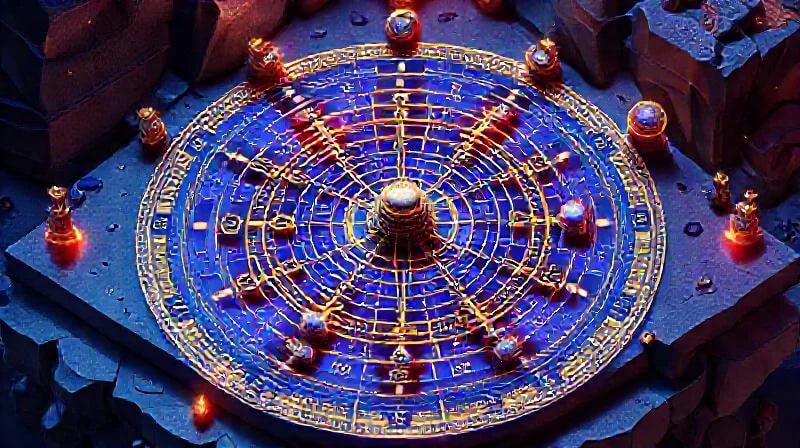 Detailed vector art illustrating the intricate geometric patterns and planetary relationships within an astrological chart.
- Angular Houses (1st, 4th, 7th, 10th): Planets in these houses are considered exceptionally strong and visible. They are at the "angles" of the chart, representing cardinal points of action and manifestation. The 10th house (Midheaven) is often considered the most powerful, followed by the 1st (Ascendant), 7th (Descendant), and 4th (Imum Coeli). An election benefits greatly when the significator of the matter is in an angular house.
- Succedent Houses (2nd, 5th, 8th, 11th): Planets in these houses are of moderate strength. They are "succeeding" the angular houses, indicating stability and resources. While not as potent as angular placements, they still provide a good foundation for action and growth. The 11th house is often favored for its association with hopes, wishes, and beneficial alliances.
- Cadent Houses (3rd, 6th, 9th, 12th): Planets in these houses are generally considered weak or debilitated. They are "falling away" from the angles, representing areas of adjustment, learning, or hidden matters. The 6th and 12th houses are traditionally the most challenging for planetary action, often associated with illness, servitude, or self-undoing. The 3rd and 9th, while cadent, can still be active for communication and travel.
The strength of a planet in a house is also influenced by its proximity to the cusp. A planet closer to the cusp of an angular house will exert more influence than one further away. This nuance is vital for precise electional work.
Speed and Direction: The Dynamics of Influence
A planet's motion—its speed and direction—is another critical accidental dignity. A planet's ability to "do its job" is directly tied to its movement.
- Direct Motion: Planets moving direct (forward) are considered strong and effective. They are progressing naturally and can bring matters to fruition.
- Retrograde Motion: Planets moving retrograde (appearing to move backward from Earth's perspective) are accidentally debilitated. They often signify delays, reversals, or a need to revisit past issues. While not always negative, retrograde planets are generally avoided as significators in electional charts, as they can make the outcome unpredictable or require extra effort.
- Stationary: A planet that is stationary (about to turn direct or retrograde) is at its most potent, though also its most unstable. A stationary direct planet can be incredibly powerful for initiating something with lasting impact, while a stationary retrograde planet can indicate a significant turning point or a stuck situation.
- Fast in Motion: A planet moving faster than its average speed is considered accidentally dignified, indicating swift action and efficient manifestation.
- Slow in Motion: A planet moving slower than its average speed is accidentally debilitated, suggesting delays, inertia, or a gradual unfolding of events.
For electional astrology, a strong significator should ideally be direct and fast in motion, especially if the election aims for quick results. This dynamic aspect of planetary motion is often overlooked but holds immense power in determining the efficacy of an elected moment. Understanding these nuances can significantly impact the success of a chosen time, as explored in detailed guides like "Planetary Magic Grimoire Traditions Celestial Intelligences Guide."
Aspects and Planetary Relationships
The relationships a planet forms with other planets through aspects also contribute to its accidental dignity. These connections can either empower or hinder its expression.
- Aspects to Benefics (Jupiter and Venus): A planet receiving a harmonious aspect (trine or sextile) from Jupiter or Venus is accidentally dignified. These aspects bring ease, good fortune, and support to the planet's agenda. Even a square or opposition from a benefic can sometimes be less detrimental than from a malefic, though it still presents challenges.
- Aspects to Malefics (Mars and Saturn): A planet receiving a challenging aspect (square or opposition) from Mars or Saturn is accidentally debilitated. These aspects can bring conflict, obstacles, delays, or hardship. Conjunctions to malefics are also generally considered weakening, unless the malefic is itself well-dignified and configured.
- Reception: When two planets are in each other's essential dignities (e.g., Mars in Aries, Venus in Libra, and they aspect each other), they are said to be in mutual reception. This significantly strengthens both planets, allowing them to cooperate and support each other's functions, even if the aspect itself is challenging.
- Application and Separation: A planet applying to an aspect is building towards that influence, while one separating is moving away from it. For electional purposes, applying aspects are generally preferred, as they indicate a developing influence, especially when applying to a benefic.
The strength of these aspects is also modified by the houses involved. For example, a benefic aspect from a planet in the 11th house (friends, good fortune) to the significator of an election is highly desirable. Conversely, a malefic aspect from the 6th or 12th house would be particularly problematic. This intricate web of relationships forms the basis of advanced predictive techniques in astrology.
 Abstract oil painting depicting planets in symbolic configurations, hinting at their placement within astrological houses and their cosmic influence.
Special Accidental Conditions: Combustion, Cazimi, and Joy
Beyond house placement, speed, and aspects, several other specific accidental conditions significantly impact a planet's strength:
- Combustion: A planet is "combust" when it is within 8.5 degrees of the Sun. This position is traditionally considered a severe accidental debility, as the planet's light and influence are "burned up" by the Sun's rays. It often signifies hiddenness, weakness, or a lack of clear expression for the combust planet. Elections where the significator is combust are generally avoided.
- Cazimi: The exception to combustion is "Cazimi" (in the heart of the Sun), when a planet is within 17 minutes of arc (0°17') of the Sun. In this precise conjunction, the planet is said to be empowered and purified by the Sun, acting as if it were sitting on a throne. This is a rare and highly beneficial accidental dignity, making the planet incredibly strong for the matter it signifies.
- Under the Sunbeams: A planet between 8.5 and 17 degrees from the Sun is "under the Sunbeams." This is a milder form of debility than combustion, but still weakens the planet's visibility and effectiveness.
- Joy: Planets are said to be in "joy" when they are in specific houses where they are traditionally considered to thrive. This provides a significant accidental boost to their power. For example, Mercury rejoices in the 1st house, Moon in the 3rd, Venus in the 5th, Mars in the 6th, Jupiter in the 11th, and Saturn in the 12th. The Sun rejoices in the 9th house.
- Peregrine: A planet is "peregrine" when it has no essential dignities (not in its domicile, exaltation, triplicity, term, or face). Such a planet is considered a "wanderer" and accidentally debilitated, lacking direction and intrinsic power. Its actions can be unpredictable.
- Besieged: A planet is "besieged" when it is situated between two malefics (Mars and Saturn). This is a severe accidental debility, as the planet is trapped and its actions are constrained by negative influences.
Applying Accidental Dignities in Electional Astrology
The practical application of accidental dignities in electional astrology involves a systematic approach to chart analysis. The goal is to identify a moment when the planet (or planets) ruling the matter of the election is as accidentally strong as possible.
Consider an election for a new business venture. The significator of business is often Mercury, and the significator of finances is Venus or the ruler of the 2nd house. For a successful election, you would ideally want:
- Mercury and Venus (or their proxies) to be in angular or succedent houses, preferably the 10th or 1st for visibility and action, or the 11th for support.
- Both planets to be in direct motion and ideally moving fast.
- They should be applying to harmonious aspects with benefics (Jupiter/Venus) and separating from challenging aspects with malefics (Mars/Saturn).
- Avoid combustion, peregrine status, or being besieged for the significators.
- Ensure the Moon, which acts as the "trigger" of the election, is also well-placed and making favorable applying aspects to the significators.
This meticulous process requires not only a deep understanding of each dignity but also the ability to synthesize multiple factors. For example, a planet in its domicile (strong essential dignity) but in the 12th house (weak accidental dignity) and retrograde (further accidental debility) might still struggle to manifest its potential. Conversely, a planet in its detriment (weak essential dignity) but in the 10th house, fast, direct, and applying to Jupiter (strong accidental dignities) could surprisingly yield positive results, albeit with more effort or unexpected turns.
Advanced Strategies and Nuances for Mastery
Mastering accidental dignities in electional astrology goes beyond simply identifying strong placements; it involves understanding their interplay and prioritizing them based on the election's specific goals. Here are some advanced considerations:
- The Lord of the Ascendant: Always ensure the ruler of the Ascendant (the significator of the native or the elected event itself) is accidentally strong. A weak Ascendant ruler can undermine even the best-laid plans.
- Moon's Role: The Moon is crucial in electional astrology, acting as the immediate trigger and conveyor of planetary influences. Ensure the Moon is not combust, void of course, or making applying aspects to malefics in cadent houses. Its applying aspects to the significators are paramount.
- Antiscia and Contra-antiscia: These are subtle points of planetary reflection that can add hidden strength or weakness. A planet's antiscia falling on a benefic or an important house cusp can subtly enhance its accidental dignity.
- Fixed Stars: Conjunctions to powerful fixed stars can imbue a planet with immense accidental strength, though this is a more advanced technique requiring careful study.
- Decisional Hierarchy: When conflicting dignities arise, a hierarchy is often applied. Angularity and direct motion are generally considered more powerful than aspects, for instance. However, the specific goal of the election dictates which dignities are prioritized. For long-term projects, stability (succedent houses) might be more important than immediate visibility (angular houses).
The synergy between essential and accidental dignities creates a comprehensive picture of a planet's total strength. A planet that is both essentially and accidentally dignified is a powerhouse, capable of achieving its aims with minimal friction. Conversely, a planet weak in both categories will struggle immensely. The true art of electional astrology lies in finding those rare moments where the cosmic currents align, guided by a profound understanding of these intricate planetary conditions. This pursuit of optimal timing is a core tenet of financial astrology and other specialized branches.
In conclusion, while essential dignities define a planet's inherent nature, accidental dignities determine its effective power and ability to act in the world. For electional astrology, mastering these nuanced conditions is not merely an academic exercise but a practical necessity for selecting moments that are truly auspicious and aligned with success. By meticulously analyzing house placements, speed, aspects, and special conditions, astrologers can unlock the full potential of a chosen moment, guiding endeavors towards their most favorable outcomes.
Explore More Astrological Insights
- Lunar Mansions Geomancy: Sacred Urban Architectural Structures
- Jungian Archetypes Natal Chart Integration
- Runes: Ancient Nordic Divination & Symbolism
- Somatic Spirituality: Embodied Awakening, Energy Healing
Note: This section is a placeholder for the NSD-2026 module. The exact content for this module was not provided in the prompt.
Source: Hybrid content assisted by AI and human editorial supervision.


Comments
Post a Comment