
Tarot AI Divination Algorithmic Dream Interpretation
The intersection of ancient divination practices and cutting-edge artificial intelligence represents a fascinating frontier in human understanding and spiritual exploration. For millennia, humanity has sought guidance and insight through various methods, from interpreting celestial alignments to deciphering the symbolic language of dreams and the Tarot. Today, as AI technologies advance, new possibilities emerge for augmenting these time-honored traditions, offering fresh perspectives and deeper analytical capabilities.
- Introduction to a New Paradigm: Tarot and AI
- The Foundations of Divination: From Ancient Wisdom to Modern Quest
- Decoding the Tarot: A Symbolic Language for Self-Discovery
- The Rise of AI in Interpretive Sciences: A New Era of Analysis
- Algorithmic Dream Interpretation: Unraveling the Subconscious
- Synergy: How AI Augments Tarot Readings and Spiritual Guidance
- Ethical Considerations and the Human Element in AI Divination
- The Future Landscape of Divination: Integrating Technology and Intuition
- Conclusion: A Harmonious Blend of Tradition and Innovation
Introduction to a New Paradigm: Tarot and AI
The concept of using artificial intelligence to interpret complex symbolic systems like Tarot or dreams might seem contradictory at first glance. Tarot, with its rich history and reliance on intuition, often appears to be the antithesis of algorithmic logic. However, AI's capacity for pattern recognition, data analysis, and natural language processing opens up unprecedented avenues for exploring the depths of these ancient practices. This article delves into how AI can serve not as a replacement for human intuition, but as a powerful tool to enhance understanding and provide more nuanced interpretations.
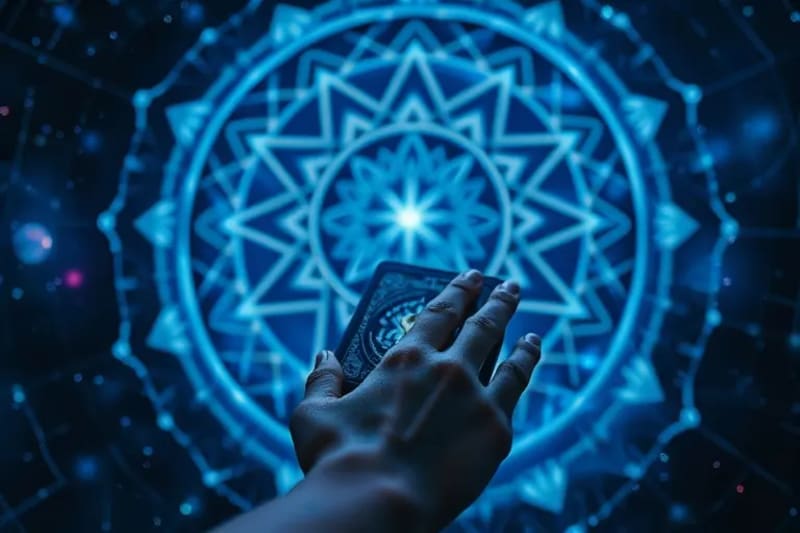
A mystical scene where ancient Tarot cards are illuminated by ethereal, glowing lines of code, symbolizing the integration of AI into spiritual practices.
The Foundations of Divination: From Ancient Wisdom to Modern Quest
Divination, the practice of seeking knowledge of the future or the unknown by supernatural means, has been an integral part of human culture across civilizations. From the oracles of Delphi to the shamans interpreting animal entrails, people have always sought ways to gain insight into their destiny and make informed decisions. These practices often involve complex symbolic systems, requiring years of study and intuitive development to master.
The underlying principle of many divination forms is the belief in interconnectedness—that seemingly random events or symbols can reflect deeper truths about an individual's path or the collective unconscious. Understanding these intricate connections is where AI can potentially offer a new layer of analysis. Traditional methods, while rich in wisdom, are often limited by human cognitive biases and the sheer volume of data to process.
- Astrology: Interpreting celestial positions and their influence on earthly events and personalities.
- Numerology: Assigning significance to numbers and their patterns.
- I Ching: An ancient Chinese divination text based on hexagrams and their interpretations.
- Tarot: A deck of cards used for insight into past, present, and future situations.
- Dream Interpretation: Analyzing the symbolic content of dreams to understand subconscious messages.
Decoding the Tarot: A Symbolic Language for Self-Discovery
The Tarot deck, typically consisting of 78 cards, is a profound system of archetypal imagery and symbolism. Each card, whether from the Major Arcana or Minor Arcana, carries multiple layers of meaning that can shift based on its position in a spread, its surrounding cards, and the specific question being asked. A skilled Tarot reader combines knowledge of these meanings with intuition, empathy, and an understanding of the querent's situation to provide insightful guidance.
The complexity of Tarot readings makes it an intriguing candidate for AI integration. An AI system could potentially analyze vast databases of Tarot interpretations, historical contexts, and psychological associations for each card. This could lead to a more comprehensive and multi-faceted interpretation, highlighting connections that a human reader might overlook due to cognitive load or personal biases. For instance, understanding relational dynamics through advanced synastry in astrology shares a similar need for complex pattern recognition, where AI could also prove beneficial.
| Tarot Arcana | Description | AI Interpretation Potential |
|---|---|---|
| Major Arcana | 22 cards representing major life lessons, karmic influences, and archetypal energies. | AI can cross-reference archetypal patterns with psychological profiles and historical narratives. |
| Minor Arcana | 56 cards divided into four suits (Wands, Cups, Swords, Pentacles), reflecting daily events and practical matters. | AI can analyze subtle numerical and elemental patterns across suits and positions in a spread. |
| Court Cards | Representing personalities, roles, or ways of being within each suit. | AI can map personality traits and social dynamics based on card combinations. |
The Rise of AI in Interpretive Sciences: A New Era of Analysis
Artificial intelligence, particularly in the form of machine learning and deep learning, excels at identifying patterns in vast datasets that are invisible to the human eye. Its applications range from medical diagnostics to financial forecasting, and increasingly, to complex interpretive tasks. Natural Language Processing (NLP) allows AI to understand, interpret, and generate human language, making it highly suitable for analyzing symbolic narratives.
An abstract digital painting illustrating a dreamscape being analyzed by a subtle, glowing neural network, symbolizing algorithmic dream interpretation.
For divination, AI can process historical texts, mythological references, psychological theories, and even user feedback to build a rich contextual understanding. This computational power can offer interpretations that are not only comprehensive but also highly personalized, drawing from a wider range of knowledge than any single human could internalize. The ability of AI to map global consciousness trends also highlights its potential to contextualize individual readings within broader societal patterns.
Algorithmic Dream Interpretation: Unraveling the Subconscious
Dreams have long been considered a window into the subconscious mind, offering insights into our fears, desires, and unresolved issues. Traditional dream interpretation relies on universal symbols, personal associations, and psychological theories (e.g., Freudian, Jungian). However, the highly personal and often chaotic nature of dreams makes their interpretation notoriously challenging.
AI can revolutionize dream interpretation by:
- Symbol Recognition: Identifying recurring symbols, motifs, and archetypes within a dream narrative and cross-referencing them with vast databases of mythological, cultural, and psychological meanings.
- Pattern Analysis: Detecting patterns in dream content over time, linking them to waking life events, emotional states, or even astrological transits.
- Personalized Dictionaries: Building a personalized dream symbol dictionary for an individual based on their past dream reports and personal associations, improving accuracy over time.
- Contextual Interpretation: Considering the dreamer's current life circumstances, emotional state, and recent experiences to provide more relevant insights.
Synergy: How AI Augments Tarot Readings and Spiritual Guidance
The true potential of AI in divination lies not in replacing human practitioners, but in augmenting their abilities. Imagine a Tarot reader using an AI assistant that can instantly recall obscure card combinations, cross-reference them with historical events, or suggest psychological frameworks relevant to the querent's spread. This allows the human reader to focus more on the intuitive and empathetic aspects of the reading, providing a richer and more profound experience.
Conceptual art depicting a bridge made of light and data streams, connecting ancient symbols with futuristic interfaces, illustrating the fusion of traditional and technological divination.
AI can also democratize access to divination. For those new to Tarot or dream interpretation, AI-powered tools can provide introductory insights and educational resources, making these complex systems more approachable. It can act as a learning aid, explaining the nuances of each card or dream symbol, and helping individuals develop their own intuitive understanding. This aligns with the goal of providing comprehensive Zodiac Signs and Natal Chart Guides, making complex astrological concepts accessible to a wider audience.
- Enhanced Context: AI can provide historical, cultural, and psychological context for symbols that might be beyond a single human's knowledge.
- Bias Reduction: By analyzing data objectively, AI can help mitigate personal biases in interpretation, offering a more neutral perspective.
- Personalized Learning: AI tools can adapt to a user's learning style and progress, offering tailored explanations and exercises.
- Accessibility: Making divination tools and knowledge available to a broader audience, regardless of their prior experience or access to human practitioners.
Ethical Considerations and the Human Element in AI Divination
While the potential benefits are significant, integrating AI into divination raises important ethical questions. The interpretation of deeply personal and spiritual matters requires sensitivity, empathy, and an understanding of the human condition that AI currently lacks. There's a risk of over-reliance on algorithmic outputs, potentially diminishing the role of intuition and personal agency.
Data privacy is another critical concern, especially when dealing with personal dream journals or sensitive questions posed to Tarot AI. Ensuring that these systems are designed with robust ethical frameworks, transparency, and user control is paramount. The human element, with its capacity for empathy, wisdom, and direct connection, remains irreplaceable in providing true spiritual guidance and emotional support. AI should be viewed as a sophisticated calculator or a vast library, not as a sentient oracle.
The European Union's General Data Protection Regulation (GDPR) sets strict guidelines for data processing, including personal and sensitive data. Any AI system handling personal dream logs or Tarot queries must adhere to these regulations, ensuring explicit consent, data minimization, and the right to be forgotten. Transparency regarding how AI algorithms arrive at their interpretations is also crucial for user trust and ethical deployment.
Furthermore, the development of AI in sensitive domains like spirituality necessitates a multidisciplinary approach, involving not only technologists but also ethicists, psychologists, and spiritual practitioners to ensure that the tools are beneficial and respectful of human values.
The Future Landscape of Divination: Integrating Technology and Intuition
The future of divination likely involves a harmonious integration of advanced technology and timeless human intuition. AI tools could become indispensable assistants for practitioners, handling the analytical heavy lifting and providing comprehensive background information, while humans provide the wisdom, empathy, and personal connection. This hybrid approach promises to make divination more accessible, accurate, and deeply insightful.
Imagine interactive Tarot apps that not only explain card meanings but also track your emotional responses to readings, offering personalized insights over time. Or dream analysis platforms that learn your unique symbolic language, providing interpretations that resonate deeply with your personal journey. The potential for growth and expanded understanding is immense, pushing the boundaries of what we consider possible in our quest for self-knowledge and spiritual enlightenment.
Conclusion: A Harmonious Blend of Tradition and Innovation
The convergence of Tarot and AI, and ancient divination with algorithmic dream interpretation, is not about replacing the mystical with the mechanical. Instead, it's about leveraging the unparalleled analytical power of AI to deepen our engagement with profound symbolic systems. By doing so, we can unlock new layers of meaning, make these practices more accessible, and ultimately, foster a more informed and nuanced path to self-discovery and spiritual growth. The journey ahead promises a fascinating blend of tradition and innovation, where technology serves to illuminate the timeless wisdom of the human spirit.
Explore More Insights
- Neptune in Signs: Generational Spirituality
- Predictive Ecological Astrology
- Second House Astrology: Resources & Values
- Scrying Techniques: Mirrors & Crystals
- Chinese Zodiac Elements: Navigating Clashes
- Love Languages Chinese Zodiac
- Lilith's Shadow & Chiron's Wound
- Mars Astrology: Drive & Passion
- Ming Gua Kua Number: Feng Shui
- Quincunx Aspect: Uncomfortable Growth
- Midheaven Aspects: Vocation & Purpose
- Cien Años Soledad: Legado García Márquez
- Derechos Autor Digital: NFT & Contenido
- Mediación Algorítmica Conflictos Laborales
- Aspectos Planetarios: Conjunción, Oposición
- Geometrías Sagradas Astrología
- Cerdo de Tierra: Compatibilidad
- Martirio Ofrenda Redentora
- Novena Protección Espiritual Ataques Digitales
- Oración Palabra Dios: Guía Espiritual
Source: Hybrid content assisted by AI and human editorial supervision.


Comments
Post a Comment